Free LLM APIs: Who Else Reads Your Prompts?
Dragos hid unique secrets in about two million AI prompts and found attackers inside three AI hosting providers, resellers logging prompts and providers ignoring zero data retention (ZDR) flags. OpenRouter then removed three providers and took 125 endpoints off its ZDR list, and eight providers, led by SiliconFlow and Novita, lost every ZDR endpoint they had. Free tiers keep prompts, so keep secrets and .env files away from them and pin requests to ZDR endpoints.

Affected systems and impact
| Flaw | Affected systems | Impact |
|---|---|---|
| PhalaA default Grafana password and a management service that trusted any local request let an attacker plant a rootkit | DeepSeek V4 Flash 0731 requests OpenRouter sent to Phala, 21 October 02:25 to 1 November 02:03 UTC | Request bodies read; 152,092 requests reached the deployment; planted credentials were used |
| GMI CloudA logging and monitoring system that kept about three days of prompts was accessed with compromised credentials | Requests to GMI Cloud endpoints, including through OpenRouter, between 18 October and 18 November | Prompts and responses exposed; test keys a researcher planted were used |
| Together AIAn AI coding agent committed a credential for a private Hugging Face repository of prompt samples | MiniMax M3, GLM-5.2 and Kimi K2.6 prompt samples, mostly from 24 June and 4, 8 and 14 July | Samples downloaded and searched for credentials, which were tested; five were Dragos canaries |
| MiniMaxA security system pulled links out of forwarded requests and opened some of them, ZDR requests included | MiniMax requests forwarded to MiniMax's own API, including through Novita between 28 May and 11 November | Links inside prompts were opened; MiniMax says it logged only the links, not whole conversations |
Twenty-four days after a security firm sent one test prompt to an AI provider, a secret link from inside it was posted in a Feishu company chat, and six devices in Beijing and Shanghai opened it within two minutes. The prompt was marked "zero data retention". If a prompt with that flag can end up in a stranger's chat, a free LLM API key from a GitHub list deserves a closer look.
The firm was Dragos, and the link was one of millions of canaries it hid in about two million prompts between July and November 2026. HD Moore, its chief research officer and the creator of Metasploit, published the results on 19 November. Three AI hosting companies had been breached without knowing it, resellers on an AI marketplace had logged customer prompts, and several providers had ignored privacy settings. Three days later, the model router OpenRouter removed three providers and took 125 endpoints off its zero-data-retention list.
This guide covers what Dragos found, what the breached providers have said since, and which OpenRouter endpoints lost their privacy status, a list OpenRouter hasn't published. It then looks at what free tiers do with prompts, and shows how to keep Claude Code away from .env files and how to set a tripwire of your own. The code is open source and was tested against Claude Code 2.1.332.
What did Dragos find when it hid secrets in two million prompts?
Dragos found attackers inside three AI hosting providers, resellers on an AI marketplace logging customer prompts, and providers that ignored privacy settings, including requests marked zero data retention (ZDR).
The method is simple to describe. Every prompt carried values that existed nowhere else: an AWS key, a hostname and a web link. Dragos started with free tokens from Thinkst's Canarytokens service, then built its own service that runs whatever each credential points to. If anyone used one of those values, someone other than the customer had read that prompt. The full write-up is on Dragos's blog.
The breaches were the most serious finding. The earliest dates back to the middle of July, and none of the three providers knew until Dragos told them. In the largest, a couple of hundred AWS keys were stolen in late October. Each key went out in exactly one request, and every request in those windows was copied. Some were requests the provider rejected before any model ran, so the attacker was copying traffic at the front door. In the other two breaches, some of the stolen requests were marked ZDR. As Dragos puts it, a privacy flag doesn't help when the attacker is already inside.
The attackers knew what to do with the keys. They tested each one, sometimes within hours. Then they listed storage buckets, searched AWS Secrets Manager and Parameter Store, tried to switch on hosted models in Amazon Bedrock and create Bedrock API keys, and added their own IAM users to keep access. The bait keys drew tens of thousands of AWS API calls.
One attacker appears to have been inside two providers at once. Its tools changed over three weeks: a script posing as Chrome on Windows, then Boto3 inside OrbStack, then the AWS command line on Kali Linux. On 1 November it added ARTEX, the LLM-driven penetration-testing framework seen in attacks on over 200 organisations and in the bank attacks that put India on alert, though Dragos doesn't tie this attacker to any group. Here ARTEX did very little: it made a handful of calls to check that stolen keys still worked. Its user agents, artex-agent and artex-judge-r121, weren't on any public indicator list Dragos could find, and they are worth adding to your detections.
How did prompts marked zero data retention still leak?
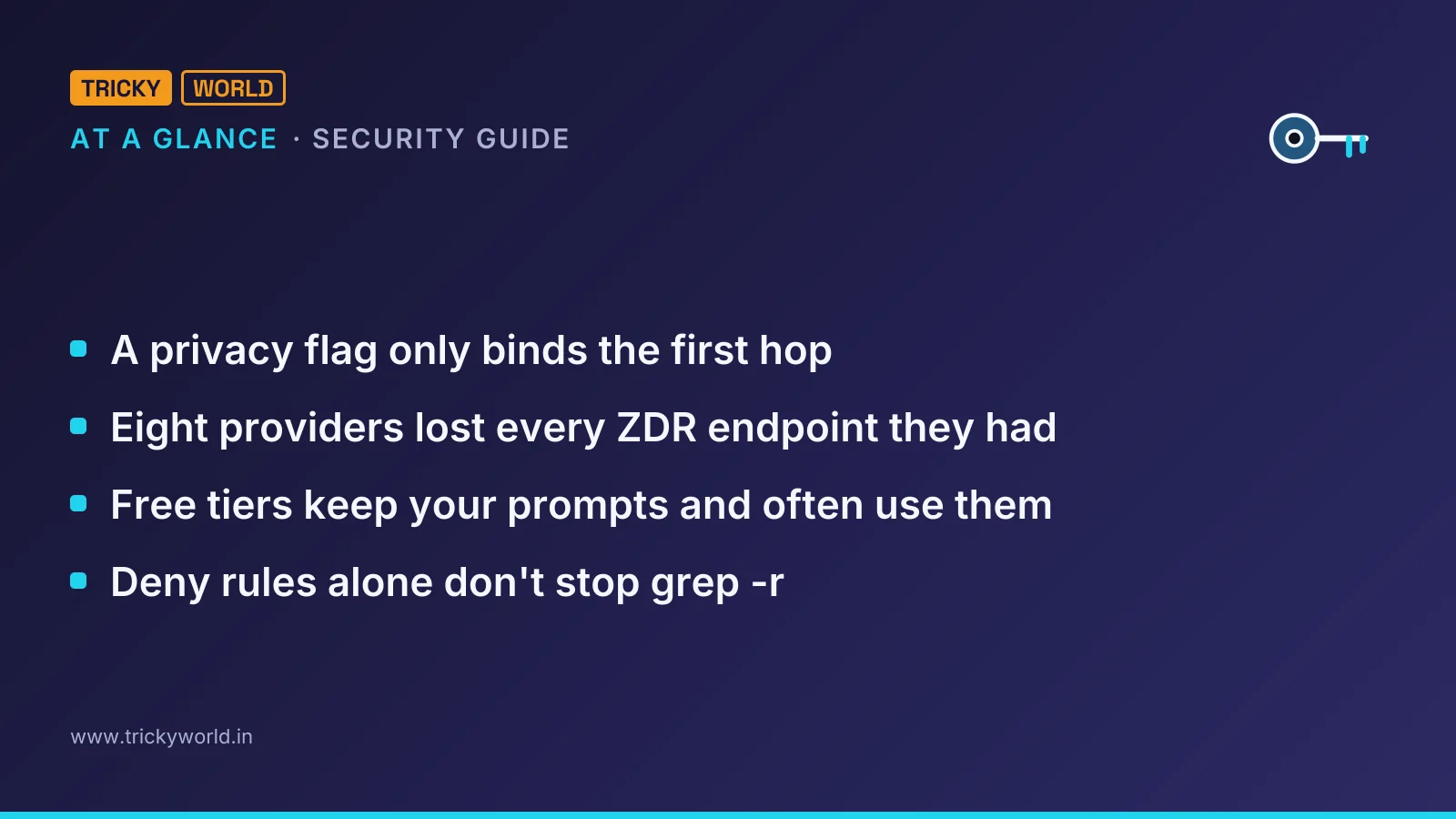
Mostly because a privacy flag only binds the first hop: Dragos saw resellers log prompts, a Chinese AI lab's systems open links from ZDR-marked requests, and US providers return to links days or months later.
The resellers needed no exploit. On some AI marketplaces, sellers offer popular models at the lowest price, switch on request logging and wait. Dragos caught individuals on home internet connections doing this. In one case, two prompts went through a single seller's offer. About a day and a half later, someone on home broadband opened both secret links and started guessing user names on the login page. Prompts for the same model sent through a different seller were never touched. The leak followed the seller, not the marketplace.
The lab case is larger. Its systems fetched the secret links from more than half the prompts Dragos sent to its models between July and October, including roughly two-thirds of those marked "no data collection" or ZDR. The scraper usually came two or three days after the request. Prompts sent to US hosting providers that resell the lab's models set off the same scraper, so the data was flowing back to the lab. Dragos doesn't name the lab.
The Feishu case from the start of this guide came from a stored copy. Dragos had given that provider only the first eight characters of the link, yet the full link turned up in the chat more than three weeks after the request, which had gone to a US-based provider with the ZDR flag set.
MiniMax, a Chinese AI lab, has since confirmed that its security system pulled links out of requests forwarded to its API and opened some of them, including requests marked ZDR or no data collection. It says the system logged only the links, not whole conversations, and that it has switched it off and deleted the links. Novita says a routing mistake sent some MiniMax requests to MiniMax's own API between 28 May and 11 November 2026, including requests that reached Novita through OpenRouter. Atlas Cloud says it forwarded some MiniMax requests there during the third quarter and early fourth quarter of 2026.
US providers aren't clean either. One of the large ones kept crawling a secret link more than two months after a single call to its search endpoint. Another returns for links days after each request, whichever router carried it. Dragos also traced about two thousand request routes. Several hundred passed through a system it couldn't identify, a handful reached a company that wasn't on the advertised path, and one marketplace seller quietly added about a thousand hidden tokens to every prompt.
Which providers were breached, and what do their notices say?
Dragos named none, but Phala, GMI Cloud and Together AI have each published a notice saying an outsider read or downloaded prompts and used credentials a researcher had planted in them.
Phala's detailed report, updated on 23 November, lists five failures behind its breach. On 20 October Phala started an experimental DeepSeek V4 Flash 0731 deployment on a new GPU server, and it took live OpenRouter traffic before it had production controls. That evening an attacker signed in to the deployment's Grafana monitoring with its default administrator password. From there it reached a management service that trusted any request from the machine itself, swapped in its own start-up script and left a rootkit that read request bodies. The exposure ran from 21 October 02:25 to 1 November 02:03 UTC, and 152,092 requests reached that deployment. Phala tells those users to rotate every credential they sent, ".env contents" included.
GMI Cloud's notice of 24 November describes a logging and monitoring system that kept about three days of prompts and responses. An outsider got into it on 21 and 22 October, and again from 27 October with two compromised credentials, which GMI revoked on 18 November. Anyone who sent requests to GMI Cloud endpoints between 18 October and 18 November, including through OpenRouter, should treat them as exposed. GMI has stopped logging prompt and response content.
Both notices date the start of the theft to 21 October. That fits Dragos's account of one attacker in two providers at once, though neither company says the incidents are linked.
Together AI's notice of 21 November has a cause every developer should note. Together kept prompt samples from its MiniMax M3, GLM-5.2 and Kimi K2.6 traffic, mostly from 24 June and 4, 8 and 14 July, in a private Hugging Face repository for testing. While its engineers worked on a public GitHub project, an AI coding agent committed a credential for that repository. Together's scanner caught it and the commit was reverted, but someone had already used it to download the samples, search them for credentials and test them. Five of those credentials were Dragos canaries. Together has since made ZDR the default for new accounts.
A fourth notice is different. Prime Intellect says someone replaced its DeepSeek V4.1 Flash deployment with an "abliterated" copy, one modified to stop refusing requests, between 8 and 10 November. Refusals on JailbreakBench fell from 98 of 100 prompts to one. It found no sign that prompts left its cluster.
Which providers did OpenRouter drop, and is the reported list right?
OpenRouter hasn't said: its 22 November post says it off-boarded three providers and removed 125 endpoints from ZDR eligibility, some of them as a precaution, without naming any.
OpenRouter's announcement also says the findings showed no breach of OpenRouter itself. It links notices from seven providers and says it is adapting Dragos's testing to run it continuously. Its chief executive, Alex Atallah, went further on X: "Providers' data-handling claims have mostly relied on self-attestation. This isn't going to be sufficient."
The press has filled the gap with guesses that don't agree. BleepingComputer named Together AI, Phala and Novita, then added Together's statement that OpenRouter didn't remove it. Atlas Cloud says it took its own models off OpenRouter by choice. Others guessed Atlas Cloud, GMI Cloud and Phala from provider pages showing no models.
OpenRouter's public API settles part of it. When TrickyWorld counted live endpoints for every model on 26 November, Phala, GMI Cloud, Atlas Cloud and MiniMax's own API served none. Together still served 37 endpoints and Novita 11. Whatever the three are, Together and Novita still serve models there.
Which endpoints lost zero data retention between 19 and 21 November?
Eight providers lost every ZDR endpoint they had, 125 in all, the same number OpenRouter gave: SiliconFlow, Novita, Z.AI, Tencent, Seed, Fish Audio, Moonshot AI and StepFun.
OpenRouter publishes its ZDR list through a public API, and the Internet Archive kept copies from 19 November at 21:04 UTC and 21 November at 21:15 UTC. Comparing the two shows 142 endpoints leaving the list. Seventeen of those were routine changes, such as retired models and a new endpoint name. The other 125 came from these providers:
SiliconFlow: 41 endpoints.
Novita: 35.
Z.AI: 15.
Tencent: 9.
Seed: 9.
Fish Audio: 7.
Moonshot AI: 6.
StepFun: 3.
Most of those endpoints are still on sale, just without ZDR. On 26 November, SiliconFlow, Z.AI, Tencent, Seed, Fish Audio and Moonshot AI still served every one of them, and StepFun two of its three: 89 endpoints across 78 models. Novita was still pulling endpoints that morning, from 14 still served at 08:20 UTC to 10 at 08:35 UTC. Moonshot AI's own endpoints for Kimi K3.1 Pro are on the list, and so are SiliconFlow's and Novita's for DeepSeek V4.1 Flash.
None of this shows that these providers leaked anything. OpenRouter says some removals were precautionary, and it hasn't published its own list, so the matching total is strong evidence, not confirmation. Two other providers had gone earlier: Phala's 20 ZDR endpoints and MiniMax's own 7 left the list between 30 October and 12 November. The full list of endpoints, with each one's status, is in the prompt-tripwire repository.
What does zero data retention promise on OpenRouter?
On OpenRouter, ZDR means no routine storage of prompts or responses after processing, but by default a self-serve account's ZDR requests can also reach Safety Retention endpoints, which may keep prompts to fight abuse.
OpenRouter's ZDR page sorts every endpoint into three tiers: ZDR, Safety Retention and Retention and Training. Safety Retention means the provider may keep prompts and responses from any request, only to fight abuse and not for training. Unless you choose "ZDR only" in your privacy settings, a self-serve account allows Safety Retention endpoints even when ZDR is enforced. Enterprise accounts default to ZDR only.
There are other limits. ZDR covers model routing, not plugins and tools such as web search, which follow their operators' policies. OpenRouter doesn't count in-memory prompt caching as retention. OpenRouter has also announced screening of all requests, ZDR traffic included, for child sexual abuse material; flagged content may be kept for review and reporting where the law requires. Above all, a label is only as good as the provider behind it, which is what the canaries tested. Dragos's advice is to verify that your privacy settings really change where requests go.
What does a free LLM API do with your prompts?
Free tiers keep your prompts and often use them: Google lets human reviewers read free Gemini prompts, NVIDIA's trial terms let it use them to improve its models, and every free text model on OpenRouter keeps them.
Interest is climbing in India. In Google Trends data for the 30 days to 26 November, searches for "awesome free llm api", "free llm api github repo" and "free llm api claude plugin" were all marked breakout in India. Among searches related to "free ai api", "nvidia ai api key free" rose 350%, and "claude code free" was among the top searches related to Claude Code.
Google's Gemini API terms, effective 23 March 2026, are blunt about the free quota. Google uses what you submit to improve its products, and "human reviewers may read, annotate, and process your API input and output". The terms say not to send sensitive, confidential or personal information. Users in the European Economic Area, Switzerland and the UK get the paid-service data terms even on the free quota. India isn't on that list.
NVIDIA's free keys from build.nvidia.com fall under its API Trial Terms of Service. They allow internal testing and evaluation only, not production. You agree not to include confidential or personal data, and NVIDIA collects your prompts and outputs, without identifying users, "to improve NVIDIA products and services, including AI models". Use is also logged for security and abuse monitoring and shared with third-party service providers.
OpenRouter's free models are no different. On 26 November, OpenRouter listed 21 models with a ":free" ID, 11 of which answer in text. By OpenRouter's own data-policy records, all 11 text models keep prompts and 6 may train on them, and none is on the ZDR list.
The lists that send developers to these keys rarely mention any of this. The biggest on GitHub, mnfst/awesome-free-llm-apis with about 14,200 stars, notes what happens to prompts for 4 of its 16 providers, mostly in footnotes. Two other popular lists, with 40-plus and 78 providers, say nothing about it.
Why do AI coding agents make a free key riskier?
A coding agent reads files to do its work, and what it reads goes into the next prompt, so an agent pointed at a free router can send your .env file along with your code.
Dragos says it directly: AI agents will send whatever they can read, credentials included. Together's breach shows the other half, since it started when an AI coding agent committed a credential to a public repository. Claude Code users have their own version of that problem, as the 1,122 GitHub files holding Claude Code secrets showed.
Free routers make the path longer. Two of the most-starred projects on GitHub, Free Claude Code with more than 70,000 stars and FreeLLMAPI with more than 50,000, sit between Claude Code and dozens of free providers. Neither README says what those providers keep. Before you connect one, read the terms of every provider behind it, and assume each one stores what you send.
How do you stop Claude Code from reading .env files?
Add Read deny rules for .env and .env.* to your Claude Code settings, then turn on its sandbox, because deny rules alone don't stop grep -r or a script that opens the file itself.
These two lines go in ~/.claude/settings.json, and because a bare file name matches at any depth under the working folder, they cover nested files too:
{
  "permissions": {
    "deny": ["Read(.env)", "Read(.env.*)"]
  }
}
TrickyWorld tested these rules against Claude Code 2.1.332 on a project with secret test values in .env files. With the rules in place, Claude Code refused its Read tool, a cat .env command and an @.env mention, and the value never reached the answer. A grep -r command and a one-line Python script still printed it.
That gap is documented by Anthropic: Read rules cover Claude's file tools and shell commands it recognises, such as cat, head and tail, not commands that read files without naming them or scripts that open files themselves. The sandbox closes it at the operating-system level, merged into the same file:
{
  "sandbox": {
    "enabled": true,
    "allowUnsandboxedCommands": false,
    "filesystem": { "denyRead": ["~/**/.env", "~/**/.env.*"] }
  }
}
Setting allowUnsandboxedCommands to false stops Claude from asking to rerun a blocked command outside the sandbox. On Linux the sandbox needs the bubblewrap and socat packages. For projects outside your home folder, such as /var/www, add a denyRead of "./**/.env" to the project's own .claude/settings.json. A .claudeignore file does nothing in Claude Code. The test machine lacked socat, so the sandbox settings follow Anthropic's documentation and weren't run here.
The kit checks all of this for you, the way Claude Code's documentation describes it. Run python3 -m tripwire claude-check in a project, and it also warns when ANTHROPIC_BASE_URL sends your prompts to a third-party router.
How do you lock OpenRouter to zero-data-retention endpoints?
Turn on ZDR for every model group in OpenRouter's privacy settings, choose "ZDR only", and send a provider object that names the exact endpoints, so requests can't drift to ones you haven't checked.
The account settings are the base layer. In requests, the documented provider routing fields add three limits: zdr, data_collection and only. This request can only reach two ZDR endpoints of DeepSeek V4.1 Flash:
{
  "model": "deepseek/deepseek-v4.1-flash",
  "messages": [{"role": "user", "content": "..."}],
  "provider": {
    "zdr": true,
    "data_collection": "deny",
    "only": ["deepinfra/fp8", "together"]
  }
}
Endpoint lists change daily, so let the kit build the list. python3 -m tripwire lock --model deepseek/deepseek-v4.1-flash reads OpenRouter's public ZDR list and leaves out Safety Retention endpoints. It also flags endpoints that lost ZDR in November, and python3 -m tripwire account checks that your key really can't reach a model without a ZDR endpoint. OpenRouter's generation records show which provider served each request.
How do you set a prompt tripwire of your own?
Put a fake credential and link that exist nowhere else in the prompts each provider receives, point them at a server you watch, and treat any use as a leak at that provider.
That is Dragos's own advice, and the prompt-tripwire kit does it with Python's standard library alone. Each canary is a link, a login and an API key for a small server you run on a hostname used for nothing else:
python3 -m tripwire plant deepinfra/fp8 siliconflow/fp8 --base-url https://ops.example.com
python3 -m tripwire serve --port 8088 --trust-proxy
python3 -m tripwire sweep --model deepseek/deepseek-v4.1-flash --base-url https://ops.example.com
python3 -m tripwire report
With your OpenRouter key in OPENROUTER_API_KEY, the sweep sends one canary to each endpoint of a model through OpenRouter, with fallbacks off, and records which provider served it. You can also paste a canary into an agent's context or a test file.
For a canary that fires even if nobody visits your server, add a free AWS key token from Thinkst Canarytokens. Its alerts can take 2 to 30 minutes. Leave the server running, because Dragos saw bait used within hours and more than two months later.
What should you do if your prompts went through these providers?
Rotate any secret you sent during a window the providers name, then check AWS CloudTrail for the tools Dragos saw if AWS keys were in your prompts.
Phala: DeepSeek V4 Flash 0731 requests that OpenRouter sent to Phala between 21 October 02:25 and 1 November 02:03 UTC.
GMI Cloud: requests to its endpoints, including through OpenRouter, between 18 October and 18 November.
Together AI: MiniMax M3, GLM-5.2 and Kimi K2.6 requests from June and July; Together is contacting affected customers.
Novita: MiniMax model requests between 28 May and 11 November, sent directly or through OpenRouter.
Atlas Cloud: anything sent to MiniMax M3, M2.7 or M3.1 Flash there, which Atlas says to treat as exposed.
Prime Intellect: review DeepSeek V4.1 Flash outputs from 8 to 10 November if your use relied on refusals.
In CloudTrail, look for the user agents artex-agent and artex-judge-r121, new IAM users and Bedrock API keys you didn't create. Then rotate, revoke and confirm the old keys are dead, as in this guide to auditing API keys after a breach.
Should you stop using a free LLM API?
No, but treat a free LLM API as public: keep secrets, customer data and private code out of it, and use paid, ZDR-only routes for anything you couldn't afford to see in someone's chat.
Read the data terms of every provider behind a key, and of every router in between.
Keep .env files away from coding agents with deny rules and the sandbox.
On OpenRouter, choose ZDR only, enforce it for every model group, and pin endpoints with only.
Seed a canary in each pipeline and agent context, and watch it.
Rotate anything you sent in the windows above.
Two million canaries showed that the weak point isn't the model but everyone who touches a prompt on its way there. Most of these fixes cost nothing but a habit: assume that someone else can read whatever leaves your machine.
Frequently asked questions
Is a paid OpenRouter account safer than a free one?
Paying changes which models you can use, not what a provider does with a prompt. What decides that is the endpoint: turn on ZDR for every model group, choose ZDR only in your privacy settings, and pin the endpoints you trust. A paid request to an endpoint without ZDR can still be stored.
Does running a model on my own machine avoid all of this?
Yes for the prompts themselves: Dragos calls hosting it yourself the only option where nobody else reads your prompts. The cost is hardware. Dragos lists a Mac Studio with 512 GB of memory from $22,299 and NVIDIA's DGX Spark at $6,950, so most teams keep it for their most sensitive work.
How do I find out which provider served an OpenRouter request?
Every response has a generation ID. OpenRouter's generation endpoint, GET /api/v1/generation?id= followed by that ID, returns the provider_name that served it, and the Logs page in your OpenRouter dashboard shows each generation too.
Can a canary token get me or a provider into trouble?
A canary only records that someone used it, and it opens nothing real: the AWS keys point at empty accounts and the links at a server you run. Send canaries only through your own accounts, to services you use, and report a hit to the provider rather than probing it yourself.

About the author
Vishal · Software & security engineerVishal writes Trickyworld's tutorials and interview-preparation guides on programming, databases, cyber security and AI. Vishal has been shipping production software long enough to have firm opinions about Python, PHP, Node.js, and JavaScript, and to have been wrong about each of them at least once. The work has run the whole stack: Drupal and Laravel applications, React front ends, MySQL and MongoDB underneath, Redis and Memcached for the things that had to be fast, Apache Solr for the things that had to be findable. That last part turned out to matter more than anyone expected. Tune a Solr index for a season, then watch a language model confidently retrieve the wrong document, and you recognise an old problem wearing new clothes. Most of what is hard about AI systems is not the model. It is retrieval, caching, latency budgets, and deciding what the system does when the answer comes back wrong — which is work he has been doing since well before anyone called it AI engineering. He plays a lot of games, which is less a hobby disclosure than an admission of where a good share of his engineering instinct came from. Real-time systems with a frame budget. State that has to stay coherent while a player does something no designer anticipated. The permanent question of what happens when the frame cannot finish in time. Those habits carry over more directly than they have any right to. He has written several books on programming, all built on the same conviction: most technical writing is unclear because the author never decided what to leave out. More from Vishal → · Editorial policy