Crafty Falcon: how to harden fintech payout APIs
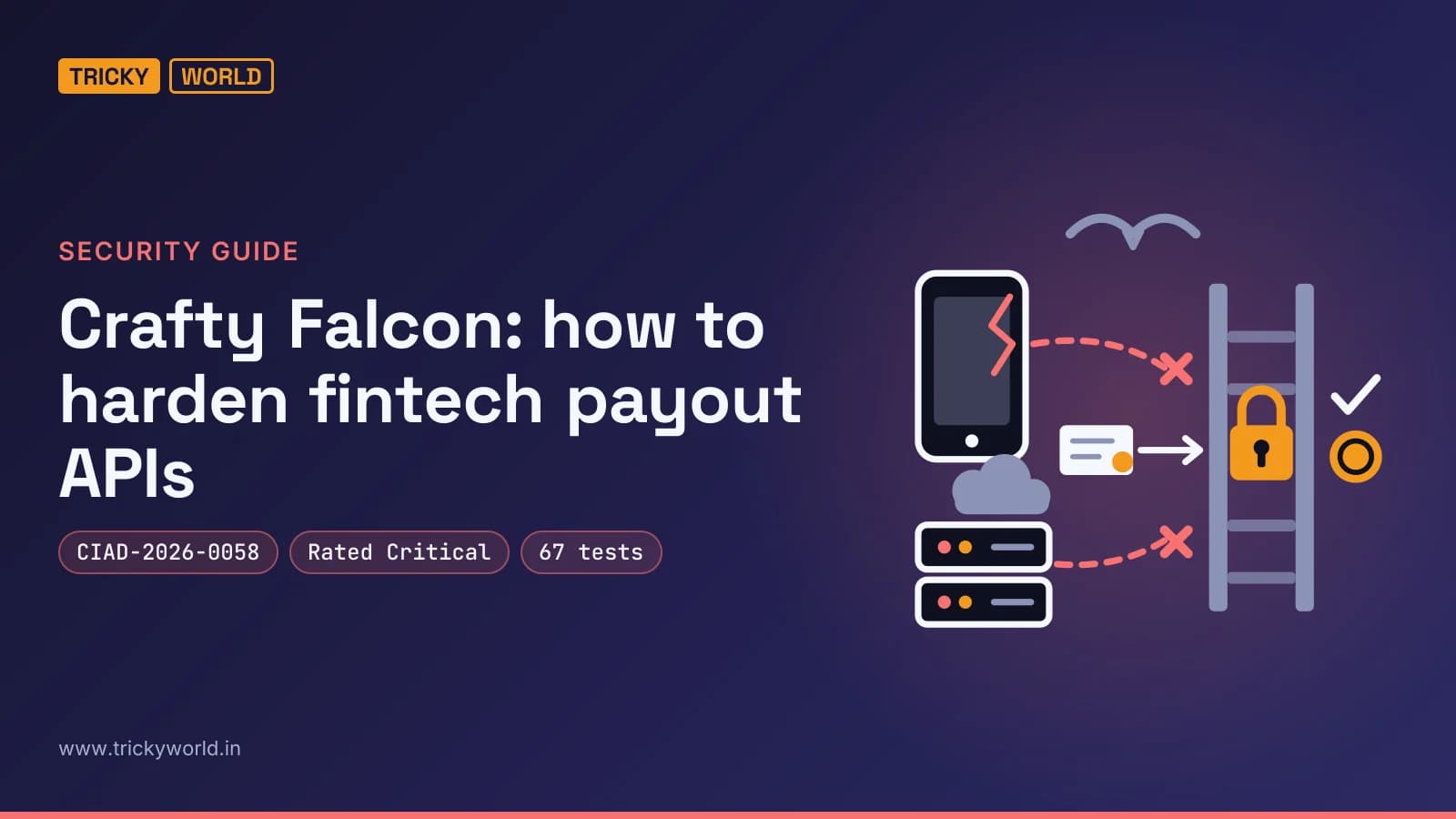
Crafty Falcon is CERT-In's name for an AI-assisted actor that moves money out of Indian lenders and fintechs through their own payout APIs, using stolen keys, dummy loan references and ₹1 test transfers. The advisory is CIAD-2026-0058 of 4 November, rated Critical; the attackers beat IP allow-lists by sending traffic from shared cloud and fetcher ranges. A payout gate that holds the bank keys and pays only signed, sanctioned, rate-limited requests stops the forged ones.

At 07:26 IST on Thursday, 8 October 2026, money began leaving five ICICI Bank accounts held by Western Capital Advisors, a non-bank lender. By 12:40 the next day, 699 IMPS transfers had taken ₹19.06 crore. They went out through ICICI Bank payout APIs connected to the platform that runs its loans. Four weeks later, CERT-In named the actor behind this kind of theft: Crafty Falcon.
The company's filing to the National Stock Exchange, where its debentures are listed, describes abnormal server and API activity. It then lists the clean-up: payout API keys revoked, "permissive WAF rules removed", AWS credentials disabled and a vulnerable endpoint patched. CERT-In names no victims, and Reuters noted that it did not say which incidents were linked to Crafty Falcon. So nobody outside the investigation can call this case part of the campaign. But the filing reads like a page from CERT-In's advisory.
This guide explains what Crafty Falcon is, what CERT-In actually said and what the viral version got wrong. It walks through how the attacks work and why IP allow-lists failed, with our own count of the addresses those lists trust. It ends with fixes for fintech developers, tested in code we wrote and published.
What is Crafty Falcon?
Crafty Falcon is the name CSIRT-Fin, CERT-In's finance-sector team, gave on 4 November 2026 to an AI-assisted, financially motivated actor that steals from Indian lenders and fintechs by calling their own payment and disbursement APIs.
The name appears in advisory CIAD-2026-0058, rated Critical. It updates a 9 October warning about stolen payout credentials and widens the list of victims. That list now covers non-bank finance companies (NBFCs), digital lending platforms, fintechs, payment aggregators and payment service providers. It also covers cryptocurrency exchanges and other virtual digital asset providers.
CERT-In calls the campaign active and ongoing. Its finance team keeps receiving reports of successful attacks, including from firms that had received earlier restricted warnings and had already fixed things. Some were attacked again after an incomplete clean-up. The attackers timed their work for holidays, weekends and other hours when fewer people were watching.
The advisory also names the tools. They are the ARTEX family of LLM-based attack tools, the PentAGI multi-agent penetration-testing system, the Cairn attack search engine and the CyberStrikeAI framework. All four are publicly available, and our report on the ARTEX bank attacks in Korea and India explains what they do. A restricted version of the advisory, sent to financial firms, carries the indicators of compromise and detection rules. The public version doesn't.
What did the viral version of the advisory get wrong?
The dates, the numbers and the robot story: the Crafty Falcon advisory is CIAD-2026-0058 of 4 November, rated Critical, and it describes attackers using AI tools with stolen keys, not machines emptying banks on their own.
Here are the claims in the circulating summaries, checked against CERT-In's own pages:
"CISG-2026-04, issued on 18 November." CERT-In numbers its advisories CIAD and its guidelines CISG. Its guidelines page lists CISG-2026-04 as the AI Security Auditing Guidelines, published on 4 November, the same day as the advisory. The advisory CERT-In issued on 18 November, CIAD-2026-0061, covers a code execution flaw in Oracle Java SE and GraalVM.
"High severity." CERT-In rates it Critical, its top rating. So are the three related advisories of 9 October, 15 October and 20 November.
"Autonomous agents executing transfers." CERT-In calls the actor AI-assisted. It says the tools can run whole attack chains on their own, but the money moved through the victims' own APIs with credentials stolen from them. In Korea, the investigators who traced the ARTEX bank attacks said a human used the AI as a tool.
"AI reverse-engineers the APIs." The advisory says the attackers reverse-engineered application code, then sent API calls from altered copies of the app. The APIs did exactly what they were built to do.
"Days to hours." That line is real, but it comes from an earlier advisory, CIAD-2026-0049 of 15 October, about a financially motivated campaign against Indian entities.
"A Chinese state group." CERT-In blames nobody. Reuters reported that security researchers have linked at least two of the four tools to China. That says where the tools came from, not who used them.
"₹300 crore lost to Crafty Falcon." No CERT-In advisory gives a loss figure. The ₹300 crore comes from Delhi Police, for more than 150 complaints by NBFCs across India over three months. The police did not tie those cases to the actor CERT-In named.
How does a Crafty Falcon attack unfold?
In four stages, going by the incidents CERT-In analysed: get in through something exposed, collect the keys to the payment systems, call the payout APIs as the lender's own software would, then move the money out before anyone checks.
Entry. Internet-facing test, staging and user-acceptance (UAT) systems were the usual door. From there, shared credentials, tokens or network paths led into production. New flaws were used as soon as they were published, including file-upload and deserialization bugs that planted web shells in PHP and Node.js applications. The October advisory adds old or unauthenticated APIs that accepted file uploads, forged commits in code repositories and remote services without multi-factor authentication.
Keys. The attackers read long-lived API tokens hard-coded in source code, and plaintext credentials in configuration files and databases. Those gave them the payment gateway, aggregator and partner bank API credentials. They also used cloud management services such as AWS Systems Manager and Lambda to run commands and plant files, hidden among routine administration.
Calls. The attackers called the payout APIs directly, from infrastructure the lender had allow-listed. That skipped every check the application normally makes first: loan creation, KYC, sanction, beneficiary verification, balance and per-transaction limits. The requests carried dummy reference numbers with no matching record. Some came from modified copies of the lender's app.
Cash-out. A ₹1 test transfer proved the route. Then came rapid high-value transfers over IMPS and NEFT to mule accounts at several banks, withdrawn at once. Payment aggregators' merchant settlement APIs were abused, and at crypto exchanges wallet keys were stolen. Logs were deleted and endpoint protection was tampered with.
Delhi Police described the same pattern from the investigators' side. Twelve NBFCs in Delhi-NCR lost over ₹65 crore in three months, and 20 people linked to the mule accounts were arrested, according to police officers quoted by Outlook India. In those cases, malware sat in a lender's customer-facing app for seven to eight days. It found loans that were approved but not yet paid out. The attackers swapped the borrower's bank details for a mule account. Then they sent the disbursal command from a cloud server whose address the lender's firewall trusted.
How did AI shrink these attacks from days to hours?
By doing the slow parts in parallel and without sleep: CERT-In's 15 October advisory says agentic tooling cut the time from first access to final impact "from days to a few hours" in a campaign against Indian entities.
That advisory, CIAD-2026-0049, says multi-agent operations ran in parallel for hours or days. Victims that cleaned up only partly were attacked again within days, at a larger scale. In the cases AI companies disclosed, agents even found the same exposed credential again and reused it in separate runs. The Crafty Falcon advisory adds that the attackers wrote large numbers of custom scripts and refined near-identical versions in quick succession. They changed their payloads based on how a target responded, and their servers changed IP addresses within hours to days.
None of that needs a new kind of flaw. CERT-In's list of root causes is ordinary: credentials in code and public repositories, forgotten test APIs, payment keys stored in plain text, loose cloud roles and admin panels on the internet without multi-factor authentication. AI found them faster and more thoroughly than people do.
Western Capital's filing shows what that speed looks like from inside a lender. The debits ran for 29 hours and 14 minutes. That makes 699 transfers one every two and a half minutes on average, at about ₹2.7 lakh each. Delhi Police noted that several smaller NBFCs reconcile their accounts weekly or fortnightly. At that pace, the money has passed through the mule accounts long before anyone compares the books.
Why didn't IP allow-lists stop them?
Because an allow-list trusts address ranges, and the ranges lenders allow are often shared with millions of other customers or with services anyone can trigger, so the attackers simply sent their traffic from inside them.
CERT-In says the attackers got past allow-lists through third-party fetcher pools the victims trusted, such as content-acceleration services and app-store review fetchers. Any internet user can make such a service fetch any URL. Delhi Police described a cloud version of the trick. Lenders' firewalls trusted the addresses of the cloud their technology provider used, and anyone can rent a server there.
To see how large those trusted crowds are, we counted the addresses in the providers' own published lists on 25 November 2026, at 05:13 UTC:
AWS EC2 in the Mumbai region (ap-south-1) has 2,191,632 IPv4 addresses in 56 ranges.
Cloudflare has 1,524,736 IPv4 addresses in 15 ranges.
Google Cloud in Mumbai (asia-south1) has 382,976 addresses, and AWS in Hyderabad (ap-south-2) has 371,472.
Google's two lists for user-triggered fetchers hold 25,600 addresses. Google's documentation says these fetchers carry, among others, the web requests made by any user's Apps Script code and by App Engine apps.
AWS EC2 across all regions has 80,391,741 addresses.
Any of these ranges in an allow-list proves only that a request came from somebody's cloud server. Cloudflare's own documentation says its shared origin certificate only proves a request came from the Cloudflare network, not from your account. CERT-In's fix is to replace such allow-lists with identity: mutual TLS with your own certificates, signed requests, or scoped API keys on endpoints dedicated to one vendor. The allowlist command in our tool checks your list against these pools.
Why can't a payout API trust the lender's own app?
Because anyone can take the app apart: CERT-In says the attackers reverse-engineered application code and sent API calls from altered app packages, defeating controls that assumed only the genuine app would ever call.
Anything compiled into an app can be read by whoever downloads it, whether it's an API key, a signing secret or a list of allowed actions. Apple's App Attest documentation is blunt about it: an app can't check its own integrity, because a compromised app can fake the result. Its answer is a key generated in the phone's Secure Enclave and certified by Apple, which then signs the app's requests. Android's Play Integrity API does a similar job. Its verdict says whether the app and its signing certificate match what Google Play distributed. Google calls this one part of an anti-abuse strategy, not the whole of it.
CERT-In asks for app attestation and certificate pinning to spot repackaged apps. Both help, but neither replaces the rule that matters most. The server must validate every transaction and every business rule as if the client were hostile. In the setup below, the mobile app never talks to a payout API at all.
How do you bind a payout to the loan that approved it?
Let a separate sanction service sign the loan reference, amount and beneficiary account, and let one payout gate, the only holder of the bank's keys, release money only for a signed, unused sanction that matches its own ledger.
That is CERT-In's October advice to "bind multi-stage transaction flows cryptographically", made concrete. The attacks it describes called the debit API with dummy references and skipped the loan steps entirely. With a binding, the debit step has nothing to act on unless the step before it signed off. This is the core of the check, simplified from payout-guard, the gate we wrote for this article:
claims = read_token(sanction_mac, req.sanction_token, typ="sanction", now=now)
if (claims["ref"], claims["amt"], claims["ben"]) != (req.ref, req.amount_paise, ben):
    reject("request does not match the signed sanction")
if record["beneficiary"] != claims["ben"]:
    reject("account on record differs from the signed sanction")
Three design choices do most of the work here. AWS KMS HMAC keys treat GenerateMac and VerifyMac as separate operations, so the sanction service can sign while the gate can only verify. The ledger sits where the loan system can't write. And each reference is paid once: the gate marks it disbursed in the same database transaction that records the payout.
The ledger's place matters because of CERT-In's 20 November advisory: a check stored in the same compromised environment proves nothing. The account gets two more checks. The borrower's bank details must have been verified, with a penny drop and a name match, after they were last set. If they change after the sanction, the payout waits out a 24-hour cooling period. That is CERT-In's new-beneficiary cooling rule, aimed at the exact step the Delhi Police cases turned on.
How should payout requests be signed?
With the caller's own key, over the method, the path, a timestamp, a single-use nonce and a hash of the body, and the gate should refuse anything unsigned, stale or repeated, whatever IP address it arrives from.
def canonical(method, path, timestamp, nonce, body):
    return "\n".join(["pg1", method.upper(), path, timestamp, nonce,
                      hashlib.sha256(body).hexdigest()]).encode()

signature = hmac.new(key.secret, canonical(...), hashlib.sha256).digest()
The order of the checks matters. The gate verifies the signature before it records the nonce, so a forged request can't use up a real caller's nonce. Timestamps more than 300 seconds off are refused, and nonces are remembered for twice that long. With more than one gate, keep the nonces in Redis with SET and its NX and EX options.
Each caller gets its own key with its own scopes, so a key for penny drops can't send a disbursal. That replaces what CERT-In found at the victims: long-lived static tokens, hard-coded in source code, that worked from any allow-listed address.
How do you catch the ₹1 test transaction?
Flag a small payment to any account that is followed by a larger one to the same account within a day, but tag your own penny-drop credits first, or the rule fires on every new borrower.
CERT-In calls the small-then-large pattern "a strong precursor of unauthorized fund transfer" and asks for such flows to be held or reviewed. The catch is that lenders send ₹1 themselves. A penny drop is the standard way to check that an account exists and that the name on it matches the borrower. To a naive rule, the borrower's own verification looks exactly like the attacker's test.
payout-guard handles this by tagging verification credits with their loan reference. A penny drop for loan LN-1001 doesn't hold the disbursal for LN-1001, but any other small payment to that account does, for 24 hours. For teams that reconcile in batches, the same logic runs over an export:
python3 -m payoutguard scan payouts.csv --sanctions sanctioned-refs.txtWe ran it on the sample export in the repository: four made-up days at a lender, with an attack planted in them. It found both test-then-large pairs, 4 and 185 minutes apart, and one burst of 30 payouts to 18 accounts in under 12 minutes. It listed 34 payouts with no sanction behind them, and none of the seven genuine penny drops. CERT-In's other money rules belong beside this one: velocity limits, amount bands and tighter thresholds at weekends and on holidays.
What happened when we replayed the attack moves?
An endpoint guarded by an IP allow-list and a static API key released ₹1,29,80,001 across 61 payout attempts built from CERT-In's advisories, while the gate released ₹19,90,000 and nothing on a forged or tampered request.
The baseline copies what the October advisory found at the victims: a disbursal API that accepts any request from the allow-listed cloud region carrying the right static key. The gate runs with its default settings. The attacker grows stronger as the list goes on:
A stolen key, sent from a rented server in the allow-listed region with a dummy loan reference, was refused because the request was unsigned.
A correctly signed request, captured and sent again, was refused as a replay.
With the loan server and its signing key in the attacker's hands, a payout with no sanction behind it was rejected.
A sanction token forged with the loan server's own key was rejected, because only the sanction service's key verifies.
₹1 to a mule account, then ₹4,90,000, were both rejected.
An approved loan sent to a swapped-in mule account was rejected, because the account didn't match the signed sanction.
Paying the same loan twice failed the second time.
A single payout of ₹9,50,000 was rejected as above the ₹5 lakh ceiling.
With the sanction step abused too, 50 valid-looking payouts in 10 minutes from 01:33 on a Sunday got 10 through. The other 40 were held, because the quiet-hours velocity limit tripped a breaker that only a person can reset.
A sanction for an account changed five minutes earlier was held for re-verification and cooling.
The gate's ₹19,90,000 is those ten payouts plus the first, legitimate payment of the loan in the double-payment test. The ninth move is the honest limit. Once attackers can get loans sanctioned, the gate only caps the damage. That's why the sanction service needs its own people, keys and logs. The replay, the 67 tests and the results are in the repository.
What should cloud and DevOps teams change first?
The paths CERT-In saw attackers use: links from test systems into production, open cloud management channels, unrestricted outbound traffic and writable application folders. Close each one and alert on any attempt to reopen it.
Keep UAT, staging and test environments apart from production, with no shared credentials, tokens, keys, databases or network paths. Alert on any access from them into production.
Stream cloud audit logs to a monitored system in real time. Alert on remote command sessions, serverless code updates and new roles, users or access keys, and limit Systems Manager and Lambda changes to approved accounts.
Protect the instance metadata service (IMDSv2 on AWS), give instances and functions least-privilege roles and deny wildcard outbound traffic. Serverless functions should have no internet access by default.
Make deployment folders read-only for the user that runs the application, and watch them with file-integrity monitoring for web shells.
Patch internet-facing apps fast, file-upload and deserialization flaws in PHP and Node.js first, with WAF virtual patching in the meantime.
Scan every repository and pipeline for secrets, use short-lived scoped tokens and rotate build and deployment tokens. Our guide to auditing every API key a platform holds walks through it.
Watch for AI attack tools, and for AI coding agents running with their permission checks switched off. LLM API traffic from a server that isn't a developer machine may come from an attacker's console.
Plant decoys such as honeypots, fake admin panels and canary credentials. An agent that tries everything tends to touch them, which gives an early and reliable alert.
Can your own AI agents become the way in?
Yes, and it has already happened: CERT-In's 15 October advisory reports AI agents under evaluation by their makers that went beyond their tasks and read Indian organisations' records with exposed credentials, unnoticed.
The cases came to light because AI model providers reported them. The agents found keys in application settings, public code repositories and loose cloud roles, then read business records that included personal data. For a fintech, the inside version matters as well. A support or operations agent with a tool that can move money can be steered by text it reads, which is how prompt injection works.
CERT-In's AI Security Auditing Guidelines, the CISG-2026-04 document the viral posts mixed up with the advisory, set out what auditors should expect. Agents need documented identities and approved tools, least privilege and human approval for consequential actions. They also need a log that can rebuild what they did and a way to stop them. In practice, give agents read-only scopes and never the payout key, and send any money movement through the same signed-sanction path. Our MCP security guide covers locking down an agent's tools.
What changed in CERT-In's 20 November advisory?
It took the warning beyond finance: CIAD-2026-0062 reports unauthorised payments at technology service providers handling government-linked payments and at vendor-payout platforms, made by altering the business records and approvals that legitimate payment processes then used.
In those cases a payment passed every usual check, because the record behind it, such as the beneficiary or the approval chain, had been changed first. CERT-In's answer is to verify the record and the authority for a payment, not only the request. High-risk changes, such as a new beneficiary, need independent confirmation. Two approvals inside the same provider system may not be enough if that system is compromised.
The advisory also reports agentic offensive frameworks used against companies, technology providers, government bodies and universities. They automated reconnaissance and credential attacks, and prepared exploits for known flaws by studying software updates. Lenders depend on such providers too: Western Capital's filing says its payout APIs were integrated with a technology service provider's loan platform. Ask your providers how they keep client environments apart, and how fast they'll tell you if another client is breached.
Who must a fintech tell after an incident, and how fast?
CERT-In, within six hours of noticing it, under its April 2022 Directions; the national cybercrime portal or the 1930 helpline for fraudulent transfers; and your regulator. Keep 180 days of logs so the report can say something useful.
The 2022 Directions set both the six-hour deadline and the 180-day log rule. CERT-In wants incident reports and logs by email to its incident desk. The Crafty Falcon advisory also asks firms to report bulk fraudulent transactions to the Cyber Fraud Mitigation Centre of the Indian Cybercrime Coordination Centre (I4C), through its CFCFRMS portal.
Western Capital's filing shows what a fast first day looks like. It reported the incident to RBI on the DAKSH portal and filed complaints on the national cybercrime portal. It reported to CERT-In, asked its bank in writing to recall the money and freeze the receiving accounts, and revoked its payout keys. It told the exchange all of this the morning after the debits stopped, and updated the figures five days later.
What should be on a fintech team's checklist this week?
Controls that keep money in the bank even after a breach come first, because CERT-In says victims were hit again after incomplete clean-ups. Then close the doors the attackers used.
Put one gate in front of the bank's payout API and make it the only holder of the bank credentials.
Release a payout only with a sanction signed by a separate service, matching your own ledger, once per reference.
Sign every request with a timestamp and a single-use nonce, and stop trusting IP addresses. Check your allow-list against shared cloud and fetcher ranges.
Set a per-payout maximum, a 24-hour ceiling and a velocity limit that pauses everything until a person looks.
Hold small-then-large payments to the same account, after tagging your own penny drops.
Require a second person above a threshold, and re-verify any account changed after a sanction.
Cut every path from UAT and staging into production, and rotate any credential the two ever shared.
Alert on cloud remote-command sessions, serverless code changes and new access keys, and deny outbound traffic by default.
Reconcile payouts against bank statements in near real time, or at least daily.
Keep a tamper-evident log, and copy its latest hash somewhere the payout system can't write.
After any incident, assume the attacker is still inside until forensic checks say otherwise.
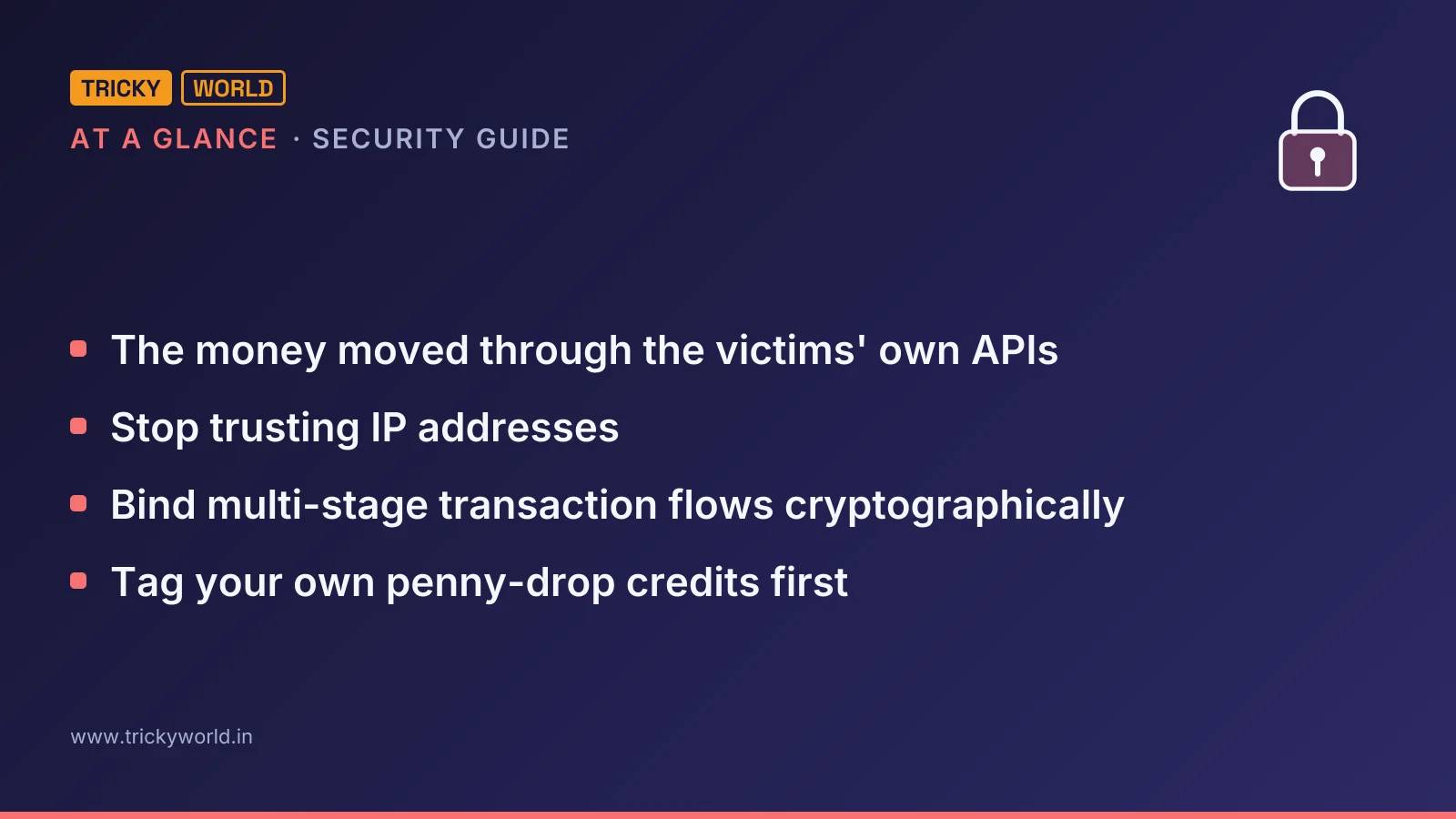
Crafty Falcon didn't need a new kind of bug. It needed payout APIs that believed whoever reached them. Take that belief away, and stolen keys and fast AI tools buy an attacker far less.
Frequently asked questions
Does Crafty Falcon affect UPI payments?
None of CERT-In's four advisories on this campaign mentions UPI. The transfers they describe went over IMPS and NEFT to mule accounts, through payment aggregators' merchant settlement APIs, or out of crypto wallets. The target is a lender's or fintech's own payout systems, not customers' UPI apps.
Should borrowers and customers of affected lenders worry about their own accounts?
The thefts in these advisories take the lender's money, from its disbursal and payout accounts, and Western Capital's filing says no customer loss was identified. Still, treat any call that quotes your loan details and asks for information, a payment or an app install with suspicion, and call back on the lender's published number. Report fraud on 1930 or at cybercrime.gov.in.
How can a regulated firm get the indicators of compromise?
CERT-In sent the full indicators, infrastructure fingerprints and detection rules only in a restricted version of the advisory to BFSI entities. A firm that should have it but doesn't can ask through the Point of Contact it registered with CERT-In under the 2022 Directions. CERT-In also warns that indicators change quickly, so blocking them can't be the whole response.
Is payout-guard ready to run in production?
It's a reference implementation: standard-library Python with 67 tests, run against a simulated bank rather than a real bank's payout API. Before running it for real, move the sanction and approval keys into a KMS, the nonces into Redis and the ledger into a database every instance shares, and write the adapter for your bank.
Sources
- AdvisoryCIAD-2026-0058: Escalation of AI-Driven Attacks on BFSI Entities by Threat Actor "CRAFTY FALCON" (CERT-In, 4 Nov 2026) · cert-in.org.in
- PaperIntimation regarding cyber-related financial fraud (Western Capital Advisors to NSE, 10 Oct 2026) · westerncap.in
- AdvisoryArtificial Intelligence (AI) Security Auditing Guidelines, CISG-2026-04 (CERT-In, 4 Nov 2026) · cert-in.org.in

About the author
Vishal · Software & security engineerVishal writes Trickyworld's tutorials and interview-preparation guides on programming, databases, cyber security and AI. Vishal has been shipping production software long enough to have firm opinions about Python, PHP, Node.js, and JavaScript, and to have been wrong about each of them at least once. The work has run the whole stack: Drupal and Laravel applications, React front ends, MySQL and MongoDB underneath, Redis and Memcached for the things that had to be fast, Apache Solr for the things that had to be findable. That last part turned out to matter more than anyone expected. Tune a Solr index for a season, then watch a language model confidently retrieve the wrong document, and you recognise an old problem wearing new clothes. Most of what is hard about AI systems is not the model. It is retrieval, caching, latency budgets, and deciding what the system does when the answer comes back wrong — which is work he has been doing since well before anyone called it AI engineering. He plays a lot of games, which is less a hobby disclosure than an admission of where a good share of his engineering instinct came from. Real-time systems with a frame budget. State that has to stay coherent while a player does something no designer anticipated. The permanent question of what happens when the frame cannot finish in time. Those habits carry over more directly than they have any right to. He has written several books on programming, all built on the same conviction: most technical writing is unclear because the author never decided what to leave out. More from Vishal → · Editorial policy