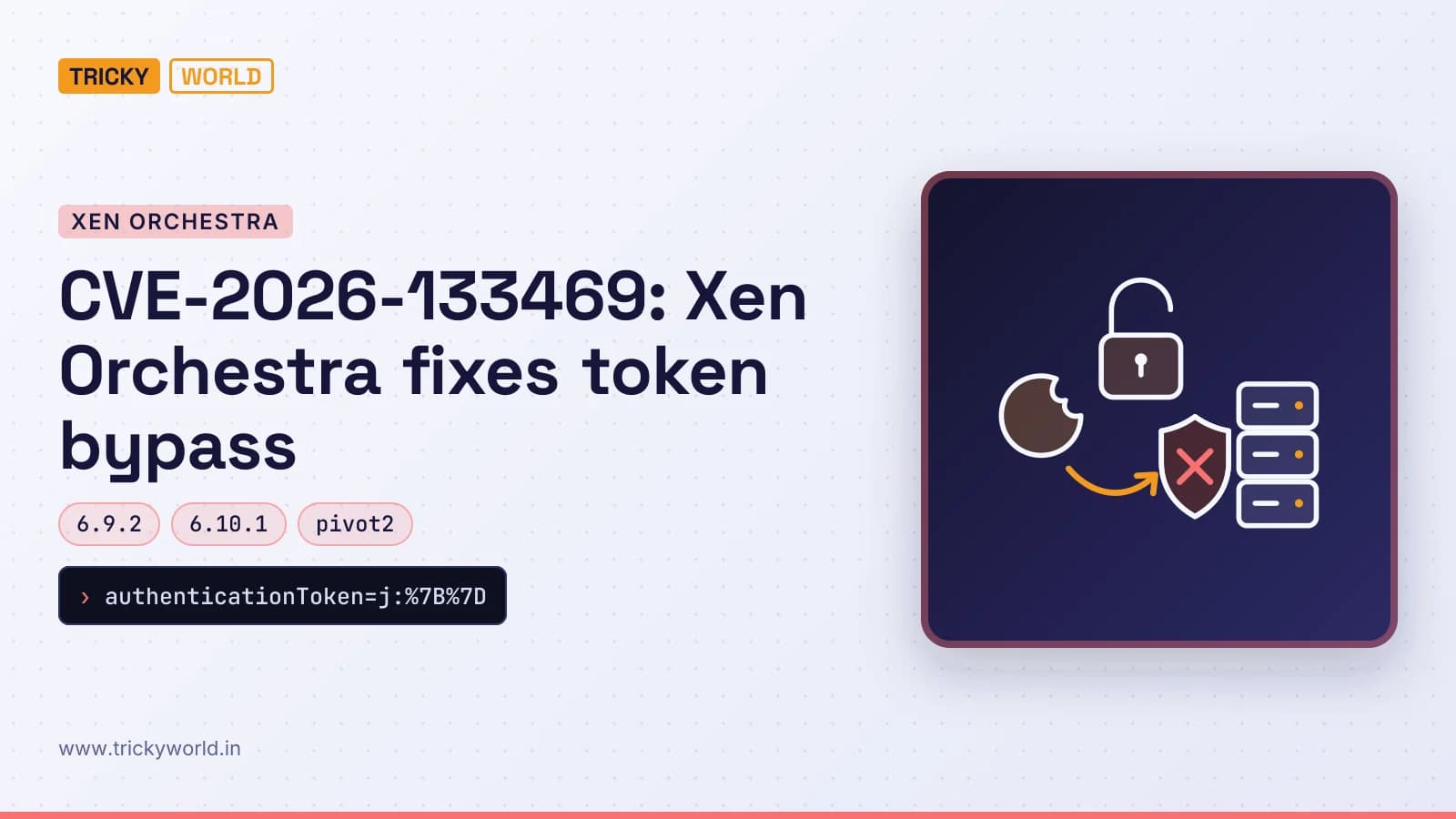
CVE-2026-133469: Xen Orchestra fixes token bypass
CVE-2026-133469 is an actively exploited Xen Orchestra token authentication bypass caused by accepting objects as token IDs. It affects stable releases before 6.9.2 and latest-channel releases before 6.10.1; update to those fixed versions. Confirmed compromise still requires reinstallation and rotation of passwords and secrets.
Summary written with AI from this article, and checked against it.

At a glanceCVE-2026-133469
CVE-2026-133469 has a CVSS 3.1 base score of 9.8 (Critical) from GitHub. It is fixed in 5.213.1 and 5.211.2.
| Severity | 9.8 Critical (CVSS 3.1, GitHub) |
|---|---|
| Fixed in | 5.213.1 and 5.211.2 |
| Affected | Not published yet |
| Exploited | Not in CISA's Known Exploited Vulnerabilities catalog |
| Public exploit | 1 GitHub repository names it: proofs of concept, scanners, detections. Unverified: some are fake or malicious. |
| Vector | CVSS:3.1/AV:N/AC:L/PR:N/UI:N/S:U/C:H/I:H/A:H |
| Weakness | CWE-1287 · CWE-287 Improper Authentication |
| Ubuntu | Not tracked yet |
| Debian | Not tracked yet |
| Red Hat | Not tracked yet |
Is there a public exploit for CVE-2026-133469?
Public code exists as of November 24, 2026: 1 public GitHub repository names it (proofs of concept, scanners and detections). It is not in CISA's Known Exploited Vulnerabilities catalog. None of it is verified: some such repositories are fake or carry malware, so read the code before running it, and only against systems you own.
From NVD, GHSA-2r3w-c2vx-fv5g · checked November 24, 2026
An empty-object cookie can log an attacker in as an existing Xen Orchestra token owner, and Vates reports active exploitation. CVE-2026-133469 affects stable releases before 6.9.2 and latest-channel releases before 6.10.1; those two versions contain the fix. Start by comparing the Xen Orchestra and xo-server versions in your deployment with the fixed versions, then work through the checks below for signs of the known campaign.
This reaches the management system, not just another web account. The CVE description describes an authentication bypass that can give an attacker Admin privileges. Vates’ security advisory warns that compromising Xen Orchestra can lead to arbitrary code execution on managed pools and a full XCP-ng node takeover as root. Track patching and compromise investigation as separate tasks for Xen Orchestra and Xen Orchestra Appliance deployments.
Check Xen Orchestra versions and XCP-ng indicators
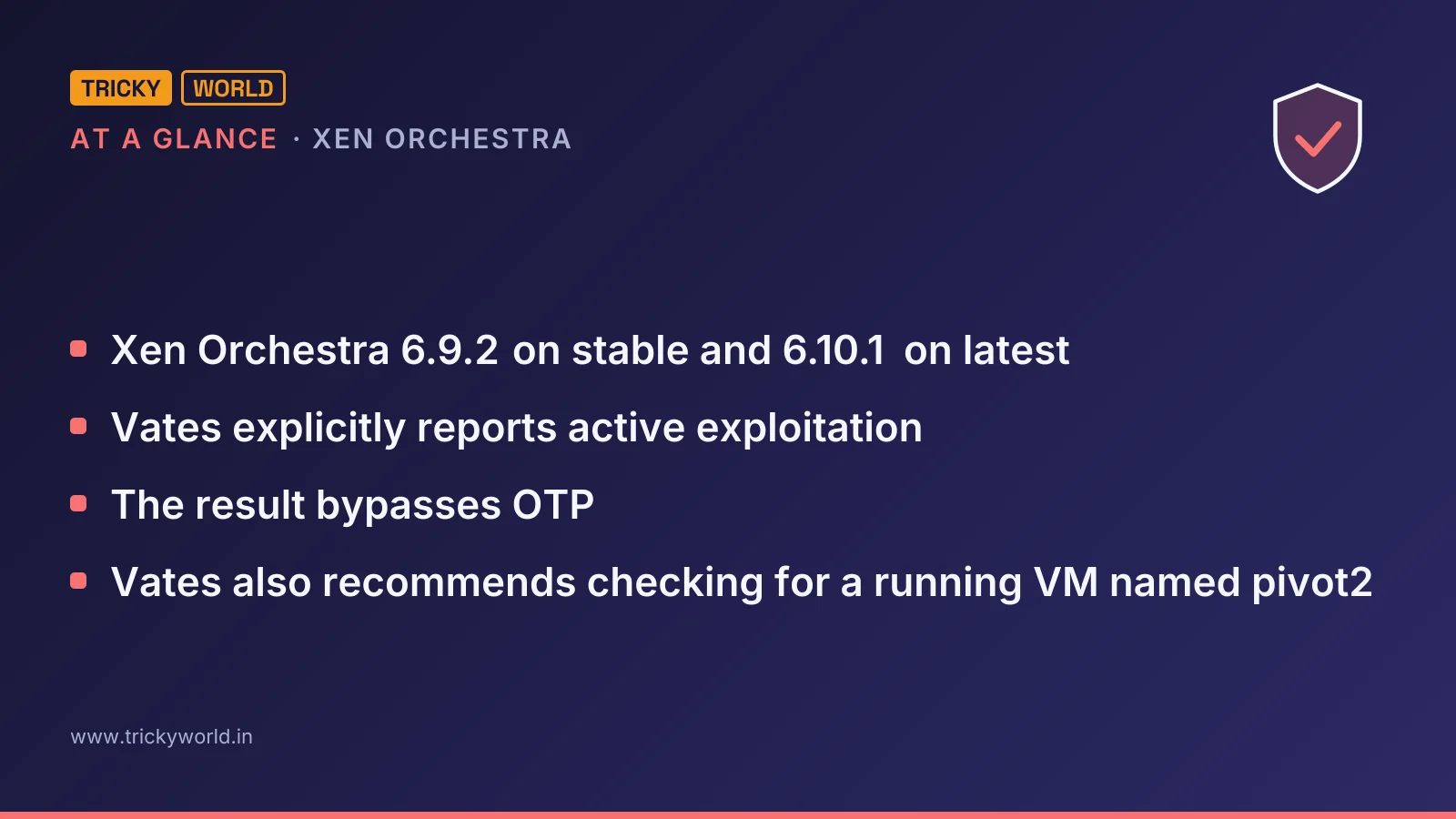
Check both the Xen Orchestra release and the xo-server package version. Vates names Xen Orchestra 6.9.2 on stable and 6.10.1 on latest as the fixed releases for CVE-2026-133469. The corresponding fixed xo-server packages are 5.211.2 and 5.213.1, respectively. Xen Orchestra Appliance is also on the advisory’s list of affected products, so include those deployments in the version check.
The Vates advisory does not provide a command for reporting the installed version. Compare the versions recorded for your deployment with those fixed targets. The host command below serves a different purpose: it searches for one of the campaign’s configuration indicators. It does not tell you whether Xen Orchestra has been updated.
Run this command on XCP-ng hosts to search VM platform information for the hvm_serial: file parameter that Vates identifies.
xe vm-list params=name-label,platform | grep -B1 'hvm_serial: file'Vates also recommends checking for a running VM named pivot2. The version check establishes whether the fix is installed. The host checks look for activity associated with the campaign Vates has reported; they do not answer the same question.
How CVE-2026-133469 turns a cookie into an identity
In CVE-2026-133469, a value that is supposed to identify a token reaches the lookup function as an object instead. Cookie parsing turns authenticationToken=j:%7B%7D into {}. REST authentication then hands that object to the Xen Orchestra token provider without first requiring it to be a string. The object survives parsing and reaches the code that selects a token.
The CVE description follows that type mismatch through the authentication code:
- The
signIn(credentials)function has no parameter schema. The deprecatedsignInWithTokenfunction does declare a type: it specifies that its token is a string. - The token provider checks whether the supplied value is falsy. An empty object is truthy, so this check lets it through.
- The token collection treats the empty object as an unfiltered lookup and returns the first token in the collection.
- If that token is unexpired and its owner still exists, the provider authenticates as the token’s owner.
Once authenticated, the caller can use /rest/v0/users/me/authentication_tokens to obtain reusable login token IDs. The CVE description’s proof of concept reports receiving unexpired token IDs from that route. One of those IDs then worked on a fresh request, authenticating the caller as an admin account.
The provider also returns bypassOtp: true. The result bypasses OTP; the code does not just return a database record selected by the wrong input. It is supplying an authenticated identity, along with the authentication properties attached to that result.
The write-up also describes indexed lookups for non-empty objects with fields such as user_id or client_id. Fixing attention on the exact empty-object cookie would miss the underlying issue. The accepted input type, and the meaning the collection assigns to that input during lookup, are what make this possible.
Vates reports exploitation despite the missing CISA listing
Vates explicitly reports active exploitation. As of November 24, 2026, CVE-2026-133469 is not listed in CISA’s catalog. These are not equivalent assessments to weigh against each other. A missing catalog entry does not negate the vendor’s report that it has observed an attack.
The NVD record carries GitHub’s CVSS 3.1 assessment of 9.8, Critical. The attribution matters here: this is GitHub’s score, not an independent assessment by NVD. Vates separately rates the impact Critical. Its advisory says that a CVSS 4.0 score is not available yet.
For an operator, I think the distinction that matters is whether the bypass is only described in an advisory or whether the vendor says attackers are already using it. Here, Vates supplies campaign indicators, host-search commands and recovery guidance as well as fixed-version targets. That calls for investigating possible activity from before the update.
Contain Xen Orchestra access and install the channel fix
Vates strongly recommends updating as soon as possible to address CVE-2026-133469, with fixes available for both release channels. It also gives containment advice for deployments that cannot finish the update immediately. Keep those two parts of the guidance distinct rather than treating containment as a replacement for the fixed release.
- Remove Internet exposure. Follow Vates’ recommendation to put Xen Orchestra on a dedicated management network. This is a containment action; it is not evidence that a deployment was untouched while it was exposed.
- Install the fix for the channel you already use. On stable, the targets are Xen Orchestra 6.9.2 and xo-server 5.211.2. On latest, they are Xen Orchestra 6.10.1 and xo-server 5.213.1. Vates says the fixes were available on November 10, 2026.
- For a Xen Orchestra installation built from source, Vates recommends updating to the latest master. The advisory supplies no update commands. Use the source-update procedure established for your deployment rather than substituting an invented command sequence.
- If you need an interim filtering control, configure the web application firewall or reverse proxy to match the empty-object cookie patterns Vates identifies. Those rules supplement the update; they do not replace it.
These are the cookie strings the vendor identifies for matching in a web application firewall or reverse proxy.
authenticationToken=j:{}
authenticationToken=j:%7B%7D
Search XCP-ng hosts and block campaign infrastructure
The CVE-2026-133469 investigation does not stop at the Xen Orchestra deployment. Vates directs operators to inspect XCP-ng VM settings, host logs and filesystem artifacts. It also recommends monitoring HTTP requests for the cookie patterns shown above, alongside those checks on the managed hosts.
Use this command to search the XCP-ng log files for the serial-file pattern listed in the Vates advisory.
zgrep -- '-serial file:' /var/log/xensource.log*The next command inspects the preload path and the ustar-named filesystem locations that appear in Vates’ detection guidance.
ls -la /etc/ld.so.preload /.ustar* /etc/cron.d/zz-ustar*The advisory names /etc/cron.d/zz-ustar2, /etc/cron.d/zz-ustar, /.ustar5 and /.ustar6 specifically. These checks are tied to the attack Vates has identified. I would not read that list as a complete inventory of the artifacts an attacker could leave after compromise, or treat the listed paths as the full scope of an investigation.
Vates recommends blocking both ingress and egress traffic for the following addresses associated with the campaign.
91.211.251.112
193.148.56.72
37.221.208.216
45.66.35.11
64.65.0.120
64.65.62.160
89.47.51.90
92.60.37.247
The vendor also recommends blocking Tor traffic to prevent communication with the campaign’s onion service. Its warning is not limited to past activity: ongoing malicious activity cannot be ruled out. Apply the infrastructure blocks together with the management-network restriction and the update. None of those controls, taken alone, is the whole response described by the advisory.
Clean indicators do not establish a clean Xen Orchestra
The published checks have limited coverage. Vates says successful exploitation of CVE-2026-133469 leaves no log that detects the unauthenticated access itself. Instead, it recommends monitoring HTTP requests for the identified cookie patterns with tools such as tcpdump or Wireshark. That limitation matters when interpreting a search that returns no matches.
“The absence of these IoCs alone is not sufficient to conclude that no compromise has occurred.”
— Vates’ security advisory
The empty-object lookup has conditions that can cause a bypass attempt to fail, too. An attacker does not get to choose which token the lookup returns. If the first token has expired, or its owner has been deleted, authentication fails and the provider does not try another token. A failed attempt therefore says nothing conclusive about whether the vulnerable input handling has been fixed.
The temporary cookie filter has its own limit: Vates warns that other formats can bypass regex-based rules. I would not accept a negative host search, a failed authentication attempt or an installed filter as the test for completed remediation. Confirming the version answers whether the fix is present. Searching for campaign indicators answers a narrower question about the activity being investigated.
Recover Xen Orchestra secrets after confirmed compromise
For a confirmed compromise, Vates recommends a full reinstallation. Its reason is that cleanup alone cannot guarantee every attacker backdoor has been removed. This is separate from installing the patched release. The update fixes CVE-2026-133469; reinstallation addresses the vendor’s concern that an attacker may already have established persistence.
Vates also says it cannot rule out configuration exfiltration and credential harvesting. The resulting rotation guidance covers all passwords and secrets used by Vates VMS, including the following:
- Management credentials and secrets, including the root account, pool secret, user accounts and one-time password secrets.
- Connected-service credentials, including proxies, backup remotes using NFS, S3, Azure or SMB, and mail-server configuration passwords.
I would not narrow that work to changing the password for whichever account appeared in an authenticated request. The advisory’s concern extends to configuration and stored credentials, not just that account. Recovery therefore reaches the connected services whose secrets Xen Orchestra held, as well as the Xen Orchestra installation itself.
This recommendation depends on whether compromise is confirmed. A deployment that needs a security update is not automatically a confirmed compromise. Once compromise is confirmed, though, Vates recommends more than deleting the named files and changing one login. The recovery plan needs to include reinstallation and the broader rotation of secrets described in the advisory.
Review the credential-to-query boundary
The call chain makes the engineering mistake concrete: a truthiness check accepted an object, then a collection lookup interpreted that object very differently from a token ID. In an authentication-code review, I would follow the parsed credential all the way through to the lookup that consumes it. Rejecting a missing value and requiring the intended type are different checks. This case depends on that difference.
Before closing the CVE-2026-133469 patch task, confirm both the appropriate fixed release and its package version. For an exposed deployment, check the Vates campaign indicators without treating a clean result as proof that no compromise occurred. If compromise is confirmed, follow the vendor’s reinstallation and secret-rotation guidance; a successful update is not the stopping point.
Frequently asked questions
Who discovered the Xen Orchestra empty-object token vulnerability?
Vates credits Filip Magic (@mad31k) and Christoffer Olsen from TDC NET Security with discovering the vulnerability.
Does a GitHub repository naming this CVE establish that its exploit code works?
No. PoC-in-GitHub lists googlesky/CVE-2026-133469 as an unverified repository naming the vulnerability. That listing does not establish that the repository’s code works.
Why should CWE-287 not be treated as the most precise classification?
The NVD record lists CWE-1287 and CWE-287. MITRE describes CWE-287, Improper Authentication, as a broad class and discourages using it to map real-world vulnerabilities when a more specific descendant applies.
Sources
- AdvisoryCVE-2026-133469 · github.com
- AdvisoryVSA-2026-062: Empty-object login token · docs.vates.tech
- Write-upCWE - CWE-287: Improper Authentication (5.0) · cwe.mitre.org
- CVE recordNVD and distribution data for CVE-2026-133469 (checked 2026-11-24) · nvd.nist.gov
- AdvisoryGHSA-2r3w-c2vx-fv5g, the vatesfr/xen-orchestra security advisory · github.com
How this article was made: drafted with AI from the sources above and fact-checked against them, then reviewed by Vishal on . How we write and check articles.

About the author
Vishal · Software & security engineerVishal writes Trickyworld's tutorials and interview-preparation guides on programming, databases, cyber security and AI. Vishal has been shipping production software long enough to have firm opinions about Python, PHP, Node.js, and JavaScript, and to have been wrong about each of them at least once. The work has run the whole stack: Drupal and Laravel applications, React front ends, MySQL and MongoDB underneath, Redis and Memcached for the things that had to be fast, Apache Solr for the things that had to be findable. That last part turned out to matter more than anyone expected. Tune a Solr index for a season, then watch a language model confidently retrieve the wrong document, and you recognise an old problem wearing new clothes. Most of what is hard about AI systems is not the model. It is retrieval, caching, latency budgets, and deciding what the system does when the answer comes back wrong — which is work he has been doing since well before anyone called it AI engineering. He plays a lot of games, which is less a hobby disclosure than an admission of where a good share of his engineering instinct came from. Real-time systems with a frame budget. State that has to stay coherent while a player does something no designer anticipated. The permanent question of what happens when the frame cannot finish in time. Those habits carry over more directly than they have any right to. He has written several books on programming, all built on the same conviction: most technical writing is unclear because the author never decided what to leave out. More from Vishal → · Editorial policy