ARTEX bank attacks: Korea hit, India on alert
Between 27 and 30 September, an attacker using the open-source AI framework ARTEX took customer data from Korean banks through staff and loan-agent systems, including 25,727 Shinhan Bank customers' records; core banking systems were not breached. On 4 November, CERT-In named ARTEX among the tools used by CRAFTY FALCON, which attacks Indian NBFCs, fintechs and payment firms and tests routes for funds with Rs 1 transactions. Investigators say a hacker used the AI as a tool.

Affected systems and impact
| Flaw | Affected systems | Impact |
|---|---|---|
| Korean bank staff and loan-agent systemsA loan-broker service that returned customer details once random values matched valid customer numbers | Shinhan Bank's loan-progress inquiry service; KB Kookmin and Hana employee systems | Names, phone numbers, annual income and loan limits of 25,727 Shinhan customers, plus 119 at KB Kookmin and 89 at Hana |
| CRAFTY FALCON (India)Payment and disbursement APIs called from modified apps, after entry through UAT or staging environments | NBFCs, digital lending platforms, fintechs, payment aggregators, payment service providers and crypto exchanges | Funds moved after Rs 1 test transactions, merchant settlement APIs abused and crypto wallet keys stolen |
| Storm-3358 (Southeast Asia)Anonymous file-upload and server-side request forgery (SSRF) flaws | Financial organisations, mostly in Southeast Asia | Remote access trojans installed |
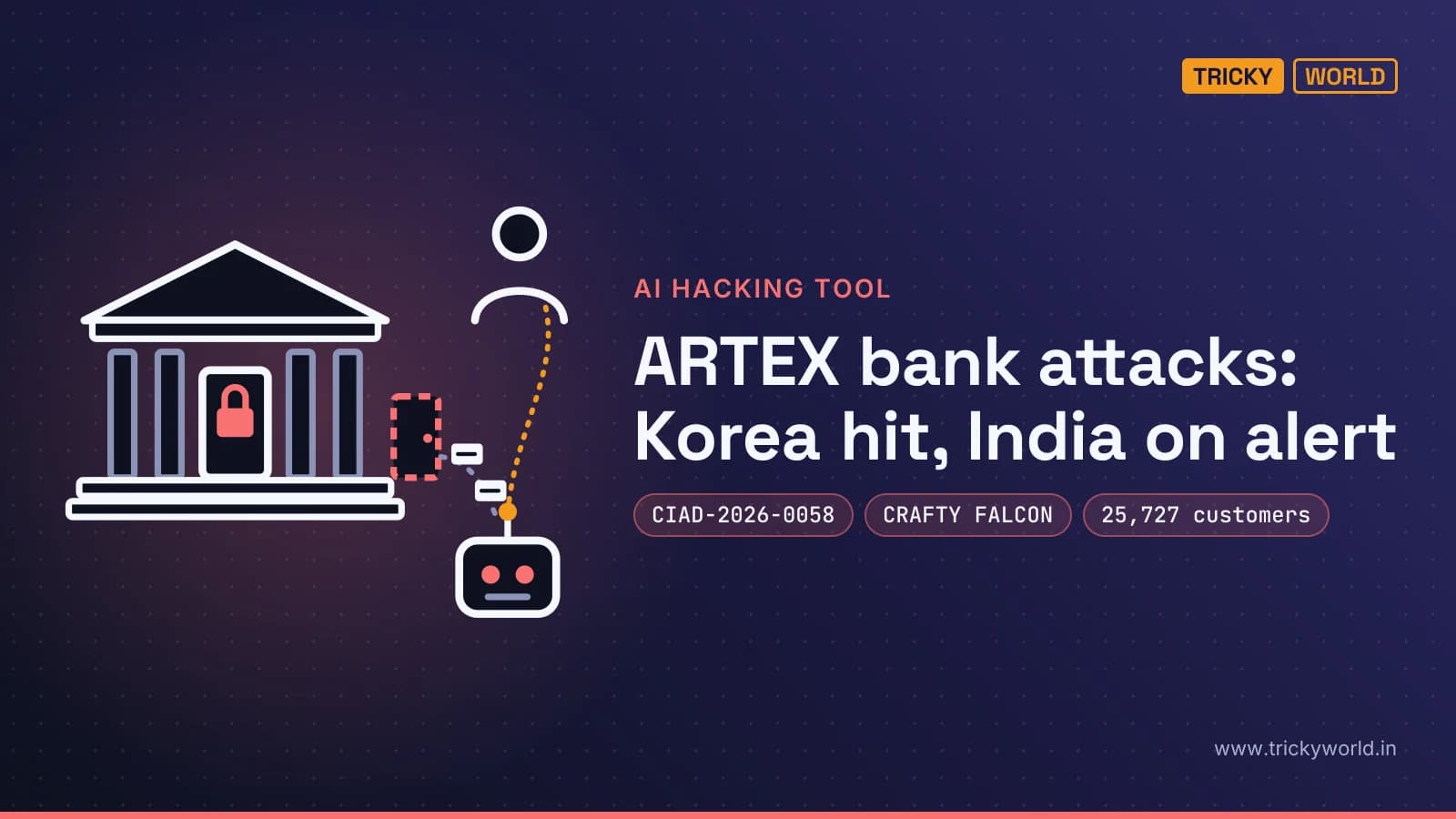
The ARTEX bank attacks put a free AI hacking tool at the centre of a banking scare. Between 27 and 30 September, an attacker working with ARTEX took customer data from Shinhan Bank, KB Kookmin Bank and Hana Bank in South Korea. On 4 November, India's CERT-In named the same tool in a critical advisory to NBFCs, digital lenders and fintechs. That campaign, it says, is still under way.
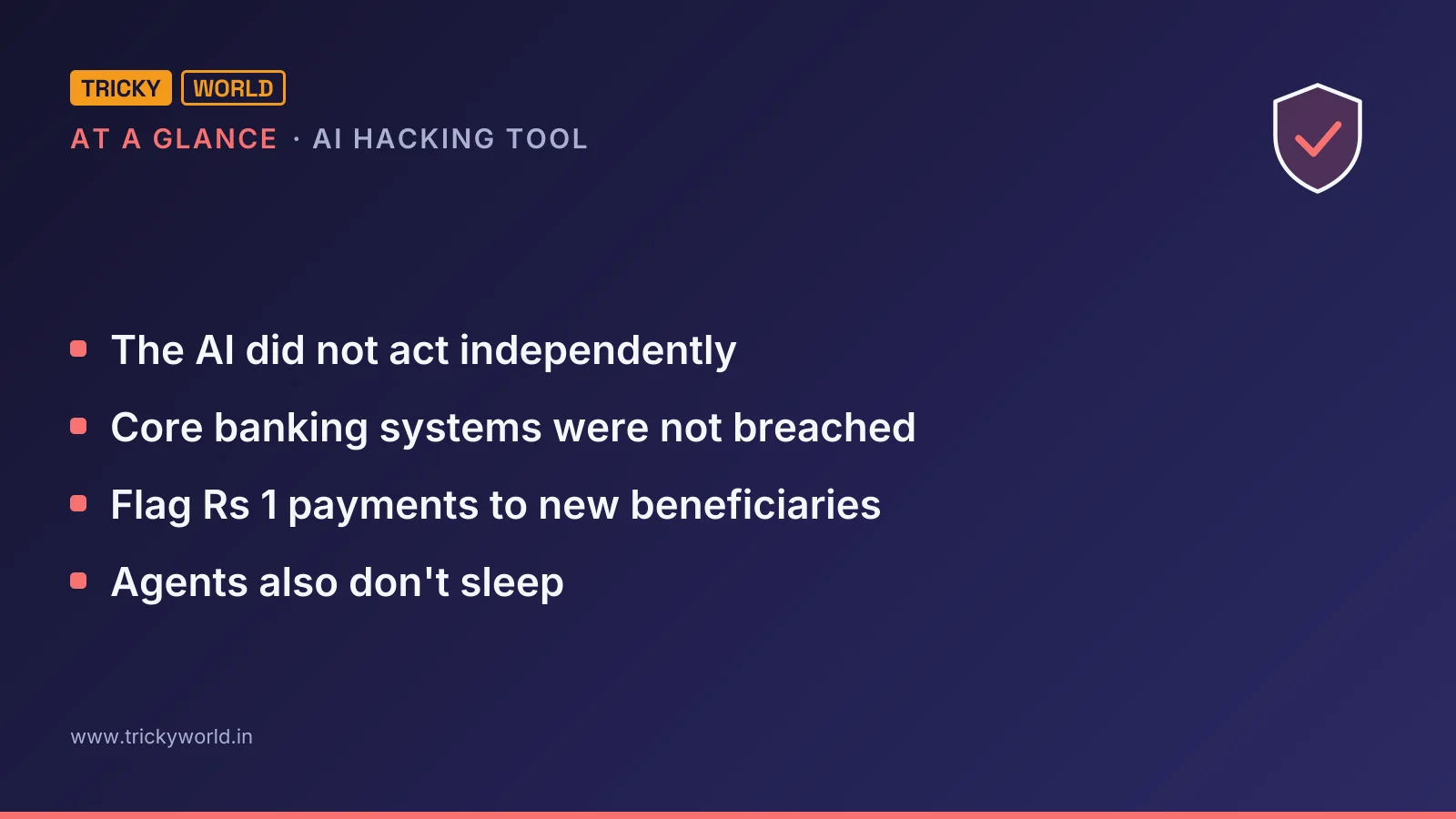
Some headlines describe an AI that breaks into banks on its own. Korea's Financial Security Institute traced the attack logs at Shinhan, and its official told The Herald Business something different: "It is true that AI was used in the attacks, but the AI did not act independently without human involvement." And: "A hacker used the AI as a tool." That difference decides what you should fix.
What is ARTEX?
ARTEX is an open-source penetration-testing framework: software that security teams use to attack their own systems before criminals do. A developer known as Autumn-27 published it on GitHub on 26 July 2026, according to Censys. You give it a target and a goal, such as admin panel access. A planner agent splits the goal into tasks, and worker agents run real tools such as nmap. The loop repeats until the goal is met.
It works with models from Anthropic, OpenAI or any OpenAI-compatible service. That is the same pattern as any AI agent, which our guide to how AI agents call tools in a loop explains. ARTEX simply points the loop at someone else's network.
After the Korean attacks were tied to it, Autumn-27 said on 8 October that they weren't involved and that ARTEX was meant for authorised testing. The repository is gone, but copies and rebrands such as ScopeWeaver still circulate. Censys counted 1,465 internet-facing ARTEX consoles in early November. About 650 of them share two identical hosting setups, so the number of real operators is smaller.
What happened in the ARTEX bank attacks in Korea?
The attacker went around the banks' main defences rather than through them. At the banks, every breach came through a system built for staff or loan agents, not the internet or mobile banking that customers use:
Institution | Where the attacker got in | What leaked |
|---|---|---|
Shinhan Bank | A loan-progress inquiry service for loan brokers | 25,727 customers' names, phone numbers, annual income and loan limits |
KB Kookmin Bank | An employee mobile work-support system | 119 customers' data |
Hana Bank | An employee sales-support system | 89 customers' data |
BNK Busan Bank | Not disclosed | Data on 11 outsourced developers |
Yegaram Savings Bank | Not disclosed | About 40,000 customers' data |
Woori Bank, NH NongHyup Bank | Probed | No breach |
The Korea JoongAng Daily adds Welcome Savings Bank and Hyundai Capital to the list. Detection was slow. Shinhan took 15 hours 26 minutes to spot its breach, Hana almost 42 hours and KB Kookmin almost 68.
The method was simple. The Kyunghyang Shinmun reports that the attacker fed random values into Shinhan's loan-broker service until it found valid customer numbers. Then it pulled the matching details. ARTEX's latest version had come out on 24 September, and the attack on KB Kookmin began three days later.
Core banking systems were not breached. The institute's official said the attacker "did not take over the systems" but "got in and extracted information by querying it", and the institute doesn't expect money to be moved out of accounts. The risk is what comes next: names, incomes and loan limits make voice-phishing calls very convincing.
CrowdStrike's report of 7 October shows how the attacker worked. Their servers left open directories with ARTEX settings and Claude Code session logs. ARTEX ran on DeepSeek v4.1-flash, probably bought through an API reseller. The attacker also asked Claude where stolen Korean data is typically sold. CrowdStrike assesses, with moderate confidence, a financially motivated Chinese speaker. Nobody has been named.
Why CERT-In has warned Indian lenders
India's version is about money, not just data. CERT-In advisory CIAD-2026-0058, rated critical, updates a 9 October warning about attacks on payment and disbursement APIs. Its finance team, CSIRT-Fin, has named the actor CRAFTY FALCON. The victims include NBFCs, digital lending platforms, fintechs, payment aggregators, payment service providers and crypto exchanges.
CERT-In lists the ARTEX family among the tools used, alongside PentAGI, Cairn and CyberStrikeAI, and describes this pattern of attack:
Entry through internet-facing UAT, staging or test environments, then into production over shared credentials or tokens.
Apps reverse-engineered and modified, so the attacker can call payment APIs that assumed only the real app would.
IP allow-lists bypassed by routing traffic through shared fetcher services, such as app-store review fetchers, that are already allowed.
Test transactions of Rs 1 to check a route for funds before large transfers.
Merchant settlement APIs abused, and crypto wallet keys stolen.
Firms that had received the earlier warnings and remediated were attacked again, some after incomplete clean-ups. Attacks were also timed for holidays and weekends, when fewer people watch. The public advisory gives no loss figure, so treat crore totals circulating online with care. Our look at India's October AI hacking claims explains why.
Is ARTEX hacking banks on its own?
Not on the evidence so far. Google's threat intelligence team found that in several cases, attackers handed ARTEX stolen credentials and then told it what to do next. In CrowdStrike's VAPOR PANDA case, recovered transcripts show a human giving the agents instructions. Our report on ARTEX attacks on over 200 organisations covers that campaign.
What ARTEX changes is speed. Google saw its commands run in bursts of 2 to 25 seconds. Microsoft found a China-aligned group, Storm-0940, going from first targeting to privileged cloud access in under three hours, more than once. Agents also don't sleep: they work around the clock, on weekends and on holidays.
It is also noisy. Google calls current use "broad and noisy, but still successful", and says these frameworks "trade stealth for velocity". In one intrusion, ARTEX produced 240 log events while working towards code execution. Google's own forecast, though, puts attacks with no human in the loop one to three months away.
Banks are now a named target. Microsoft reported on 6 November that Storm-3358, a Cambodia-based group, began using ARTEX against financial organisations in October, mostly in Southeast Asia. It exploited anonymous file-upload and server-side request forgery (SSRF) flaws, then installed remote access trojans.
What banks, NBFCs and fintech teams should check
The ARTEX bank attacks didn't need a new kind of flaw. They needed reachable weak spots and an attacker patient enough, or automated enough, to find them. Based on what the Korean investigators and CERT-In found, I'd start here:
Staff and partner tools. List every internet-facing portal for loan agents, brokers and employees. Each needs server-side authentication and rate limits that can't be dodged.
Test environments. Keep UAT and staging away from production: no shared credentials, tokens, databases or network paths.
The app itself. Validate every transaction on the server. Sign API requests with a nonce and timestamp, and use app attestation to catch modified apps.
Money flows. Flag Rs 1 payments to new beneficiaries that are followed by large ones. CERT-In calls this "a strong precursor of unauthorized fund transfer".
Decoys. Honeypots, decoy admin panels and canary credentials catch agents that test everything. Microsoft adds "fake wins", which can make an agent stop on a false success.
Your own tools. Don't download ARTEX to try it. Sophos already detects a backdoored copy of its Docker image, and CERT-In wants written approval and a defined scope for every penetration test.
If you bank with an affected lender
The Korean data is exactly what scammers want. A caller who knows your loan amount or income can sound just like your bank. If a call mentions your loan and asks you to verify details or install an app, hang up. Call back on the number printed on your card or the bank's website. In India, report fraud to the 1930 helpline or at cybercrime.gov.in.
Woori Bank and NH NongHyup Bank were probed in the same wave. They weren't breached, because the weaknesses the attacker looked for weren't there. That works against an AI attacker as well as a human one.
Frequently asked questions
Were passwords or card details stolen in the Korean bank attacks?
Passwords and card CVC numbers were not directly exposed, a Korean regulatory source told the Korea JoongAng Daily. Korean reports say resident registration numbers were among the leaked data, alongside names, incomes and loan records, which is why regulators warned of follow-on fraud.
How can a security team spot ARTEX activity?
Sophos says to look for temporary files named like i12345_b2.ps1, markers such as ARTX123 in commands, and bursts of near-identical commands. Microsoft notes that ARTEX uses tools such as Nmap, curl, wget and headless Chromium by default, whose default user agents can show up in logs, though an agent changes them quickly.
Does blocking ARTEX's IP addresses stop the attacks?
Not for long. Korea's Financial Security Institute found the attacker switching to another IP address whenever one was blocked, and called blocking little more than emergency first aid. CERT-In says the infrastructure behind CRAFTY FALCON rotates IP addresses within hours to days.
Which other AI attack frameworks are attackers using?
Google and CERT-In name PentAGI, CAIRN, Hexstrike and CyberStrikeAI alongside ARTEX. PentAGI, from VXControl, comes in open-source and commercial editions and runs its tools in Kali Linux sandboxes. Censys found CyberStrikeAI running on 70 of the same servers as ARTEX.
Sources
- Write-upExclusive: Chinese AI tool ARTEX used in wave of bank hacks, probe finds (The Herald Business, 3 Oct 2026) · biz.heraldcorp.com
- Write-upARTEX: Agentic Asbestos (Censys, 5 Nov 2026) · censys.com
- Write-upSuspected AI hacks hit Korean banks and lenders, exposing loan data (Korea JoongAng Daily, 4 Oct 2026) · koreajoongangdaily.com
- Write-upThe Korean financial sector was breached by a two-month-old Chinese AI (The Kyunghyang Shinmun, 4 Oct 2026) · khan.co.kr
- Write-upUnknown Threat Actor Uses AI-Driven ARTEX to Target South Korean Finance (CrowdStrike, 7 Oct 2026) · crowdstrike.com
- AdvisoryCIAD-2026-0058: Escalation of AI-Driven Attacks on BFSI Entities by Threat Actor "CRAFTY FALCON" (CERT-In, 4 Nov 2026) · cert-in.org.in
- Write-upARTEX and Friends: Enter Agentic Offensive Frameworks (Google Threat Intelligence Group, 31 Oct 2026) · cloud.google.com
- Write-upAI-driven, large-scale nation-state campaign using ARTEX enables supply chain compromise (Microsoft, 21 Oct 2026) · microsoft.com
- Write-upARTEX abuse expands as cybercriminals target financial sector (Microsoft, 6 Nov 2026) · microsoft.com
- Write-upARTEX: Attackers apply agentic AI (Sophos, 10 Nov 2026) · sophos.com

About the author
Vishal · Software & security engineerVishal writes Trickyworld's tutorials and interview-preparation guides on programming, databases, cyber security and AI. Vishal has been shipping production software long enough to have firm opinions about Python, PHP, Node.js, and JavaScript, and to have been wrong about each of them at least once. The work has run the whole stack: Drupal and Laravel applications, React front ends, MySQL and MongoDB underneath, Redis and Memcached for the things that had to be fast, Apache Solr for the things that had to be findable. That last part turned out to matter more than anyone expected. Tune a Solr index for a season, then watch a language model confidently retrieve the wrong document, and you recognise an old problem wearing new clothes. Most of what is hard about AI systems is not the model. It is retrieval, caching, latency budgets, and deciding what the system does when the answer comes back wrong — which is work he has been doing since well before anyone called it AI engineering. He plays a lot of games, which is less a hobby disclosure than an admission of where a good share of his engineering instinct came from. Real-time systems with a frame budget. State that has to stay coherent while a player does something no designer anticipated. The permanent question of what happens when the frame cannot finish in time. Those habits carry over more directly than they have any right to. He has written several books on programming, all built on the same conviction: most technical writing is unclear because the author never decided what to leave out. More from Vishal → · Editorial policy