Shirudo: can eBPF shields guard your web server?
Shirudo is an open-source runtime from Cisco and OpenAI that loads small signed programs, called shields, into a running Linux system to block a known flaw until the real patch is installed. It is pre-release and needs a patched development kernel, a TPM 2.0 chip and a signed boot image, so no stock Linux distribution can run it today. None of the three demo shields came before its fix, and the Java4Shell one was Java bytecode, not eBPF.

At a glanceCVE-2026-114938
CVE-2026-114938 has a CVSS 3.1 base score of 8.1 (High) from Oracle. No fixed version has been published yet. Debian bookworm fixed it in openjdk-17 17.0.21.1+2-1~deb12u1.
| Severity | 8.1 High (CVSS 3.1, Oracle) |
|---|---|
| Fixed in | No fixed version published yet |
| Affected | Oracle jdk 5 versions listed by NVD, 1.8.0 to 27.0.1.0.3 |
| Exploited | Not in CISA's Known Exploited Vulnerabilities catalog |
| EPSS | 59% chance of exploitation in the next 30 days (FIRST, November 24, 2026) |
| Public exploit | 82 GitHub repositories name it: proofs of concept, scanners, detections. Unverified: some are fake or malicious. |
| Vector | CVSS:3.1/AV:N/AC:H/PR:N/UI:N/S:U/C:H/I:H/A:H |
| Weakness | CWE-122 Heap-based Buffer Overflow |
| Ubuntu | 26.04 resolute openjdk-8: Not affected · 24.04 noble openjdk-8: Not affected · 24.04 noble openjdk-lts: Not affected · 22.04 jammy openjdk-8: Not affected · 22.04 jammy openjdk-lts: Not affected · 20.04 focal openjdk-8: Not affected |
| Debian | bookworm openjdk-17: Fixed (17.0.21.1+2-1~deb12u1) · sid openjdk-17: Fixed (17.0.21.1+2-1) · trixie openjdk-21: Fixed (21.0.13.1+2-1~deb13u1) · forky openjdk-21: Vulnerable · sid openjdk-21: Fixed (21.0.13.1+2-1) · trixie openjdk-25: Fixed (25.0.5.1+2-1~deb13u1) |
| Red Hat | Fixed: RHEL 10 (RHSA-2026:100568, RHSA-2026:100572), RHEL 10.0 Extended Update Support (RHSA-2026:100568), RHEL 10.2 Extended Update Support (RHSA-2026:100568, RHSA-2026:100572), RHEL 8 (RHSA-2026:100563, RHSA-2026:100567) |
| Also in | Oracle jre, Oracle graalvm, Oracle graalvm for jdk, Amazon corretto, Chainguard cg-skills, Red Hat amq broker |
Is there a public exploit for CVE-2026-114938?
Public code exists as of November 25, 2026: 82 public GitHub repositories name it (proofs of concept, scanners and detections). It is not in CISA's Known Exploited Vulnerabilities catalog. None of it is verified: some such repositories are fake or carry malware, so read the code before running it, and only against systems you own. FIRST's EPSS puts the chance of exploitation in the next 30 days at 59%, higher than 99.1% of scored CVEs.
From NVD, Ubuntu, Debian, Red Hat · checked November 25, 2026
At a glanceCVE-2026-109618
CVE-2026-109618 has a CVSS 3.1 base score of 9.8 (Critical) from NVD, and 9.2 (Critical, CVSS 4.0) from PHP. It is fixed in PHP 8.2.35, 8.3.36, 8.4.27 and 8.5.12. Ubuntu 26.04 fixed it in php8.5 8.5.4-0ubuntu1.5. Debian bookworm fixed it in php8.2 8.2.36-1~deb12u1.
| Severity | 9.8 Critical (CVSS 3.1, NVD) · 9.2 Critical (CVSS 4.0, PHP) |
|---|---|
| Fixed in | PHP 8.2.35, 8.3.36, 8.4.27, 8.5.12 |
| Affected | PHP 7.3.0 – before 8.2.35; 8.3.0 – before 8.3.36; 8.4.0 – before 8.4.27; 8.5.0 – before 8.5.12 |
| Exploited | Yes: in CISA's Known Exploited Vulnerabilities catalog since October 26, 2026 |
| EPSS | Over 99.9% chance of exploitation in the next 30 days (FIRST, November 24, 2026) |
| Public exploit | 792 GitHub repositories name it: proofs of concept, scanners, detections. Unverified: some are fake or malicious. |
| Vector | CVSS:3.1/AV:N/AC:L/PR:N/UI:N/S:U/C:H/I:H/A:H |
| Weakness | CWE-1325 · CWE-416 Use After Free · CWE-755 Improper Handling of Exceptional Conditions · CWE-824 Access of Uninitialized Pointer |
| Ubuntu | 26.04 resolute php8.5: Fixed (8.5.4-0ubuntu1.5) · 24.04 noble php8.3: Fixed (8.3.6-0ubuntu0.24.04.13) · 22.04 jammy php8.1: Fixed (8.1.2-1ubuntu2.28) · 20.04 focal php7.4: Fixed (7.4.3-4ubuntu2.29+esm5) · 18.04 bionic php7.2: Fixed (7.2.24-0ubuntu0.18.04.17+esm14) · 16.04 xenial php7.0: Fixed (7.0.33-0ubuntu0.16.04.16+esm22) |
| Debian | bookworm php8.2: Fixed (8.2.36-1~deb12u1) · trixie php8.4: Fixed (8.4.27-1~deb13u1) · forky, sid php8.4: Fixed (8.4.28-3) |
| Red Hat | Fixed: RHEL 10 (RHSA-2026:87070, RHSA-2026:87071, RHSA-2026:98609), RHEL 10.0 Extended Update Support (RHSA-2026:88561), RHEL 8 (RHSA-2026:87073, RHSA-2026:87080), RHEL 8.4 Advanced Mission Critical Update Support (RHSA-2026:88565) · RHEL 6: Out of support scope |
| Also in | Siemens ruggedcom ape1808 firmware, Palo Alto PAN-OS, Palo Alto Networks panorama virtual appliance, Siemens blueplanet 360 nx3 m6 wm od iisx firmware, Siemens blueplanet 360 nx3 m6 wm od iisx-s firmware, Siemens energy engage |
Is there a public exploit for CVE-2026-109618?
Yes: CVE-2026-109618 is exploited in the wild. CISA added it to its Known Exploited Vulnerabilities catalog on October 26, 2026. 792 public GitHub repositories name it: proofs of concept, scanners and detections. None of it is verified: some such repositories are fake or carry malware, so read the code before running it, and only against systems you own. FIRST's EPSS puts the chance of exploitation in the next 30 days at over 99.9%, higher than 99.9% of scored CVEs.
From NVD, GHSA-w8hw-w9fx-j79w, Ubuntu, Debian, Red Hat · checked November 25, 2026
At a glanceCVE-2026-109619
CVE-2026-109619 has a CVSS 3.1 base score of 8.1 (High) from NVD, and 9.2 (Critical, CVSS 4.0) from PHP. It is fixed in PHP 8.2.35, 8.3.36, 8.4.27 and 8.5.12. Ubuntu 26.04 fixed it in php8.5 8.5.4-0ubuntu1.5. Debian bookworm fixed it in php8.2 8.2.36-1~deb12u1.
| Severity | 8.1 High (CVSS 3.1, NVD) · 9.2 Critical (CVSS 4.0, PHP) |
|---|---|
| Fixed in | PHP 8.2.35, 8.3.36, 8.4.27, 8.5.12 |
| Affected | PHP 5.4.0 – before 8.2.35; 8.3.0 – before 8.3.36; 8.4.0 – before 8.4.27; 8.5.0 – before 8.5.12 |
| Exploited | Yes: in CISA's Known Exploited Vulnerabilities catalog since October 26, 2026 |
| EPSS | Over 99.9% chance of exploitation in the next 30 days (FIRST, November 24, 2026) |
| Public exploit | 30 GitHub repositories name it: proofs of concept, scanners, detections. Unverified: some are fake or malicious. |
| Vector | CVSS:3.1/AV:N/AC:H/PR:N/UI:N/S:U/C:H/I:H/A:H |
| Weakness | CWE-1325 · CWE-416 Use After Free · CWE-755 Improper Handling of Exceptional Conditions · CWE-824 Access of Uninitialized Pointer |
| Ubuntu | 26.04 resolute php8.5: Fixed (8.5.4-0ubuntu1.5) · 24.04 noble php8.3: Fixed (8.3.6-0ubuntu0.24.04.13) · 22.04 jammy php8.1: Fixed (8.1.2-1ubuntu2.28) · 20.04 focal php7.4: Fixed (7.4.3-4ubuntu2.29+esm5) · 18.04 bionic php7.2: Fixed (7.2.24-0ubuntu0.18.04.17+esm14) · 16.04 xenial php7.0: Fixed (7.0.33-0ubuntu0.16.04.16+esm22) |
| Debian | bookworm php8.2: Fixed (8.2.36-1~deb12u1) · trixie php8.4: Fixed (8.4.27-1~deb13u1) · forky, sid php8.4: Fixed (8.4.28-3) |
| Red Hat | Fixed: RHEL 10 (RHSA-2026:87070, RHSA-2026:87071, RHSA-2026:98609), RHEL 10.0 Extended Update Support (RHSA-2026:88561), RHEL 7 Extended Lifecycle Support (RHSA-2026:88693), RHEL 8 (RHSA-2026:87073, RHSA-2026:87080) · RHEL 6: Out of support scope |
| Also in | Siemens ruggedcom ape1808 firmware, Palo Alto PAN-OS, Palo Alto Networks panorama virtual appliance, Siemens amis ts, Siemens blueplanet 360 nx3 m6 wm od iisx-s firmware, Siemens energy engage |
Is there a public exploit for CVE-2026-109619?
Yes: CVE-2026-109619 is exploited in the wild. CISA added it to its Known Exploited Vulnerabilities catalog on October 26, 2026. 30 public GitHub repositories name it: proofs of concept, scanners and detections. None of it is verified: some such repositories are fake or carry malware, so read the code before running it, and only against systems you own. FIRST's EPSS puts the chance of exploitation in the next 30 days at over 99.9%, higher than 100% of scored CVEs.
From NVD, GHSA-6wmf-4rv5-p3rp, Ubuntu, Debian, Red Hat · checked November 25, 2026
At a glanceCVE-2026-31431
CVE-2026-31431 has a CVSS 3.1 base score of 7.8 (High) from CNA. It is fixed in Linux kernel 5.10.254, 5.15.204, 6.1.170, 6.6.137, 6.12.85 and 6.18.22. Debian bookworm fixed it in linux 6.1.176-1.
| Severity | 7.8 High (CVSS 3.1, CNA) |
|---|---|
| Fixed in | Linux kernel 5.10.254, 5.15.204, 6.1.170, 6.6.137, 6.12.85, 6.18.22 |
| Affected | Linux kernel 4.14 – before 5.10.254; 5.11 – before 5.15.204; 5.16 – before 6.1.170; 6.2 – before 6.6.137; 6.7 – before 6.12.85; 6.13 – before 6.18.22 |
| Exploited | Yes: in CISA's Known Exploited Vulnerabilities catalog since May 1, 2026 |
| EPSS | Over 99.9% chance of exploitation in the next 30 days (FIRST, November 24, 2026) |
| Public exploit | openwall.com, openwall.com, openwall.com, openwall.com, copy.fail · 324 GitHub repositories name it: proofs of concept, scanners, detections. Unverified: some are fake or malicious. |
| Vector | CVSS:3.1/AV:L/AC:L/PR:L/UI:N/S:U/C:H/I:H/A:H |
| Weakness | CWE-1288 · CWE-669 |
| Ubuntu | Not tracked yet |
| Debian | bookworm linux: Fixed (6.1.176-1) · trixie linux: Fixed (6.12.117-1) · forky linux: Fixed (7.3.5-1) · sid linux: Fixed (7.3.6-1) |
| Red Hat | Fixed: RHEL 10 (RHSA-2026:13566, RHSA-2026:19074), RHEL 10.0 Extended Update Support (RHSA-2026:13887), RHEL 8 (RHSA-2026:13578, RHSA-2026:13577, RHSA-2026:15976), RHEL 8.4 Advanced Mission Critical Update Support (RHSA-2026:14165) |
| Also in | Red Hat openshift container platform, Red Hat enterprise linux, Red Hat enterprise linux aus, Red Hat enterprise linux eus, Red Hat enterprise linux tus, Red Hat enterprise linux update services for sap solutions |
Is there a public exploit for CVE-2026-31431?
Yes: CVE-2026-31431 is exploited in the wild. CISA added it to its Known Exploited Vulnerabilities catalog on May 1, 2026. NVD links 5 exploit references and 324 public GitHub repositories name it: proofs of concept, scanners and detections. None of it is verified: some such repositories are fake or carry malware, so read the code before running it, and only against systems you own. FIRST's EPSS puts the chance of exploitation in the next 30 days at over 99.9%, higher than 99.9% of scored CVEs.
At 12:14 UTC on 18 November 2026, an Elasticsearch server in a test lab printed a warning that an AI agent's code had put there: "Base64 guard installed". Twenty-two milliseconds later, the guard rejected an exploit for Java4Shell, a remote-code-execution flaw in Java, while the server kept running. Five days later, Cisco and OpenAI released the system behind that guard as Shirudo, an open-source runtime for shielding Linux servers.
That demo is the best case the two companies could show, and it hides three catches. The guard was Java bytecode, not the eBPF kernel technology the launch was about. Oracle's patch for the flaw had been out for 15 hours. And no stock Linux distribution can run Shirudo today, because it needs a development kernel with patches no upstream tree carries, a TPM 2.0 chip and a signed boot image.
This guide explains what Shirudo is and what the launch coverage got wrong. It shows how a shield travels from an AI agent into a running kernel, and what one can and can't do for a PHP, Java or Node.js web server. It ends with a tool we wrote and tested that checks how far your own server is from running Shirudo, and what would break if it did.
What is Shirudo?
Shirudo is an open-source runtime from Cisco and OpenAI, released on 23 November 2026, that loads small signed programs, called shields, into a running Linux system to block a known flaw until the real patch is installed.
The name is Japanese for "shield", and the project's documentation writes it in lower case, shirudo. Its name is plain Shirudo, not Project Shirudo, since the press release only calls it "a new project", and the documentation calls the shields upatches. The code is on GitHub under the BSD 2-Clause licence, with its BPF programs dual-licensed BSD and GPL.
The ideas are older than the launch. Isovalent, the eBPF company Cisco owns, calls Shirudo a rewrite of Tetragon, its runtime security tool, for the age of AI agents. Instead of handing an agent a policy language written for people, Shirudo lets it write the shield as code. Daniel Borkmann, one of the Linux kernel's BPF maintainers, first presented it at the Linux Plumbers Conference in Prague, held from 5 to 7 October 2026. On 23 November, Cisco and OpenAI announced it as a project they develop together, with OpenAI's Codex writing the demo shields.
The project is pre-release and frank about its limits. Its FAQ answers the question "Is shirudo ready for production?" with "Not yet". There is no release, the version file reads 0.0.0-dev, and the only item on its releases page is a test kernel. The documentation says Shirudo "does not replace kernel updates" and that a shield "covers the time until the machine runs a fixed kernel".
What did the launch coverage get wrong?
Mostly the timing and the scope, because Shirudo shields flaws that are already known, needs restarts in places, wasn't using eBPF in its headline demo and isn't ready for production servers.
Here are the claims made about Shirudo since the launch, checked against the primary sources:
"Zero-day protection." A shield is written for a flaw someone already knows about. Shirudo's own documentation describes the problem as the gap between a public fix and the day every machine has booted it. None of the three demo shields came before its fix, as the timeline below shows.
"Zero restarts." Kernel shields do load and unload without a reboot. But a server only becomes a Shirudo machine by booting a patched kernel from a signed boot image. The web server shield applies to processes started after it loads, so Apache needs one restart, and Shirudo's own way of adding a Java shield takes effect when a Java program starts.
"eBPF shields stopped Java4Shell." The demo shield was Java bytecode, not eBPF. Cisco's blog says agents should put defences right next to the workload, "whether that's in eBPF in the kernel, Java bytecode, or a firewall or network rule".
"Shirudo blocked the PHP flaw." The PHP shield in the repository is a sandbox for Apache and PHP-FPM. Its README says the sandboxes "do not close the hole in PHP". Instead, they stop what an attacker does next.
"Exploited within a day." Cisco's blog says exploit campaigns for both bugs were under way "within a day of disclosure, if not before". CISA's catalogue of exploited flaws lists the two PHP bugs, added on 26 October, but its 24 November version doesn't list Java4Shell. Calif, the start-up that found both, says Java4Shell has no universal exploit and is holding back its product-specific ones.
"Built for the Indian developer market." Nothing in either company's announcement, the code or the documentation targets India or any one market. The press release is datelined San Jose, and anyone can contribute on GitHub.
"Ready to set up on your web server." It isn't ready for production, as the FAQ says, and the system requirements below rule out every stock distribution kernel.
How does a Shirudo shield get onto a server?
An operator machine compiles and signs each shield and publishes it to a container registry, and every server pulls it on a timer, checks the signature in its kernel, loads it and records the change in its TPM chip.
Write. A kernel shield starts as a few lines of C for the kernel's BPF virtual machine, often refusing the one call that a kernel fix closes. An engineer can write it, or an AI agent such as OpenAI's Codex, which wrote the launch's Java shield.
Sign. The
shirudo buildcommand compiles it with clang and wraps it in a small signed loader program. The signature is ML-DSA-87, a post-quantum algorithm and the only one Shirudo accepts.Publish. Shields are packed into
.beepackages and pushed to an OCI registry, the kind that stores container images. The design doesn't trust the registry, which can withhold or replay a package but can't forge one.Pull. Each server runs a one-shot command from a systemd timer, about once a minute. Nothing listens on a port, and no agent stays running.
Load. The kernel checks the loader's signature against a keyring sealed at boot, before its verifier checks the program's safety. Shirudo's own BPF programs refuse every other BPF load from user space, even by root.
Measure. Each load and unload extends a register in the TPM, and
shirudo attestreturns TPM-signed evidence that the operator checks offline.Retire. Once the real patch is installed, a signed unload directive removes the shield, and the TPM records that too.
In the project's quickstart, those steps come down to a handful of commands on each side:
operator$ shirudo build fix.bpf.c --keys-dir "$KEYS" -o fix.upatch
operator$ shirudo build --unload fix --payload-sha256 "$PAYLOAD" --keys-dir "$KEYS" -o fix.unload.upatch
target#   shirudo upatch load fix.upatch
target#   shirudo attest --nonce="$NONCE" --output=ev.json
operator$ shirudo attest verify --evidence=ev.json --nonce="$NONCE" --ak-name="$AK" --expect-chain="$CHAIN"
target#   shirudo upatch unload fix.unload.upatch
Why lock BPF down at all? Because the tool that patches a running kernel is also a weapon. The documentation puts it plainly: if root can load BPF, "an attacker who gains root can load BPF too", to hide, read kernel memory or detach the shield. On a Shirudo machine, root without the operator's signing key can't run BPF the operator didn't ship.
What can a kernel shield block?
A kernel shield refuses a dangerous call before the vulnerable code runs, at a security hook or at the entry of certain kernel functions, but it can't replace the buggy function itself the way kernel live patching does.
The project's own example is Copy Fail (CVE-2026-31431), a bug in the Linux kernel's AF_ALG crypto sockets that lets a local user become root. Its CVE record was published on 22 April 2026, with fixes in stable kernels such as 6.6.137, 6.12.85 and 6.18.22, and CISA added it to its list of exploited flaws on 1 May. Shirudo's shield refuses the step the exploit builds on, splicing a file's pages into an AF_ALG socket, in a security hook. In the live-patching guide, a probe prints SPLICE_OK before the shield loads and SPLICE_BLOCKED after it, while every other use of the socket keeps working. "The kernel is the one that booted," the guide notes.
That matters to web servers because attacks chain. A PHP or Java bug gives an attacker code running as the web server's user, and a local root bug like Copy Fail turns that into control of the machine. OpenAI's own research pipeline, which produced 948 working Linux root exploits in 30 hours, shows how quickly that second step can now be found.
User-space code is harder. A shield can attach to a function inside a program, but the documented kinds there only read the function's arguments and return value, and the kinds that refuse a call work on kernel functions. So for a memory bug inside a library, such as the Brotli decoder flaw that hit Node.js, a Shirudo shield can count and log the calls or fence the process in, but it can't block the bad input. The Java case shows the workaround, a guard written in the application's own runtime.
How did the Java4Shell shield work?
It was a Java agent, code that OpenAI's Codex generated to add a check to the JDK's Base64 decoder, rejecting the input shape that triggers the overflow, and the lab attached it to a running Elasticsearch 9.5.5 process.
Isovalent's write-up of the test shows the agent's loop: take in the vulnerability details, build a reproducer, pick the best place for a guard, and repeat until the guard stops the exploit. The Elasticsearch log then records the guard rejecting an input 65 characters long, with one padding character.
Java4Shell, CVE-2026-114938, is a heap overflow in OpenJDK's fast Base64 decoder, the hand-written assembly that uses AVX-512 instructions on x86-64 processors. Quang Luong of Calif found it with Codex in about an hour, according to Calif's write-up, and built a first exploit in two more. On newer JDKs, a string of 64 "A"s followed by one "=" is enough to make the decoder write 62 bytes past the end of its buffer. Calif showed remote code execution in Jenkins, Keycloak, Jira and other products, before login in some of them.
The bug affects OpenJDK 17.0.6 and later until the November fix, and only on CPUs with AVX-512 VBMI, such as Intel Xeon chips from Ice Lake on and AMD chips from Zen 4 on. ARM servers are not affected. Oracle's patch came on 17 November at 1 p.m. Pacific time, in its November Critical Security Patch Update. Oracle rates the flaw 8.1 out of 10 and "difficult to exploit", while Calif scores it 9.2 under the newer CVSS 4.0. The bug wasn't secret before then. A user reported the crash on 9 June, and a fix proposed in September was closed without being merged. Calif found the bug again on 24 October.
Shirudo's own path for Java shields is slower than the demo suggests. It ships a signed agent file and adds it to JAVA_TOOL_OPTIONS, which a Java process reads when it starts. The documentation says a JVM "already running keeps the agents it started with until it restarts". Only Java processes that a systemd user manager starts pick up the setting, and a system service needs the flag in its own unit. The demo's log shows the guard arriving through the JVM's attach mechanism, which the shipped agent also offers, as java -jar java-base64.jar <pid>, for JVMs that Shirudo doesn't start. That route bypasses Shirudo's signature check and its TPM record.
Without Shirudo, Calif's interim fix also needs a restart. Start the JVM with -XX:-UseBASE64Intrinsics, or with -XX:UseAVX=2 on x86-64 only, until your vendor's patched JDK is installed. To see whether a server's CPU can reach the bug at all, Calif suggests this check, which prints all four flags on an affected machine:
grep -m1 '^flags' /proc/cpuinfo | tr ' ' '\n' | grep -E '^(avx512f|avx512bw|avx512vbmi|bmi2)$'On our Ubuntu test machine, which has a 10th-generation Intel laptop chip, the check prints only bmi2, so that machine can't hit the bug.
Can Shirudo protect a PHP web server?
It can contain one but not cure it, because the app-sandbox shield stops a compromised Apache or PHP-FPM from planting PHP files, running other programs or connecting beyond private networks, without fixing the PHP2Shell bugs themselves.
PHP2Shell is the name for two PHP flaws, CVE-2026-109618 and CVE-2026-109619, in request memory handling that let an attacker run code on a server without logging in. PHP fixed them on 21 October in versions 8.5.12, 8.4.27, 8.3.36 and 8.2.35, and CISA listed both as exploited five days later. Our PHP2Shell guide covers the update and the interim settings.
The app-sandbox package labels the web server's program files, and every process that runs them carries the label. Its shipped rules let those processes run no program but their own, connect only to loopback and private address ranges, and create, rename or write no file ending in .php. For PHP-FPM, the list adds .phar, .phtml and similar names. The rules are compiled into the signed shield, so nobody on the server can loosen them.
The project's Apache tutorial runs a script that does what an attacker with PHP code execution would try next. Inside the sandbox, writing shell.php, renaming a text file to .php and making a d.php folder are all refused. The shell command doesn't run, and a connection to 1.1.1.1 fails with "permission denied", although Apache started as root. The site's own text-file write and its local connection still work. With the shield removed, every one of those steps succeeds.
Three limits matter on a real server. A process enters the sandbox when it starts a labelled program, so the package's README says to restart the application after the first load. A package upgrade replaces the labelled binary with an unlabelled one, so the shield must be loaded again after every upgrade. And the network rules take address ranges only, which suits a PHP site that talks to a local database better than one that calls payment or mail APIs by name.
What can Shirudo do for a Node.js server?
Less than for PHP or Java today, because the repository has no Node.js shield, so a Node server gets kernel shields underneath it and, with some care, the same sandbox around it.
Adding Node.js to the sandbox means listing the node binary in the package's Beefile and writing rules for it, and those rules then cover every Node process on the machine, including build tools and scripts. A Node API that calls outside services needs their address ranges in the rules. One that starts helper programs, such as an image converter, needs them labelled too. For flaws inside Node.js itself, the fix is still the runtime update: for the Brotli bug, that means Node.js 22.23.4, 24.22.1 or 26.12.1.
How fast did the first shields follow the fixes?
Each of the three demo shields was committed to Shirudo's public repository after the fix it covers, between about two and a half days and seven months later.
We compared each shield's commit history with the date its fix became public:
Java4Shell. Oracle's patch came out at 21:00 UTC on 17 November. The lab's demo shield logged a rejection at 12:14 UTC the next day, 15 hours later. The shield in the repository was written on 20 November and merged on 21 November.
PHP2Shell. PHP's fixes came out on 21 October. The app-sandbox shield, which names both CVEs as the flaws it covers, was committed on launch day, 23 November, 33 days later.
Copy Fail. The CVE record was published on 22 April, and CISA flagged active exploitation on 1 May. The shield was committed on 22 November, seven months later.
Commit dates show when a shield became public, not when work on it began, and these shields were demonstrations rather than a race against attackers. None of the three demo shields came before its fix. OpenAI says the goal is tested shields published "alongside vulnerability disclosures", which would make them most useful while a fleet rolls a patch out, not before the patch exists.
What does a server need before it can run Shirudo?
A kernel with the signed BPF loader interface and five patches no upstream tree carries yet, a TPM 2.0 chip, systemd 256 or newer, a dracut-built initrd and a boot through a signed unified kernel image.
The kernel. The project tests on a bpf-next development kernel, and its current test build is Linux 7.4 with eight patches, five of which Shirudo itself needs. Two of those add new security hooks, one that sees commands sent to the TPM and one that checks reads of another process's memory. "There is no fallback for an older kernel," the docs say.
A TPM 2.0. Every change is recorded in it, and there is no mode without one. The kernel must expose it as
/dev/tpmrm0, with a SHA-256 bank of registers.The boot. It takes systemd 256 or newer, an initrd built by dracut, and a unified kernel image booted through systemd-stub. Its command line sets
bpf.keyring_unsealed=1anddm_verity.keyring_unsealed=1, so that the keyrings can be filled and then sealed.The operator machine and registry. The operator needs clang and LLVM 23, and OpenSSL 3.5 or newer for ML-DSA signing. Registries and log collectors must accept TLS 1.3 with a hybrid post-quantum key exchange, unless a server is listed as an exception.
The hardware. x86-64 is fully tested and arm64 partly, and no riscv64 machine has booted it yet.
The kernel gap is narrower than it sounds. We checked the mainline Linux source at 7.4-rc4, and it already has the signed-loader fields that Shirudo's start-up check looks for, plus the parameter that keeps the BPF keyring open at boot. It still lacks the TPM-command and process-memory hooks, so even the newest mainline kernel needs Shirudo's patches. The full list is on the system requirements page.
What stops working on a server that runs Shirudo?
Anything else that loads BPF fails, including Cilium, Falco's eBPF drivers, Tetragon, bpftrace and bcc, and systemd quietly drops the unit settings it enforces with BPF, such as IPAddressDeny= and DeviceAllow=.
The interoperability page lists the casualties. At start-up, systemd finds that it can't load BPF and starts units without these settings: IPAddressAllow=, IPAddressDeny=, IPAccounting=, DeviceAllow=, DevicePolicy=, SocketBindAllow=, SocketBindDeny=, RestrictNetworkInterfaces= and RestrictFileSystems=. The units still start, and nothing reports an error. PrivateDevices=yes still gives a service its own /dev, but the device policy it adds is a BPF program, so that part goes too.
On our Ubuntu 22.04 machine, 28 unit files use such settings. They include systemd-journald, systemd-logind, systemd-udevd and systemd-resolved, which run on every boot. They also include the PHP-FPM 8.2 and 8.3 units from the widely used ondrej/php packages, which set PrivateDevices=true. On a Shirudo machine, those services would keep running with less protection than their unit files promise.
The rest of the list is short but sharp. A container runtime's device rules are BPF programs too, and the docs tell you to test your runtime on a Shirudo machine before trusting it. Crash dumps through kdump and kexec are refused, and so is hibernation. The new systemd-keyring-setup in systemd 263 conflicts with Shirudo's start-up and has to be masked. And a quick investigation with bpftrace has to happen on a machine that doesn't enforce.
How can you check whether your server could run Shirudo?
Run shirudo-ready, a small Python tool we wrote and tested for this guide, which reads the kernel's BTF and system files without root, repeats Shirudo's kernel checks and lists what enforcement would break.
git clone https://github.com/vishal1610kamal/trickyworld_shirudo_ready
cd trickyworld_shirudo_ready
python3 -m shirudoready
python3 -m shirudoready btf vmlinux.btf
BTF is the type information the kernel publishes at /sys/kernel/btf/vmlinux. The tool reads it without any library and applies the tests of Shirudo's own start-up check: the loader-signature fields with their exact types, the 49 security hooks Shirudo's programs attach to, and module signing. It then checks the active security modules, 31 kernel options, the TPM, the systemd version, the boot path and dracut, and it reads systemd units the way systemd does.
As a control, we ran it against the BTF and configuration of Shirudo's own test kernel, downloaded from the project's release with its SHA-256 checked. Every kernel check passed, and all 31 options were set. Our Ubuntu 22.04 machine, on kernel 6.8.0-149 with systemd 249, failed 7 of 11 checks:
FAIL  signed_loader_kernel_abi  struct bpf_map.sha is missing
FAIL  kernel_lsm_hooks          kernel has no LSM hooks ... (7 of 49)
FAIL  bpf_lsm_active            active LSMs: lockdown,capability,landlock,yama,apparmor (no bpf)
FAIL  kernel_config             1 required option(s) missing ... CONFIG_CRYPTO_MLDSA
OK    tpm2_device               /dev/tpmrm0 present, TPM 2.0, SHA-256 PCR bank
FAIL  systemd_version           systemd 249
FAIL  uki_boot                  UEFI boot, but no systemd-stub variables
FAIL  dracut_initrd             dracut is not installed
The missing hooks include the two that only Shirudo's patches add, so no stock kernel update closes that gap today. The repository holds the full results and 61 tests, which pass on Python 3.10 to 3.13.
How can you try Shirudo without risking a server?
Use a throwaway virtual machine, where the project's quickstart boots a test machine under QEMU with a software TPM and walks one shield through signing, loading, TPM checks and unloading. Isovalent also runs a browser-based lab.
The quickstart needs a Linux host with KVM, clang and LLVM 23, OpenSSL 3.5, Docker or Podman to build the VM bundle, QEMU and swtpm. On a Mac, it runs inside a Lima VM on an M3 chip or later. The core steps are these:
testing/vm/kernel-artifact.sh fetch
make && make shirudo-build
make -C testing vm VM_NAME=quickstart
make -C testing vm-ssh VM_NAME=quickstart
We didn't boot the VM for this guide, and the tool above read the test kernel's files as data instead. Isovalent and OpenAI will cover Shirudo in a webinar on 15 December 2026. The project asks for the kind of help a web team can give: a test that reproduces a bug, a run against a kernel you use, or a report of where a shield breaks real traffic.
How do shields compare with live patching, Tetragon and WAF rules?
Each covers a different layer, because a WAF rule filters requests before they reach the server, kernel live patching swaps in fixed code, and a Shirudo shield blocks the vulnerable path inside the system with a signed, measured program.
Kernel live patching, with tools such as kpatch, replaces a broken function with fixed code. It runs as native kernel code that no verifier checks, it is built for one kernel build, and the TPM doesn't record it by default. Shirudo's comparison page calls the two complementary: a shield blocks the path quickly, then a live patch or a new kernel fixes it.
Tetragon, Shirudo's ancestor, enforces policies written in its own policy language and accepts changes at run time. It is the established option today, but it can't run on a Shirudo machine, because its programs can't load there.
Cisco Live Protect is Cisco's shielding feature for its own products, built on Tetragon.
WAF virtual patching sits in front of the web server and sees requests. It is quick to deploy, but it can't see a local root exploit that never crosses the network.
What should a web server team do this week?
Patch first, because Shirudo can't run on a stock production server yet, then make the bugs it was shown against harder to exploit, and try Shirudo in a test VM if you run Linux fleets.
Move PHP to 8.5.12, 8.4.27, 8.3.36 or 8.2.35, or your distribution's backport, and restart every PHP worker.
Install your vendor's patched JDK. Until then, check the CPU flags above and start affected x86-64 JVMs with
-XX:-UseBASE64Intrinsics.Update Node.js to 22.23.4, 24.22.1 or 26.12.1 for the Brotli flaw.
Confirm your distribution's kernel fix for Copy Fail, and use kernel live patching where you can't reboot.
Contain the web server now with what you already have: an AppArmor or SELinux profile, systemd's sandboxing options and outbound firewall rules in nftables, which keep working on a Shirudo machine too.
Run shirudo-ready, and note which BPF tools and systemd settings you rely on.
Read Shirudo's threat model before the 15 December webinar.
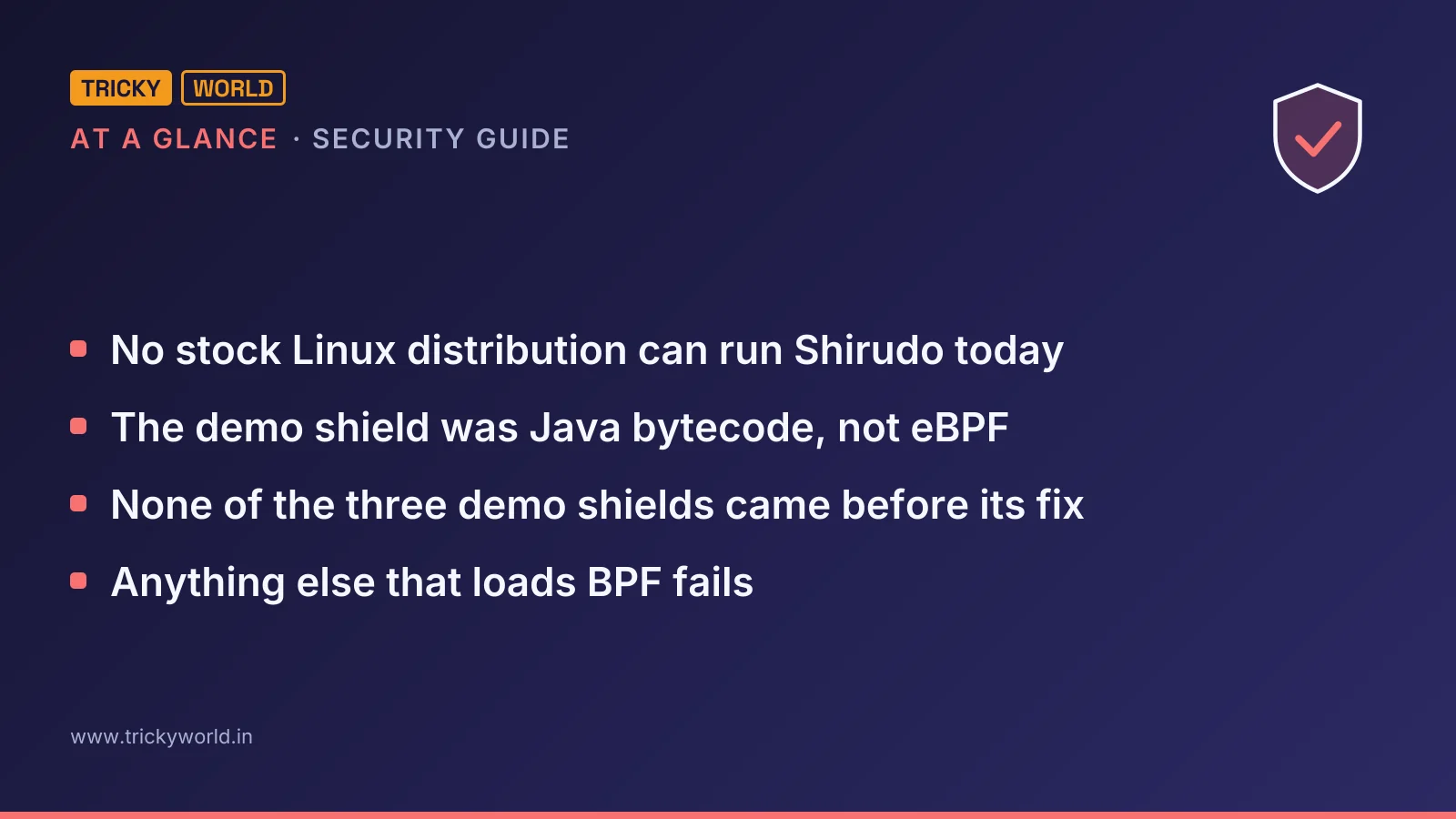
Shirudo's engineering is careful, with signed loaders, a sealed keyring and a TPM record of every change. What it can't be yet is a shield for the server you run today. For that server, the patch is still the shield.
Frequently asked questions
Is Shirudo free to use in a company?
Yes. The BSD 2-Clause licence allows commercial use, and the BPF programs are also offered under the GPL. Neither Cisco nor OpenAI has announced paid support or a hosted version, so help for now comes through the project's GitHub repository and documentation.
Does Shirudo send data to OpenAI or Cisco?
Not by itself. Its FAQ says it sends data only where you configure it to: with no package repository, update tree or telemetry endpoint set, it sends nothing. The runtime doesn't need Codex or any AI model either. An agent is one way to write shields, and engineers can write them by hand.
Can Shirudo run inside a container or on Kubernetes?
Its commands must run on the host, not inside a container, and one instance runs per host. A Kubernetes node can be a Shirudo machine, but a network plugin built on BPF can't run there, not even Cilium, which Isovalent created. The cluster needs a plugin that doesn't use BPF, and shields can then sandbox containers and pods.
What happens to loaded shields when a server reboots?
They come back. Shirudo keeps a copy of every loaded shield and loads it again when it starts from the initrd at the next boot, before other workloads run. The TPM register starts from zero at each boot and records that restore, so the evidence stays checkable.
Sources
- Write-upOpenAI and Cisco introduce Shirudo (OpenAI, 23 Nov 2026) · openai.com
- Write-upCisco and OpenAI introduce Shirudo (Isovalent at Cisco, 23 Nov 2026) · isovalent.com
- Write-upCisco and OpenAI Launch Shirudo, A New Project to Safeguard Agentic AI (Cisco press release, 23 Nov 2026) · newsroom.cisco.com
- CVE recordCVE-2026-114938 (NVD) · nvd.nist.gov
- CVE recordCVE-2026-109618 in the National Vulnerability Database · nvd.nist.gov
- AdvisoryGHSA-w8hw-w9fx-j79w, the php/php-src security advisory · github.com
- CVE recordCVE-2026-109619 in the National Vulnerability Database · nvd.nist.gov
- AdvisoryGHSA-6wmf-4rv5-p3rp, the php/php-src security advisory · github.com
- CVE recordCVE-2026-31431 in the National Vulnerability Database · nvd.nist.gov

About the author
Vishal · Software & security engineerVishal writes Trickyworld's tutorials and interview-preparation guides on programming, databases, cyber security and AI. Vishal has been shipping production software long enough to have firm opinions about Python, PHP, Node.js, and JavaScript, and to have been wrong about each of them at least once. The work has run the whole stack: Drupal and Laravel applications, React front ends, MySQL and MongoDB underneath, Redis and Memcached for the things that had to be fast, Apache Solr for the things that had to be findable. That last part turned out to matter more than anyone expected. Tune a Solr index for a season, then watch a language model confidently retrieve the wrong document, and you recognise an old problem wearing new clothes. Most of what is hard about AI systems is not the model. It is retrieval, caching, latency budgets, and deciding what the system does when the answer comes back wrong — which is work he has been doing since well before anyone called it AI engineering. He plays a lot of games, which is less a hobby disclosure than an admission of where a good share of his engineering instinct came from. Real-time systems with a frame budget. State that has to stay coherent while a player does something no designer anticipated. The permanent question of what happens when the frame cannot finish in time. Those habits carry over more directly than they have any right to. He has written several books on programming, all built on the same conviction: most technical writing is unclear because the author never decided what to leave out. More from Vishal → · Editorial policy