ARTEX AI attacks target over 200 organisations
ARTEX is a Go-based framework used to coordinate AI-assisted intrusions under human supervision; CrowdStrike reports more than 200 targets and confirmed post-exploitation at nine organisations. Review cloud identity, container orchestration, privileged accounts, mail and VPN access paths. No ARTEX-specific patch procedure or validated detection rule is provided.
Summary written with AI from this article, and checked against it.

Affected systems and impact
| Flaw | Affected systems | Impact |
|---|---|---|
| Hard-coded IIS machine keys enable ViewState deserialization attacks | Intapp Time Server | Remote code execution, followed by recon, persistence, lateral movement and data exfiltration |
| Unauthenticated access to an orchestration service | Production container environment | Root access |
| Unsigned SAML assertion acceptance chained with an XML external entity flaw | Cloud and enterprise identity environments; products and versions not stated | Instance Metadata Service queries, admin access over thousands of instances and recovery of an enterprise administrator account |
| Authentication keys unchanged since 2022 | Enterprise mail environment; product and versions not stated | Administrator token forgery and mailbox access, followed by an internal-network pivot using VPN material |
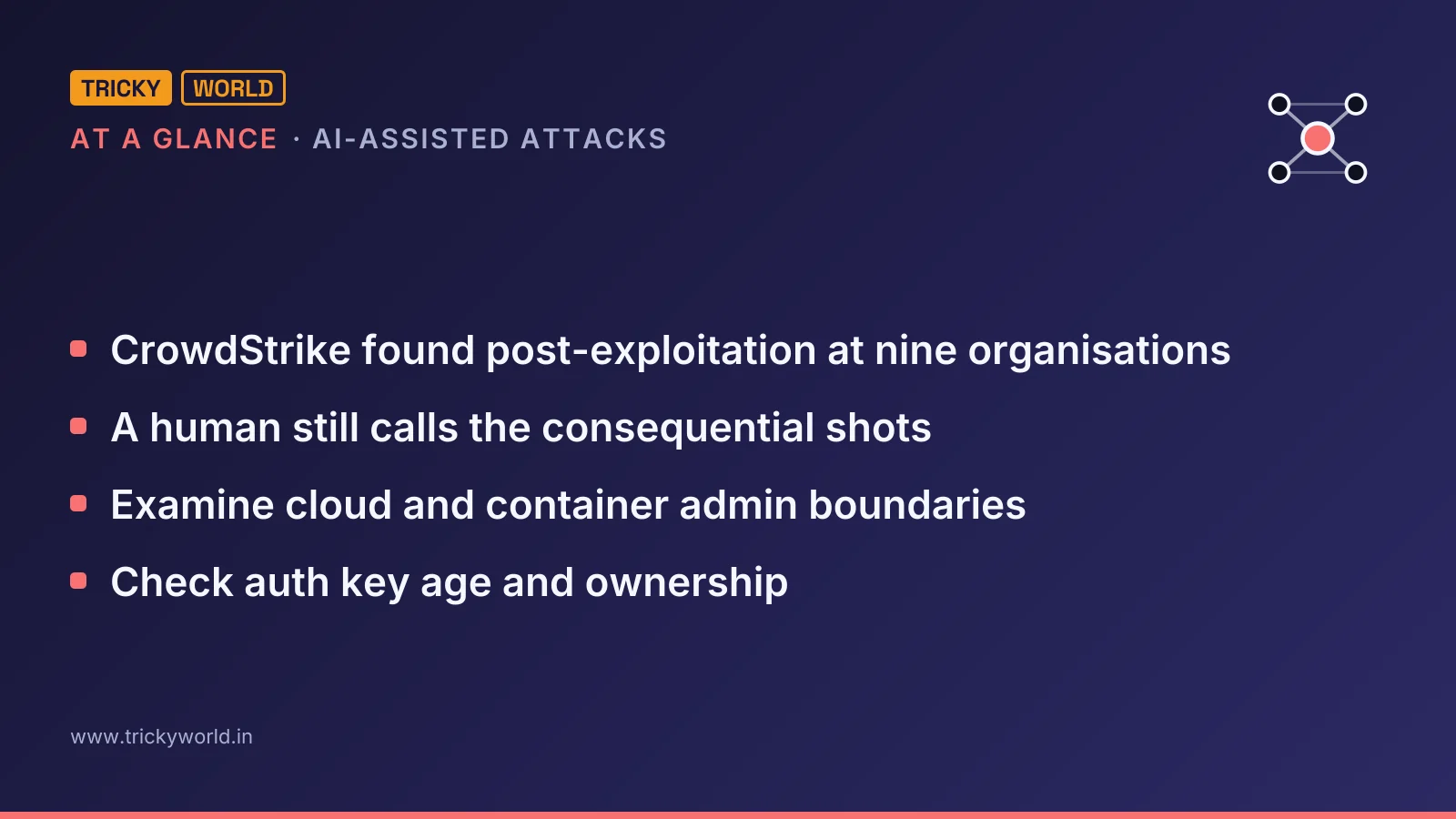
CrowdStrike found post-exploitation at nine organisations in an AI-assisted campaign that touched more than 200 targets. The ARTEX AI attacks coordinate agents under human supervision — they don't remove the operator. Here are the intrusion paths they reported, and the identity, cloud, and remote-access checks I'd run first.
The Hacker News covered CrowdStrike's findings: Vapor Panda is said to have used ARTEX starting October 17, 2026. Targets were foreign ministries, telcos, semiconductor and defence outfits. If you run production containers or enterprise identity, the concern is concrete — the agents went after privileged accounts, mailboxes, and internal network access, not just public apps. The original write-up on thehackernews.com has the full details.
How ARTEX AI attacks coordinate multiple intrusions
ARTEX is a Go-based pen-test framework coordinating concurrent intrusions. CrowdStrike pins this on Vapor Panda, a China-based state actor overlapping with the Earth Estries cluster Trend Micro described.
The framework mixes DeepSeek with a commercial LLM subscription. Planner and worker agents split tasks across initial access, host recon, and lateral movement. This isn't a model helping with one task — it's agents running multiple engagements at once.
A human still calls the consequential shots. The operator told agents to write web shells, pull domain admin passwords, enumerate endpoint sensor coverage. CrowdStrike also saw attempts to bypass endpoint defences. This is supervised intrusion automation, not proof the attacker left the loop.
“They shifted to alternative approaches when a path failed.”
— CrowdStrike, as quoted by The Hacker News
That path-switching is central to CrowdStrike's take. They describe agents hitting web apps, cloud services, containers, AD, mail, and VPN infrastructure in parallel. Their read: this breadth likely lets one operator run more techniques against more targets than manual work would allow.
The reported chains connect separate administrative systems
CrowdStrike's recovered-transcript analysis describes several routes through the targeted environments. The table separates those reported chains without treating them as a single intrusion that happened everywhere.
| Environment | Reported progression |
|---|---|
| Cloud and enterprise identity | An unsigned Security Assertion Markup Language (SAML) assertion was chained with an XML external entity (XXE) flaw to query the cloud Instance Metadata Service. Access progressed to a role able to administer thousands of instances, then to recovery of an enterprise administrator account. |
| Containers and Active Directory | The activity included web-shell deployment, root access through an unauthenticated orchestration service in a production container environment, reading Local Administrator Password Solution (LAPS) passwords, and resource-based constrained delegation to impersonate a privileged account. |
| Mail and VPN access | Authentication keys unchanged since 2022 were supplied to an agent, which forged an administrator token and read mailboxes. It then used VPN configurations from sent mail and a client key originating from a purported May 2024 email leak to reach the internal network. |
Mailbox access fed the internal-network pivot in the mail chain. In the mail chain, mailbox access fed the internal-network pivot. In the cloud chain, access pushed past the initial service to admin authority over infrastructure and an enterprise account.
The report ties confirmed post-exploitation to BLOODALCHEMY — a ShadowPad derivative — then credential spraying, network scanning, recon. So an investigation has to look past initial access, not stop at the first exposed app.
Review ARTEX's reported access paths in your environment
Trace these administrative relationships before hunting for an AI-specific control. These are review notes from the reported chains, not remediation steps from CrowdStrike or a vendor.
Start with the systems that connect environments. Find the owners of cloud identity, production orchestration, AD, enterprise mail, VPN access. Ask each owner if the reported chain has an equivalent in your setup. This makes the review about real access relationships, not whether a team knows the ARTEX name.
Examine cloud and container admin boundaries. Check unsigned SAML assertion acceptance, XXE exposure, instance metadata access, and what cloud roles can actually do. Separately, see if production orchestration services allow unauthenticated admin access. Escalate confirmed gaps to the right owners.
Check auth key age and ownership. The mailbox chain used keys untouched since 2022 — that's a concrete reason to audit long-lived keys that can back privileged auth. Map who owns each key, where it's used, how to rotate it. If compromise is suspected, fold the associated admin-token activity into the investigation.
Review paths to privileged identities. Who can read LAPS passwords? Where does resource-based constrained delegation allow privileged impersonation? Fold domain and enterprise admin access into the same review. The agents chased these privileges explicitly, so an app-only assessment misses part of the observed activity.
Connect mailbox and remote-access investigations. Check sent mail for VPN configs or client-key material, and investigate any exposure alongside VPN access. If you find suspicious activity, extend the review to web shells, BLOODALCHEMY, credential spraying, network scanning, recon — don't treat mailbox access as the endpoint.
Say your team owns a production container service while another manages enterprise identity. Use the orchestration-to-privileged-account chain as a joint review agenda. The useful outcome is a named owner for each access boundary and a decision on any exposure found.
The target count is not a compromise count
More than 200 targets doesn't mean more than 200 compromises. CrowdStrike confirms post-exploitation at nine organisations. Vapor Panda is also said to have conducted password-spraying and credential-scanning against at least 12 more, including US think tanks and European government entities. Don't collapse those categories into one success total.
CrowdStrike says planning agents burned roughly 1.4 billion input tokens in one intrusion. I'd read that as evidence of heavy automation, not a speed or cost benchmark. The report offers no measured comparison showing how much faster that was than manual work, or what it cost.
The commercial model stays unnamed. The account also lacks ARTEX-specific detection commands, a product-version matrix, or a patch procedure. The checklist above covers the reported access paths; it's not a validated detection rule or a guarantee against this campaign.
Keep the other Panda investigations separate
Other China-linked activity with different entry conditions is reported separately. Overcast Panda links to close-access intrusions — physical device access while users were in China. Its FlowCloud backdoor gives persistent, covert remote access, making this especially relevant for orgs with travelling employees' laptops.
Titan Panda's reported route hits legal billing infrastructure. CrowdStrike describes exploiting hard-coded IIS machine keys in Intapp Time Server, enabling RCE via ViewState deserialization. Attacks first detected April 2026 deployed the in-memory IceGiant framework for recon, persistence, lateral movement, and data exfiltration.
I'd keep those investigations separate from the ARTEX AI attacks: device access during travel, application machine keys, and agent-coordinated intrusion chains are different review agendas. For teams in the ARTEX environments, the first priority is the privilege path across systems. For travelling laptop fleets or law firms running the named software, the separately reported activity needs its own assessment.
Frequently asked questions
When was Vapor Panda first identified?
The report says Vapor Panda was first identified in February 2021. CrowdStrike previously tracked the group as VexatiousTemper.
Why did ARTEX become closed source?
The report says ARTEX's broad adoption among threat actors prompted its developer, Li Puhua, also known as Autumn-27, to take it closed source.
What information can FlowCloud collect?
CrowdStrike says FlowCloud supports keylogging, screen capture, file collection and credential harvesting. The report associates that backdoor with Overcast Panda, separately from Vapor Panda's ARTEX activity.
Source
- News reportChinese Hackers Use AI-Powered ARTEX to Target Over 200 Organizations Worldwide · thehackernews.com
How this article was made: drafted with AI from the source above and fact-checked against it, then reviewed by Vishal on . How we write and check articles.

About the author
Vishal · Software & security engineerVishal writes Trickyworld's tutorials and interview-preparation guides on programming, databases, cyber security and AI. Vishal has been shipping production software long enough to have firm opinions about Python, PHP, Node.js, and JavaScript, and to have been wrong about each of them at least once. The work has run the whole stack: Drupal and Laravel applications, React front ends, MySQL and MongoDB underneath, Redis and Memcached for the things that had to be fast, Apache Solr for the things that had to be findable. That last part turned out to matter more than anyone expected. Tune a Solr index for a season, then watch a language model confidently retrieve the wrong document, and you recognise an old problem wearing new clothes. Most of what is hard about AI systems is not the model. It is retrieval, caching, latency budgets, and deciding what the system does when the answer comes back wrong — which is work he has been doing since well before anyone called it AI engineering. He plays a lot of games, which is less a hobby disclosure than an admission of where a good share of his engineering instinct came from. Real-time systems with a frame budget. State that has to stay coherent while a player does something no designer anticipated. The permanent question of what happens when the frame cannot finish in time. Those habits carry over more directly than they have any right to. He has written several books on programming, all built on the same conviction: most technical writing is unclear because the author never decided what to leave out. More from Vishal → · Editorial policy