CVE-2026-19868: SonicOS authentication bypass risk
CVE-2026-19868 is an exploited SonicOS SSL-VPN flaw that may let users with valid alternate-method credentials bypass SAML-enforced MFA. SonicWall urges updates; confirm the exact firmware with the vendor because NVD publishes neither affected versions nor a fixed version. After updating, verify retained alternate authentication paths, not just SAML login.
Summary written with AI from this article, and checked against it.

Affected systems and impact
| Flaw | Affected systems | Impact |
|---|---|---|
| CVE-2026-107155Permissive cross-domain policy | SonicOS management interface; versions not stated | May allow a remote unauthenticated attacker to perform unauthorized operations under specific conditions |
| CVE-2026-107154Session validation weakness | SonicOS management interface; versions not stated | May allow a remote unauthenticated attacker to perform unauthorized operations under specific conditions |
| CVE-2026-19868Authentication enforcement weakness across alternate authentication methods | SonicOS SSL-VPN service accepting alternate authentication methods alongside SAML; affected-version range not stated | Users with valid credentials for an alternate authentication method may bypass SAML-enforced MFA |
| CVE-2026-82308Pre-authentication heap-based buffer overflow | SonicOS SSL-VPN service; versions not stated | May allow a remote unauthenticated attacker to cause application-level denial-of-service |
| CVE-2026-109593Not stated | End-of-life Global Management System (GMS) systems | Not stated |
| CVE-2026-109594Not stated | End-of-life Global Management System (GMS) systems | Not stated |
At a glanceCVE-2026-19868
CVE-2026-19868 has a CVSS 3.1 base score of 7.5 (High) from CISA. No fixed version has been published yet.
| Severity | 7.5 High (CVSS 3.1, CISA) |
|---|---|
| Fixed in | No fixed version published yet |
| Affected | Not published yet |
| Exploited | Yes: in CISA's Known Exploited Vulnerabilities catalog since November 6, 2026 |
| EPSS | 0.6% chance of exploitation in the next 30 days (FIRST, November 8, 2026) |
| Public exploit | 2 GitHub repositories name it: proofs of concept, scanners, detections. Unverified: some are fake or malicious. |
| Vector | CVSS:3.1/AV:N/AC:H/PR:N/UI:N/S:C/C:H/I:L/A:N |
| Weakness | CWE-308 |
| Ubuntu | Not tracked yet |
| Debian | Listed, no packages yet |
| Red Hat | Not tracked yet |
Is there a public exploit for CVE-2026-19868?
Yes: CVE-2026-19868 is exploited in the wild. CISA added it to its Known Exploited Vulnerabilities catalog on November 6, 2026. 2 public GitHub repositories name it: proofs of concept, scanners and detections. None of it is verified: some such repositories are fake or carry malware, so read the code before running it, and only against systems you own. FIRST's EPSS puts the chance of exploitation in the next 30 days at 0.6%, higher than 50% of scored CVEs.
Valid credentials for an alternate login method may let a SonicOS SSL-VPN user bypass SAML-enforced multi-factor authentication (MFA), according to SonicWall. CVE-2026-19868 is now in CISA's exploited-vulnerability catalog. SonicWall urges customers to update, but NVD's record does not yet publish a fixed version. That leaves two immediate jobs: check which authentication paths the service accepts, and confirm which update addresses the flaw.
An MFA requirement on the intended SonicOS SSL-VPN sign-in path is not enough to dismiss this advisory. The Hacker News reports that SonicWall investigated a report of potential exploitation and urged customers to update as soon as possible. The question is not just whether the usual login asks for MFA. It is whether another accepted authentication method can avoid the SAML controls that your access policy depends on.
Check SonicOS login paths before choosing an update
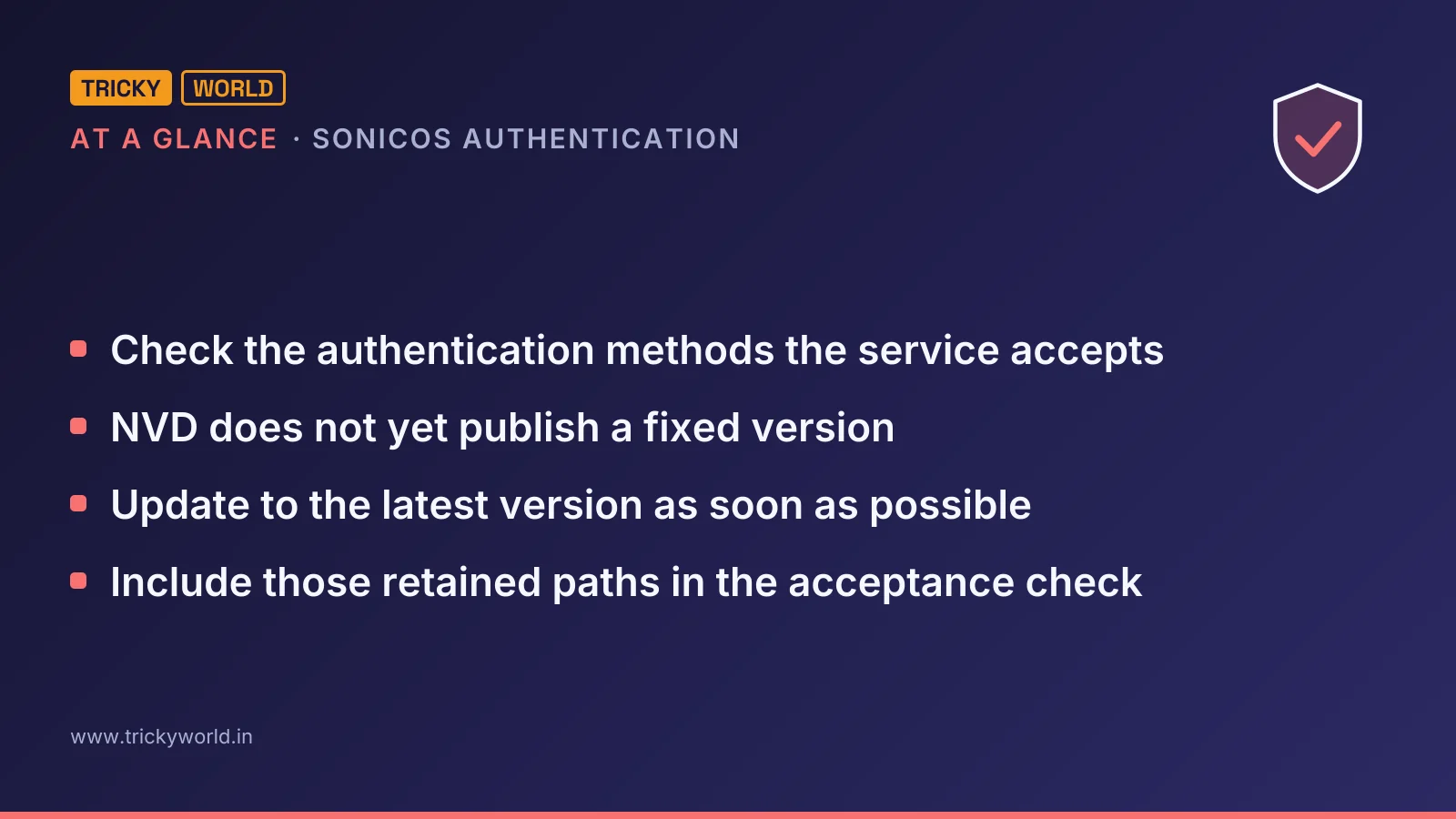
Check the authentication methods the service accepts, not only whether SAML-enforced MFA is configured. SonicWall's description of CVE-2026-19868 specifically involves valid credentials for an alternate method. Start the review with those methods and their relationship to SAML, rather than treating the presence of an MFA setting as the answer.
Record the installed SonicOS version on each appliance under review. Keep that information with the update decision so it is available when confirming the target firmware. Do not declare an appliance fixed against an assumed version cutoff, though: NVD does not yet publish a fixed version.
Review the authentication methods accepted by the SSL-VPN service. Identify where SAML is intended to enforce access and MFA, then check whether the service also accepts another authentication method. The question to answer is whether your configuration contains the alternate-method condition SonicWall describes, not simply whether SAML is enabled.
Ask SonicWall to identify the appropriate updated firmware for the installed version and appliance. The vendor's published recommendation is to update to the latest version as soon as possible. Get that update target confirmed rather than trying to infer a build number from the vulnerability identifier; the identifier does not supply the missing version information.
After applying the vendor-identified update, verify the intended sign-in behaviour and review any alternate authentication methods you deliberately retain. Include those retained paths in the acceptance check. A successful SAML login tests the intended route, but it does not by itself answer the question about the other accepted methods.
This sequence is for review and verification, not for testing a bypass. SonicWall's reported recommendation is to update to the latest version as soon as possible, while the NVD details checked on November 9, 2026 do not yet identify a fixed version.
How CVE-2026-19868 crosses the SAML boundary
CVE-2026-19868 is in authentication enforcement across different methods. SonicWall describes a user who already has valid credentials for an alternate method potentially getting around the SAML authentication controls applied to SSL-VPN access. The distinction between those methods is central to the description:
“An authentication enforcement vulnerability in SonicOS SSL-VPN service may allow a user with valid credentials for an alternate authentication method to bypass SAML authentication controls.”
— SonicWall, in its advisory reported by The Hacker News
The credential prerequisite matters here. SonicWall does not describe a bypass requiring no credentials at all. But having valid credentials for an alternate method is not the same as completing the SAML-controlled authentication flow, either. The flaw matters because that SAML-controlled flow may be the path enforcing MFA.
Consider a deployment where the intended SSL-VPN sign-in route uses SAML-enforced MFA while another authentication method remains available. This is a hypothetical review scenario, not a reported incident. Checking only the intended route in that scenario would still leave the advisory's central condition unanswered: what happens through the other accepted method?
SonicWall also keeps the outcome conditional: successful exploitation may bypass SAML-enforced MFA. In incident tickets or management briefings, state that the advisory does not establish that every deployment permits the bypass. It does not establish that every SonicOS deployment, or every configuration with an alternate authentication method, permits the bypass.
Proving that the expected login flow requests MFA is one check. Establishing that accepted alternatives cannot avoid the intended authentication controls is another. For this advisory, the second check needs explicit attention rather than being treated as something the first check has already settled.
CISA's catalog entry raises the patching priority
CISA added CVE-2026-19868 to its Known Exploited Vulnerabilities (KEV) catalog on November 6, 2026. That entry is the basis for treating the flaw as an exploited vulnerability, rather than only as a theoretical weakness in authentication enforcement.
SonicWall's public account says less about the activity itself. The company says it investigated a report indicating potential exploitation, but it has not disclosed further specifics about the nature of the attack or who was responsible. Keep those statements together when describing the status: CISA has cataloged CVE-2026-19868 as exploited, and the vendor has not published a detailed account of the reported activity.
My priority would be to confirm the update path promptly, without waiting for a fuller attack narrative. That is a patching judgement based on CISA's listing and SonicWall's update advice. It is not evidence that any particular organisation has been compromised, and it should not be presented as such.
The Hacker News reports a November 20, 2026 patching recommendation for Federal Civilian Executive Branch (FCEB) agencies. As of November 9, that date is still ahead. The scope matters: it is a federal-agency recommendation, not a universal deadline that applies to every SonicWall customer.
For other organisations, SonicWall's advice is still to update as soon as possible. The federal date is not evidence that leaving an appliance unchanged until then is safe. It gives the federal response a target date; it does not identify a period during which the vulnerability presents no risk.
The accompanying fixes reach beyond SAML authentication
SonicWall also patched separate issues in the SonicOS management interface and SSL-VPN service. A review of alternate authentication paths addresses the circumstances described for CVE-2026-19868. It does not address these other reported weaknesses, so the authentication review and the accompanying fixes are not interchangeable pieces of work.
The accompanying flaws affect the following interfaces and services. SonicWall's descriptions, as reported by The Hacker News, give these potential consequences:
| Vulnerability | Interface or service | Potential consequence |
|---|---|---|
| CVE-2026-107155 | SonicOS management interface | A permissive cross-domain policy could allow a remote unauthenticated attacker to perform unauthorized operations under specific conditions. |
| CVE-2026-107154 | SonicOS management interface | A session validation weakness could allow a remote unauthenticated attacker to perform unauthorized operations under specific conditions. |
| CVE-2026-82308 | SonicOS SSL-VPN service | A pre-authentication heap-based buffer overflow could allow a remote unauthenticated attacker to cause application-level denial-of-service. |
These distinctions help when assigning the work. The management-interface findings concern potentially unauthorized operations, while the buffer overflow is described as an availability issue. The reporting does not describe that overflow as remote code execution. There is no reason to replace the stated consequence with a different one in a patch ticket.
CISA's catalog does not list these three accompanying vulnerabilities in the November 9 details. That difference in catalog status is not proof that exploitation is impossible. The descriptions also retain their conditions and possibilities; they do not say that every exposed interface can be attacked successfully.
For the patch ticket, I would ask for confirmation that the chosen vendor update addresses the relevant SonicOS advisories. Closing only an MFA-policy review would leave the other reported fixes outside the acceptance check, even though they concern the same software being reviewed for an update.
Keep the separate GMS migration advice separate
SonicWall's other recent warning concerns two unpatched vulnerabilities in end-of-life Global Management System (GMS) systems: CVE-2026-109593 and CVE-2026-109594. For those systems, SonicWall urges customers to upgrade to Network Security Manager (NSM); for SonicOS, it recommends a software update. The NSM migration is not the fix for the SSL-VPN authentication bypass. Teams managing both products should record the SonicOS firmware-update decision and the GMS management-product migration decision separately, rather than combine them into a generic SonicWall update task.
The missing fixed build limits version-only checks
No fixed version is published yet in the NVD details checked on November 9, 2026. Those details do not provide an affected-version range, either. Without those boundaries, the NVD record cannot supply a reliable version-only answer to whether a particular appliance is vulnerable or already fixed.
That missing metadata is different from an absence of a patch announcement. The Hacker News reports that SonicWall has patched the issues and advises customers to update. NVD's lack of a fixed-version value does not establish that no patch exists. It means the public record does not yet supply the build number needed to make an independent comparison against an installed version.
The reporting cited here documents SonicWall's recommendation to update, not a specific interim configuration workaround for CVE-2026-19868. Switching authentication methods, disabling an option or changing a policy therefore cannot be presented here as a vendor-confirmed mitigation. An internal decision to alter access is still an internal decision; it needs to remain distinct from a documented fix for this advisory.
The choice is not between trusting MFA and abandoning it. The work is to verify whether the service enforces the intended authentication controls across the methods it accepts, then apply the vendor-confirmed update. Until a fixed build is published, citing an invented version boundary is not a responsible basis for closing CVE-2026-19868.
Attach SonicWall's confirmation of the exact firmware addressing the advisory to the change record, giving the latest-version update decision a concrete target and supporting evidence rather than an assumed build number.
Frequently asked questions
What severity does CISA assign to CVE-2026-19868?
CISA assigns a CVSS 3.1 score of 7.5, rated High, in the NVD details checked on November 9, 2026. That is the attributed score to use rather than an unattributed severity figure.
Is verified public exploit code available for CVE-2026-19868?
PoC-in-GitHub lists two GitHub repositories that name the vulnerability, but the listing is unverified. Their presence does not establish that a working public exploit has been validated.
Has NVD completed its analysis of these SonicOS vulnerabilities?
As checked on November 9, 2026, NVD marks CVE-2026-19868 as Undergoing Analysis. It marks CVE-2026-107155, CVE-2026-107154 and CVE-2026-82308 as Awaiting Analysis.
Sources
Primary sources
- CVE recordNVD and distribution data for CVE-2026-19868, CVE-2026-107155, CVE-2026-107154, CVE-2026-82308 (checked 2026-11-09) · nvd.nist.gov
Reports of the story
- News reportCISA Flags SonicWall SonicOS MFA Bypass Flaw Amid Reports of Possible Exploitation · thehackernews.com
How this article was made: drafted with AI from the sources above and fact-checked against them, then reviewed by Vishal on . How we write and check articles.

About the author
Vishal · Software & security engineerVishal writes Trickyworld's tutorials and interview-preparation guides on programming, databases, cyber security and AI. Vishal has been shipping production software long enough to have firm opinions about Python, PHP, Node.js, and JavaScript, and to have been wrong about each of them at least once. The work has run the whole stack: Drupal and Laravel applications, React front ends, MySQL and MongoDB underneath, Redis and Memcached for the things that had to be fast, Apache Solr for the things that had to be findable. That last part turned out to matter more than anyone expected. Tune a Solr index for a season, then watch a language model confidently retrieve the wrong document, and you recognise an old problem wearing new clothes. Most of what is hard about AI systems is not the model. It is retrieval, caching, latency budgets, and deciding what the system does when the answer comes back wrong — which is work he has been doing since well before anyone called it AI engineering. He plays a lot of games, which is less a hobby disclosure than an admission of where a good share of his engineering instinct came from. Real-time systems with a frame budget. State that has to stay coherent while a player does something no designer anticipated. The permanent question of what happens when the frame cannot finish in time. Those habits carry over more directly than they have any right to. He has written several books on programming, all built on the same conviction: most technical writing is unclear because the author never decided what to leave out. More from Vishal → · Editorial policy