CVE-2026-125396: Check Ghostscript behind uploads
CVE-2026-125396 is a use-after-free in Ghostscript’s font-loading code that lets crafted documents escape its sandbox and execute commands. Debian lists fixed packages; Ubuntu is still assessing its releases. Update the renderer actually used by upload, preview and print features: host updates do not replace copies bundled in containers or applications.
Summary written with AI from this article, and checked against it.

Affected systems and impact
| Flaw | Affected systems | Impact |
|---|---|---|
| CVE-2026-125396Use-after-free in Ghostscript’s font-loading code | Ghostscript reached through upload, preview and print features, including paths through ImageMagick, Pillow, libvips and a Qt plugin | Sandbox escape and server-side command execution as the low-privilege rendering account |
| CVE-2026-65640WordPress upload-path flaw | WordPress | Not stated |
At a glanceCVE-2026-125396
CVE-2026-125396 has a CVSS 4.0 base score of 8.5 (High) from Vulncheck, and 7.8 (High, CVSS 3.1) from Vulncheck. No fixed version has been published yet. Debian bookworm fixed it in ghostscript 10.0.0~dfsg-11+deb12u9.
| Severity | 8.5 High (CVSS 4.0, Vulncheck) · 7.8 High (CVSS 3.1, Vulncheck) |
|---|---|
| Fixed in | No fixed version published yet |
| Affected | Not published yet |
| Exploited | Not in CISA's Known Exploited Vulnerabilities catalog |
| EPSS | 0.2% chance of exploitation in the next 30 days (FIRST, November 21, 2026) |
| Public exploit | 1 GitHub repository names it: proofs of concept, scanners, detections. Unverified: some are fake or malicious. |
| Vector | CVSS:4.0/AV:L/AC:L/AT:N/PR:N/UI:P/VC:H/VI:H/VA:H/SC:N/SI:N/SA:N/E:X/CR:X/IR:X/AR:X/MAV:X/MAC:X/MAT:X/MPR:X/MUI:X/MVC:X/MVI:X/MVA:X/MSC:X/MSI:X/MSA:X/S:X/AU:X/R:X/V:X/RE:X/U:X |
| Weakness | CWE-648 |
| Ubuntu | 26.04 resolute ghostscript: Being assessed · 24.04 noble ghostscript: Being assessed · 22.04 jammy ghostscript: Being assessed · 20.04 focal ghostscript: Being assessed · 18.04 bionic ghostscript: Being assessed · 16.04 xenial ghostscript: Being assessed |
| Debian | bookworm ghostscript: Fixed (10.0.0~dfsg-11+deb12u9) · trixie (security), trixie ghostscript: Fixed (10.05.1~dfsg-1+deb13u3) · forky, sid ghostscript: Fixed (10.08.0~dfsg-2) |
| Red Hat | Not tracked yet |
Is there a public exploit for CVE-2026-125396?
Public code exists as of November 22, 2026: 1 public GitHub repository names it (proofs of concept, scanners and detections). It is not in CISA's Known Exploited Vulnerabilities catalog. None of it is verified: some such repositories are fake or carry malware, so read the code before running it, and only against systems you own. FIRST's EPSS puts the chance of exploitation in the next 30 days at 0.2%, higher than 5.6% of scored CVEs.
pwn.ai demonstrated server-side command execution through ordinary upload, preview and print features in about ten applications. The flaw, CVE-2026-125396, lets a crafted file escape Ghostscript’s sandbox. Debian lists fixed packages; Ubuntu is still assessing its releases. Find the renderer those features actually use, then choose a package target.
For a team running document previews, image uploads or shared printing, Ghostscript may be hidden behind another library. The report describes pwn.ai’s research, which found paths through ImageMagick, Pillow, libvips and a Qt plugin. A thumbnail or crop operation can start Ghostscript without the application calling it directly. Miss that dependency, and a patching exercise can leave out the very worker that renders the incoming files.
Check Ghostscript where the rendering actually happens
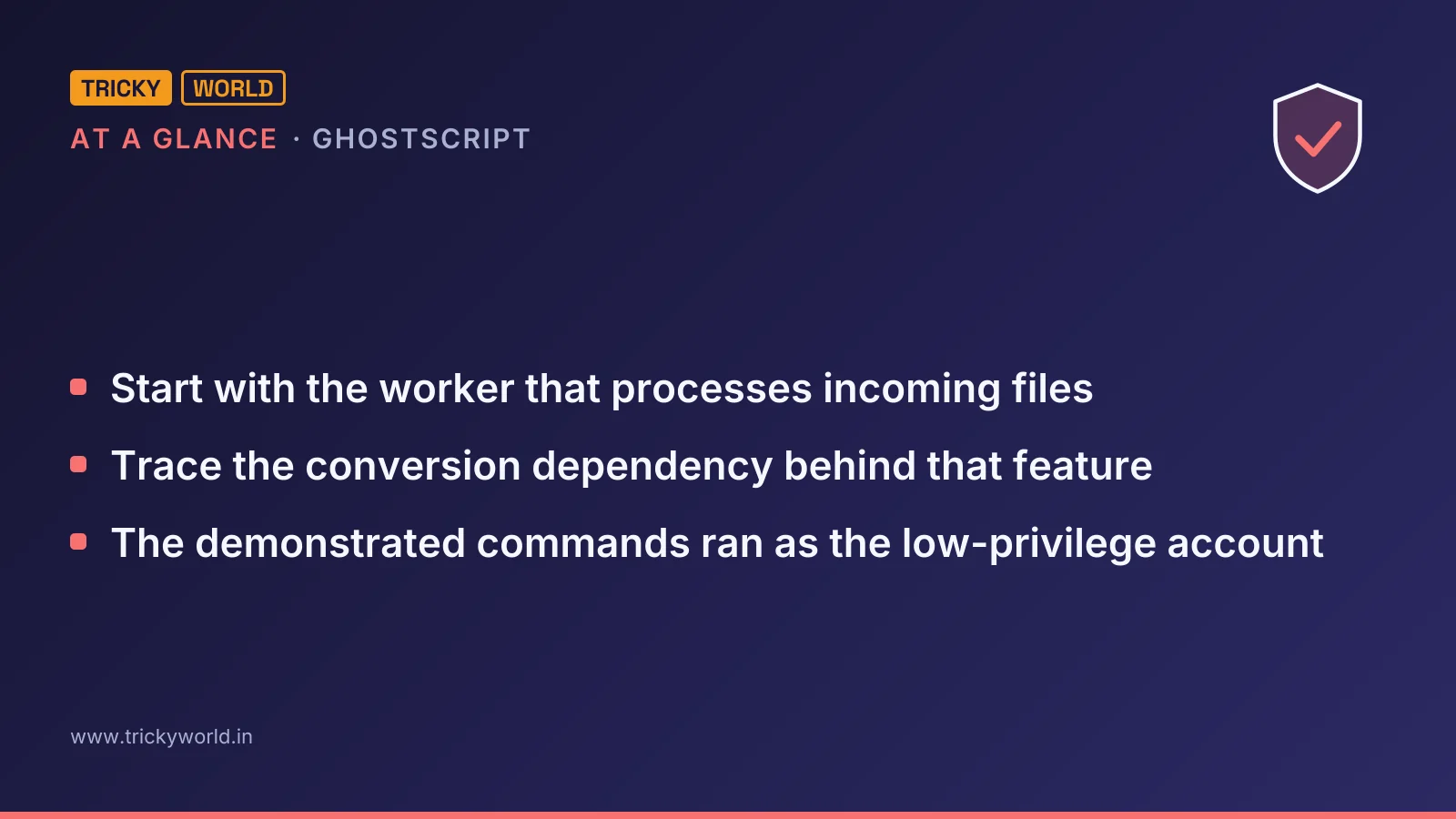
The renderer’s environment is the one that matters. Replacing a host operating-system package does not replace a separate Ghostscript copy bundled in a container image or application. Start with the worker that processes incoming files.
Identify the feature that handles outside documents. Include upload forms, attachment previews, image transformations and print queues in that check. The researchers demonstrated routes through those kinds of features, so do not limit the search to code that explicitly mentions Ghostscript.
Trace the conversion dependency behind that feature. Check whether ImageMagick, Pillow, libvips or a Qt plugin hands PostScript content to Ghostscript. Follow the conversion through to the interpreter; the application’s own dependency list may not make that final hand-off obvious.
Locate the Ghostscript installation used by that processing environment. Separate the host package from copies inside containers or application bundles before deciding which installation needs replacement.
Compare that installation’s package details with its distribution’s tracker. Where the tracker lists a fixed package for CVE-2026-125396, use that distribution-specific target. Do not assume that every installation needs to share an upstream-looking version number to count as fixed.
Consider a service whose web application sends uploaded documents to a containerised worker. Check whether the updated package or application image reaches the environment that performs the conversion. Do not mark a containerised worker complete on the strength of its host’s updated package inventory.
How a harmless-looking upload reaches the interpreter
A file named with a .png, .jpg or .pdf extension can still carry PostScript or EPS content to Ghostscript. That is one of the routes described in the research. The filename does not reliably describe what the rendering chain will process, and the exact path to the interpreter depends on the libraries the application uses.
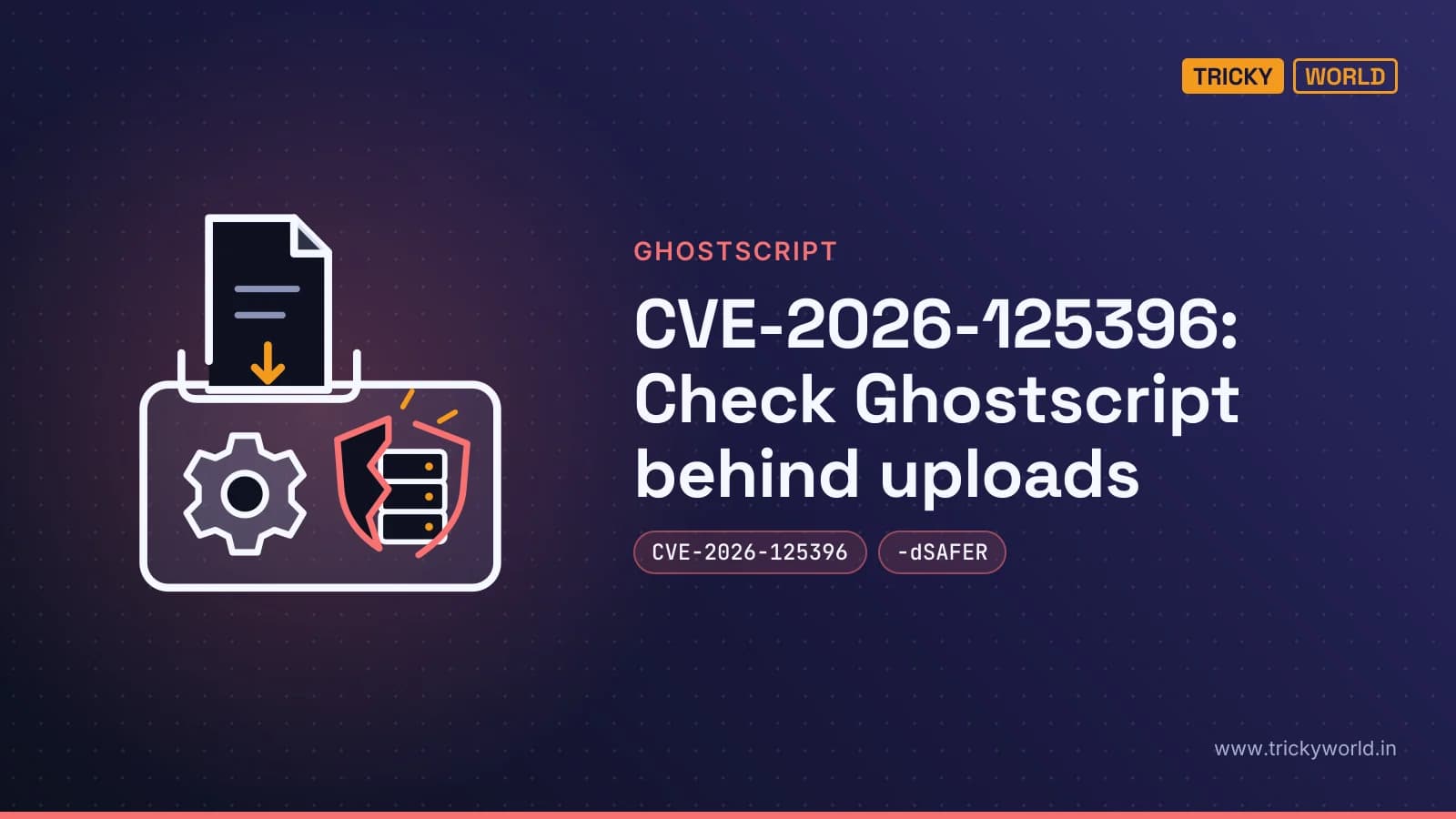
CVE-2026-125396 is a use-after-free in Ghostscript’s font-loading code. A crafted document can exploit it to disable checks enforced by -dSAFER, the sandbox intended to stop documents from executing commands or accessing files. Accepting a document is only the start of the problem here. Once the document reaches Ghostscript, it can undermine the interpreter’s own restrictions.
Some demonstrated paths required no login; WordPress required permission to upload files. These are the conditions described for several of pwn.ai’s application paths, along with the action that triggered processing in each case.
| Tested application path | Access described | Processing trigger |
|---|---|---|
| Shared Debian 13 print queue | No login | An anonymous print job |
| Roundcube webmail | No login for the tested delivery path | The recipient opens a message containing the attachment |
| Forminator and Essential Addons for Elementor | Public upload forms | A file upload |
| WordPress Core | An account permitted to upload files; Authors and higher have this by default | A file upload |
Do not use the CVE’s local classification to settle whether a web application is exposed. The researchers reached the interpreter over the network through application features, as the access conditions above show. An attacker does not necessarily need a login on the rendering server: another service can accept the document and start the interpreter on the attacker’s behalf.
The demonstrated commands ran as the low-privilege account responsible for rendering. That is server-side command execution, not evidence of administrator-level access. The distinction matters when assessing a document worker. Keep the demonstrated execution separate from assumptions about what the account can do, then assess the permissions and controls around that worker.
Choose a package for CVE-2026-125396
Debian’s tracker gives concrete distribution-package targets for CVE-2026-125396. According to the NVD record and distribution status information checked on November 22, Debian Bookworm is fixed in ghostscript 10.0.0~dfsg-11+deb12u9. For Debian Trixie, including its security entry, the fixed package is ghostscript 10.05.1~dfsg-1+deb13u3. Those are package targets for the named distributions, rather than a single version to apply everywhere.
That changes an important detail from the earlier reporting. pwn.ai’s survey listed Debian 12 Bookworm as vulnerable; the current Debian tracker lists a fixed package instead. For a Debian deployment, base the update decision on the tracker’s current package status, rather than carrying forward the older survey result as though the package status had not changed.
The publications also disagree in a way that needs to stay visible. The news report describes an upstream fix, but NVD remains at Awaiting Analysis and does not yet publish a fixed upstream version. Debian independently lists the distribution-specific fixes above. Those entries do not establish a universal version boundary for every Ghostscript build, so they cannot fill that gap in the upstream information.
Ubuntu’s tracker marks Ghostscript as Being assessed for 26.04, 24.04, 22.04, 20.04, 18.04 and 16.04. That tells us the assessment status; it does not give us a published fixed-package target. Nor does it establish that every application running on those releases exposes a working route to the interpreter. Package status and application reachability are separate checks.
Where a tracker confirms a fixed package, apply that update and verify that it reached the application’s rendering environment. The earlier survey described other distribution fixes as pending or in progress, but it did not establish the current status of several Red Hat-related distributions or stable Fedora. For those deployments, check the relevant tracker rather than treating missing current information as a clean bill of health.
A working demonstration is not evidence of attacks
The evidence supports demonstrated exploitation paths, not a claim of observed attacks. The report says there have been no reports of this flaw being used in attacks, and CISA’s catalog does not list CVE-2026-125396 as of November 22. Neither proves that exploitation cannot occur.
One published proof-of-concept file described in pwn.ai’s technical analysis shows only the core memory manipulation. It changes a value inside the running interpreter, then restores that value. It does not start a shell or touch host files. That demonstrates the core memory manipulation, but it does not demonstrate the complete effect of every upload-to-command-execution path described in the research. For separate reading, see the Medusa ransomware analysis.
Do not postpone a confirmed fix for CVE-2026-125396 because no attacks have been reported or because the public proof-of-concept stops short of starting a shell. The reverse inference is also a mistake: an application name appearing in the research does not prove that every deployment of that application is reachable in the same way. The route still depends on the libraries, accepted content and access requirements in that deployment.
The report says Artifex is moving the vulnerable internal operation into safer code. It describes that work as ongoing. That is not evidence that every downstream package has received the necessary changes, and it says nothing conclusive about whether a copy bundled with an application has received them either.
Reduce Ghostscript exposure while packages catch up
Authenticate print queues, restrict accepted content and review renderer confinement while waiting for packages to break the demonstrated route or restrict what the renderer can do. The research identifies practical measures for both. None replaces the work of getting the corrected renderer into the environment that processes the file, even if a control interrupts one of the tested paths.
Require authentication on shared print queues. This reduces the anonymous submission path demonstrated against the Debian queue. It does not remove CVE-2026-125396, so treat it as a change to who can submit a job, not as a Ghostscript fix.
Limit the file types accepted by image-processing features. Review what content the conversion chain accepts, rather than checking filename extensions alone. Disguised PostScript content reached Ghostscript in the research, which is why the content reaching the converter matters here.
Check the system controls surrounding the renderer. In one reported test, an AppArmor profile prevented the compromised interpreter from starting a shell. That is a useful containment result for that test. It is not a guarantee that every profile will produce the same result.
For WordPress, the report describes a separate upload-path fix under CVE-2026-65640. The WordPress fix and the Ghostscript fix address different links in the chain; neither stands in for the other. Updating WordPress does not remove the need to update an affected renderer. Updating Ghostscript likewise does not replace the application-side fix.
Public upload processors, anonymously accessible print queues and attachment-rendering services belong at the front of this work queue because they are demonstrated entry routes, not hypothetical categories. For CVE-2026-125396, check the renderer used by each application for a confirmed fix, then check that the application-level controls on the route into it have been addressed.
Frequently asked questions
Which Ghostscript package does Debian list for Forky and Sid?
Debian’s tracker lists Ghostscript as fixed in 10.08.0~dfsg-2 for both Forky and Sid.
Why are both 8.5 and 7.8 severity scores associated with this CVE?
Vulncheck supplies both scores: 8.5 High under Common Vulnerability Scoring System (CVSS) 4.0 and 7.8 High under CVSS 3.1. They use different scoring-system versions and are not NVD’s own assessment.
Does the GitHub repository listing verify a working exploit?
No. PoC-in-GitHub lists one repository naming the CVE, Mahgal/upload2shell-check, and marks the listing as unverified. Its presence alone does not validate an exploit or establish that a particular deployment is vulnerable.
Sources
Primary sources
- CVE recordNVD and distribution data for CVE-2026-125396 (checked 2026-11-22) · nvd.nist.gov
Reports of the story
- News reportResearchers Demonstrate Ghostscript Sandbox-Escape RCE via Crafted File Uploads in Popular Apps · thehackernews.com

About the author
Vishal · Software & security engineerVishal writes Trickyworld's tutorials and interview-preparation guides on programming, databases, cyber security and AI. Vishal has been shipping production software long enough to have firm opinions about Python, PHP, Node.js, and JavaScript, and to have been wrong about each of them at least once. The work has run the whole stack: Drupal and Laravel applications, React front ends, MySQL and MongoDB underneath, Redis and Memcached for the things that had to be fast, Apache Solr for the things that had to be findable. That last part turned out to matter more than anyone expected. Tune a Solr index for a season, then watch a language model confidently retrieve the wrong document, and you recognise an old problem wearing new clothes. Most of what is hard about AI systems is not the model. It is retrieval, caching, latency budgets, and deciding what the system does when the answer comes back wrong — which is work he has been doing since well before anyone called it AI engineering. He plays a lot of games, which is less a hobby disclosure than an admission of where a good share of his engineering instinct came from. Real-time systems with a frame budget. State that has to stay coherent while a player does something no designer anticipated. The permanent question of what happens when the frame cannot finish in time. Those habits carry over more directly than they have any right to. He has written several books on programming, all built on the same conviction: most technical writing is unclear because the author never decided what to leave out. More from Vishal → · Editorial policy