CVE-2026-129448: Roller 6.1.5 fixes exploited flaw
Apache Roller 6.1.5 fixes CVE-2026-129448, an actively exploited XML-RPC deserialization flaw allowing unauthenticated remote code execution in releases from 4.0 up to, but not including, 6.1.5. Upgrade affected deployments to 6.1.5; Cisco Expressway and VMware Cloud Foundation also have listed fixes, while SAP’s exact fixed version still needs vendor confirmation.
Summary written with AI from this article, and checked against it.

Affected systems and impact
| Flaw | Affected systems | Impact |
|---|---|---|
| CVE-2026-129448XML-RPC vendor extension types deserialized before authentication | Apache Roller 4.0 up to, but not including, 6.1.5 | Unauthenticated remote code execution |
| CVE-2026-76466Hard-coded credentials | Cisco Expressway before x15.5.20; clustered devices with network access and persistent cookies | Unauthenticated attackers could execute commands as root through the database service |
| CVE-2026-123890Authentication bypass using an alternate path or channel | VMware Cloud Foundation 5.0 through releases before 5.2.5; network access to vCenter required | Unauthenticated attackers could bypass authentication and gain unauthorised access |
| CVE-2025-42884Injection of JNDI environment properties or a URL during lookup operations | SAP NetWeaver Enterprise Portal 7.50 | Unauthenticated attackers could disclose or modify server information |
At a glanceCVE-2026-129448
CVE-2026-129448 has a CVSS 3.1 base score of 9.8 (Critical) from Apache. It is fixed in Apache roller 6.1.5.
| Severity | 9.8 Critical (CVSS 3.1, Apache) |
|---|---|
| Fixed in | Apache roller 6.1.5 |
| Affected | Apache roller 4.0 – before 6.1.5 |
| Exploited | Yes: in CISA's Known Exploited Vulnerabilities catalog since November 20, 2026 |
| EPSS | 5.5% chance of exploitation in the next 30 days (FIRST, November 21, 2026) |
| Public exploit | 3 GitHub repositories name it: proofs of concept, scanners, detections. Unverified: some are fake or malicious. |
| Vector | CVSS:3.1/AV:N/AC:L/PR:N/UI:N/S:U/C:H/I:H/A:H |
| Weakness | CWE-502 Deserialization of Untrusted Data |
| Ubuntu | Not tracked yet |
| Debian | Listed, no packages yet |
| Red Hat | Not tracked yet |
Is there a public exploit for CVE-2026-129448?
Yes: CVE-2026-129448 is exploited in the wild. CISA added it to its Known Exploited Vulnerabilities catalog on November 20, 2026. 3 public GitHub repositories name it: proofs of concept, scanners and detections. None of it is verified: some such repositories are fake or carry malware, so read the code before running it, and only against systems you own. FIRST's EPSS puts the chance of exploitation in the next 30 days at 5.5%, higher than 92.9% of scored CVEs.
Apache Roller’s XML-RPC flaw is under active exploitation, according to CISA’s Known Exploited Vulnerabilities (KEV) catalog. CVE-2026-129448 affects Roller releases from 4.0 up to, but not including, 6.1.5; the listed fix is 6.1.5. Start by checking the release actually installed on each Roller deployment. The Cisco, SAP and VMware issues added alongside it also need attention, but their patch targets and the limits of the reporting need to stay attached to the right products.
CISA added all four vulnerabilities to the catalog on November 20, 2026. The Hacker News report says Federal Civilian Executive Branch (FCEB) agencies have been urged to patch by November 23, 2026. The concern for teams running these products goes beyond a vulnerability score. CISA records exploitation, while the reported vulnerabilities could allow remote code execution, commands run as root and unauthorised access.
Check Apache Roller for CVE-2026-129448
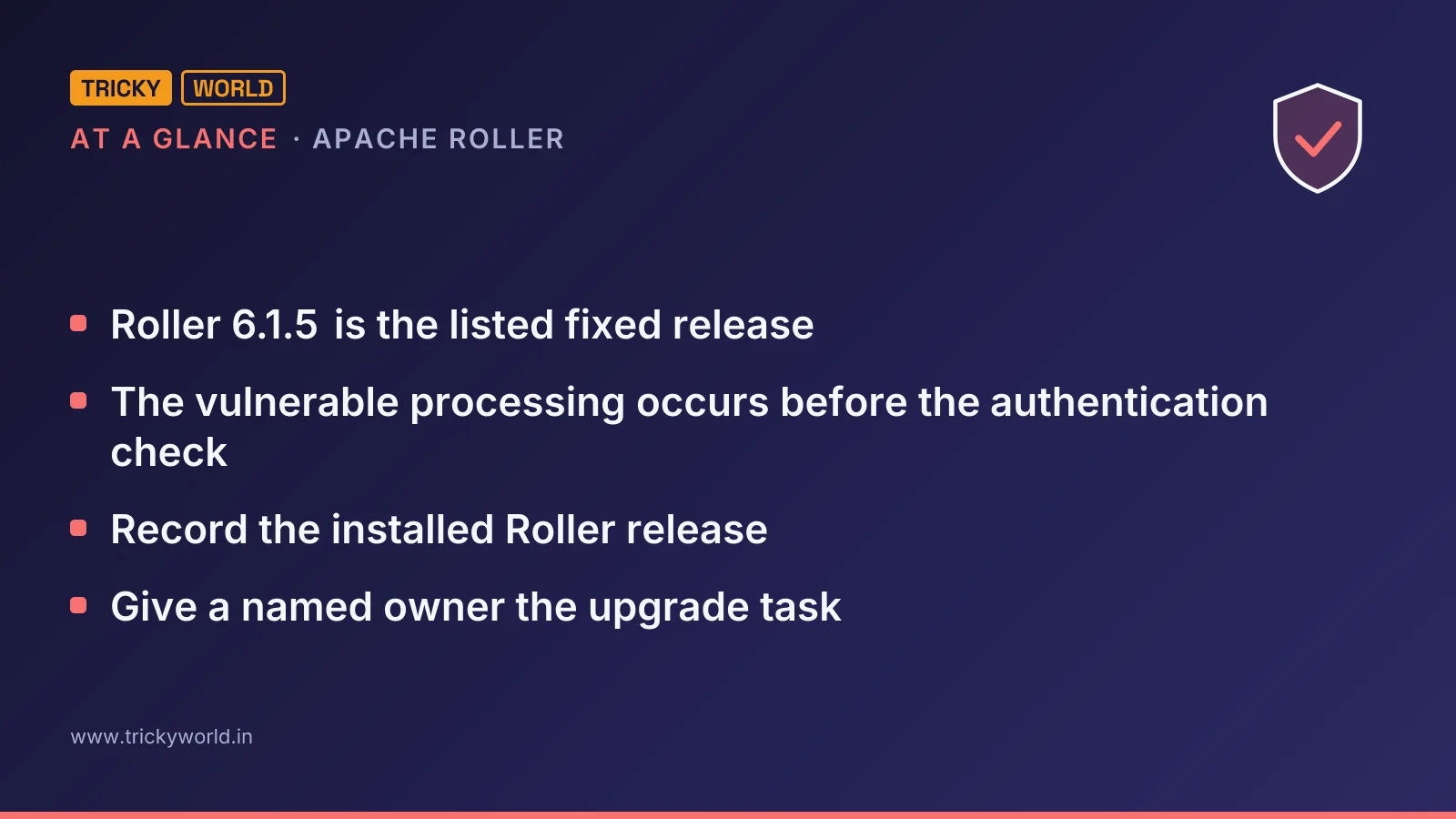
Roller 6.1.5 is the listed fixed release. In NVD’s Apache Roller entry, the affected range starts at 4.0 and stops before 6.1.5. Compare the affected range for CVE-2026-129448 with the installed release on each Roller deployment. A general inventory entry for Apache software does not identify the product and version closely enough to answer this question.
Work through the deployments individually: record the installed Roller release, identify who operates it and give a named owner the upgrade task. The point is to keep the upgrade decision attached to an actual Roller deployment and the published version boundary, rather than an imprecise inventory label.
For an installation within that range, the supported patch target given here is Roller 6.1.5. Neither account supplies a temporary Roller mitigation or a command for checking the version. There is no basis in those accounts for replacing the published fix with a guessed configuration change, or for presenting an unverified command as the way to check an installation.
Roller’s XML-RPC path processes data before authentication
The order of operations is the problem in CVE-2026-129448. The Hacker News describes an XML-RPC endpoint that accepts and deserializes vendor extension types before authentication takes place. An unauthenticated remote attacker could use that behaviour to execute arbitrary code.
This is a more specific report than a general warning about unsafe input. XML-RPC is the reported entry point, and the vulnerable processing occurs before the authentication check. That distinction belongs in the patch discussion: the attack described here does not require the attacker to obtain a Roller account first.
According to the report, Apache Roller’s maintainers acknowledged active exploitation but did not disclose how attackers were using the flaw or identify those responsible. CISA’s catalog establishes that exploitation has occurred; it does not provide those missing campaign details. There is enough information to make the remediation decision without treating the incomplete account of the attacks as a complete one.
Cisco Expressway needs a cluster-specific review
Cisco Expressway’s CVE-2026-76466 concerns hard-coded credentials, not the deserialization behaviour described for CVE-2026-129448. NVD lists releases before x15.5.20 as affected. The listed fixed release is x15.5.20.
The attack conditions need to survive any shorthand used in the patch ticket. The Hacker News says an unauthenticated remote attacker with persistent cookies and network access could execute commands as root on a clustered device through the database service. That description includes both access conditions and a clustered-device context. Calling it an unrestricted remote attack would drop those qualifications and overstate what was reported.
The report credits F6 with finding exploitation against a Russian organisation after a proof-of-concept exploit became available. Attackers reportedly moved laterally and accessed sensitive data. The activity has not been attributed to a threat actor, so the account provides observed consequences without identifying who was behind them.
For Expressway, combine the version check and the review of those network and cluster conditions in the same piece of work. Uncertainty about whether the described conditions are present is not a reason to leave an affected release sitting without an assigned upgrade plan. Keep the exposure question explicit while assigning the upgrade.
VMware’s fix target is a Cloud Foundation version
The VMware issue, CVE-2026-123890, is described as an authentication bypass affecting vCenter. An unauthenticated attacker with network access to vCenter could bypass authentication and gain unauthorised access. Network access is part of that description, not a qualification to discard when passing the issue to another team.
As with CVE-2026-129448, the update target needs equally careful wording. NVD identifies VMware Cloud Foundation 5.0 through releases before 5.2.5 as affected, with Cloud Foundation 5.2.5 as the listed fix. This is a Cloud Foundation version target; it is not a supplied standalone vCenter version. Match the remediation to the product named in the advisory, and keep that product name beside the version number rather than relabelling the number as a vCenter release.
The Hacker News links exploitation to Armory Castle, formerly UNC5221, which it describes as a suspected China-nexus cyberespionage group. The group is said to have combined the vCenter flaw with CVE-2026-102764 in BeyondTrust Remote Support. The reported purpose of that chain was to deploy custom backdoors for persistent access and data theft.
The account describes suspected espionage activity and a reported exploit chain. It does not establish that the group targeted every affected VMware installation, and an affected installation should not be described as one of its targets on that basis alone.
SAP’s unpublished fixed version leaves a patch-target gap
For SAP NetWeaver Enterprise Portal, the follow-up differs from that for CVE-2026-129448: the affected version is named, but the fixed version is not. NVD lists version 7.50 as affected by CVE-2025-42884. The record checked on November 22, 2026, provides no published fixed version.
The two accounts answer different parts of the patch question. The Hacker News says the issue was fixed in November 2025, while the checked NVD record does not name the fixed release. Neither inventing a package number nor declaring that no patch exists is justified by those statements. An exact upgrade target needs confirmation from SAP; the missing number in the checked record is a gap to resolve, not a number to infer.
The reported flaw could allow an unauthenticated attacker to disclose or modify server information through injected JNDI environment properties or a URL used during lookup operations. The Hacker News also says there appeared to be no public reports documenting active exploitation when its article was written. CISA nevertheless lists the vulnerability as exploited. Both statements belong in the account, even though they describe different amounts of publicly available evidence.
Keep those evidence levels separate. The absence of a public campaign write-up is not a reason to disregard the catalog entry. In the other direction, the catalog entry does not supply SAP’s missing fixed-version number. Exploitation status and an exact remediation target are two questions here, and answering one does not answer the other.
Turn the KEV entries into an owned patch plan
The reported November 23 deadline applies to FCEB agencies, not universally to every organisation running these products. Private teams should still turn the exploitation evidence for CVE-2026-129448 and the other listed flaws into assigned work instead of leaving the findings to wait for a routine review. That recommendation does not require presenting the agencies’ deadline as an obligation for everyone else.
- Identify the actual products and releases. Check Roller deployments, Expressway devices, NetWeaver Enterprise Portal installations and the relevant VMware environment separately. Keep each product name attached to its version throughout the work. In particular, do not let the Cloud Foundation fix become an incorrectly labelled vCenter target as the finding moves into a patch plan.
- Assign the published upgrades. The respective listed fixed versions are Roller 6.1.5, Expressway x15.5.20 and Cloud Foundation 5.2.5. For SAP, explicitly assign the task of obtaining the vendor-confirmed remediation target. Recording an unsupported version would conceal the unresolved question rather than settle it.
- Review the exposure described for each flaw. Roller’s reported XML-RPC path processes data before authentication. Expressway involves persistent cookies, network access and a clustered device; vCenter requires network access. Keep those distinctions in the review so that the work follows the described attack conditions instead of a generic description of remote exposure.
- Track patching and possible compromise separately. The Cisco and VMware accounts report lateral movement and persistent backdoors. Given those reports, investigate relevant activity alongside remediation, rather than treat a completed upgrade as the answer to every incident question. An upgrade task and an investigation should not be recorded as though they were the same task.
Frequently asked questions
What severity does Apache assign to CVE-2026-129448?
Apache assigns it a CVSS 3.1 score of 9.8, rated Critical, as recorded by NVD.
What is SAP’s severity rating for CVE-2025-42884?
SAP assigns a CVSS 3.1 score of 6.5, rated Medium, as recorded by NVD. CISA has nevertheless included it in the Known Exploited Vulnerabilities catalog since November 20, 2026.
Is public Apache Roller exploit code verified?
The PoC-in-GitHub index names three repositories for CVE-2026-129448 in the November 22 check, but labels them unverified. Their presence should not be described as verification that the code works.
Sources
Primary sources
- CVE recordNVD and distribution data for CVE-2026-129448, CVE-2026-76466, CVE-2025-42884, CVE-2026-123890 (checked 2026-11-22) · nvd.nist.gov
Reports of the story
- News reportHackers Exploit Critical VMware, Cisco, and Apache Flaws as Espionage Attacks Emerge · thehackernews.com
How this article was made: drafted with AI from the sources above and fact-checked against them, then reviewed by Vishal on . How we write and check articles.

About the author
Vishal · Software & security engineerVishal writes Trickyworld's tutorials and interview-preparation guides on programming, databases, cyber security and AI. Vishal has been shipping production software long enough to have firm opinions about Python, PHP, Node.js, and JavaScript, and to have been wrong about each of them at least once. The work has run the whole stack: Drupal and Laravel applications, React front ends, MySQL and MongoDB underneath, Redis and Memcached for the things that had to be fast, Apache Solr for the things that had to be findable. That last part turned out to matter more than anyone expected. Tune a Solr index for a season, then watch a language model confidently retrieve the wrong document, and you recognise an old problem wearing new clothes. Most of what is hard about AI systems is not the model. It is retrieval, caching, latency budgets, and deciding what the system does when the answer comes back wrong — which is work he has been doing since well before anyone called it AI engineering. He plays a lot of games, which is less a hobby disclosure than an admission of where a good share of his engineering instinct came from. Real-time systems with a frame budget. State that has to stay coherent while a player does something no designer anticipated. The permanent question of what happens when the frame cannot finish in time. Those habits carry over more directly than they have any right to. He has written several books on programming, all built on the same conviction: most technical writing is unclear because the author never decided what to leave out. More from Vishal → · Editorial policy