KEPCO data breach hits over 1.5 million people
KEPCO confirmed unauthorized access to its ON billing and SRM procurement systems, exposing data on more than 1.5 million people, including bank and card details for ON customers. Affected people should check KEPCO's direct notification and independently verify unexpected payment requests. The access method and attacker identity remain unconfirmed.
Summary written with AI from this article, and checked against it.

An intruder accessed Korea Electric Power Corporation (KEPCO) systems holding data on more than 1.5 million people, BleepingComputer reports. The two affected systems are ON, its billing platform, and SRM, its electronic procurement system. For anyone caught up in the KEPCO data breach, the immediate work is to check KEPCO's direct notification and watch for targeted phishing. There is also a distinction to keep straight throughout the reporting: KEPCO has confirmed exposure, but not every theft claim made about these systems has been verified.
The disclosure covers electricity customers, company representatives and employees. For billing customers, the exposed fields go well beyond contact details: they include bank accounts, card numbers and electricity charges. Potentially exposed individuals are warned that the information could be used for targeted phishing and impersonation. The company says it is coordinating with government and financial authorities to prevent that information from being abused.
Check your KEPCO notice and reject suspicious requests
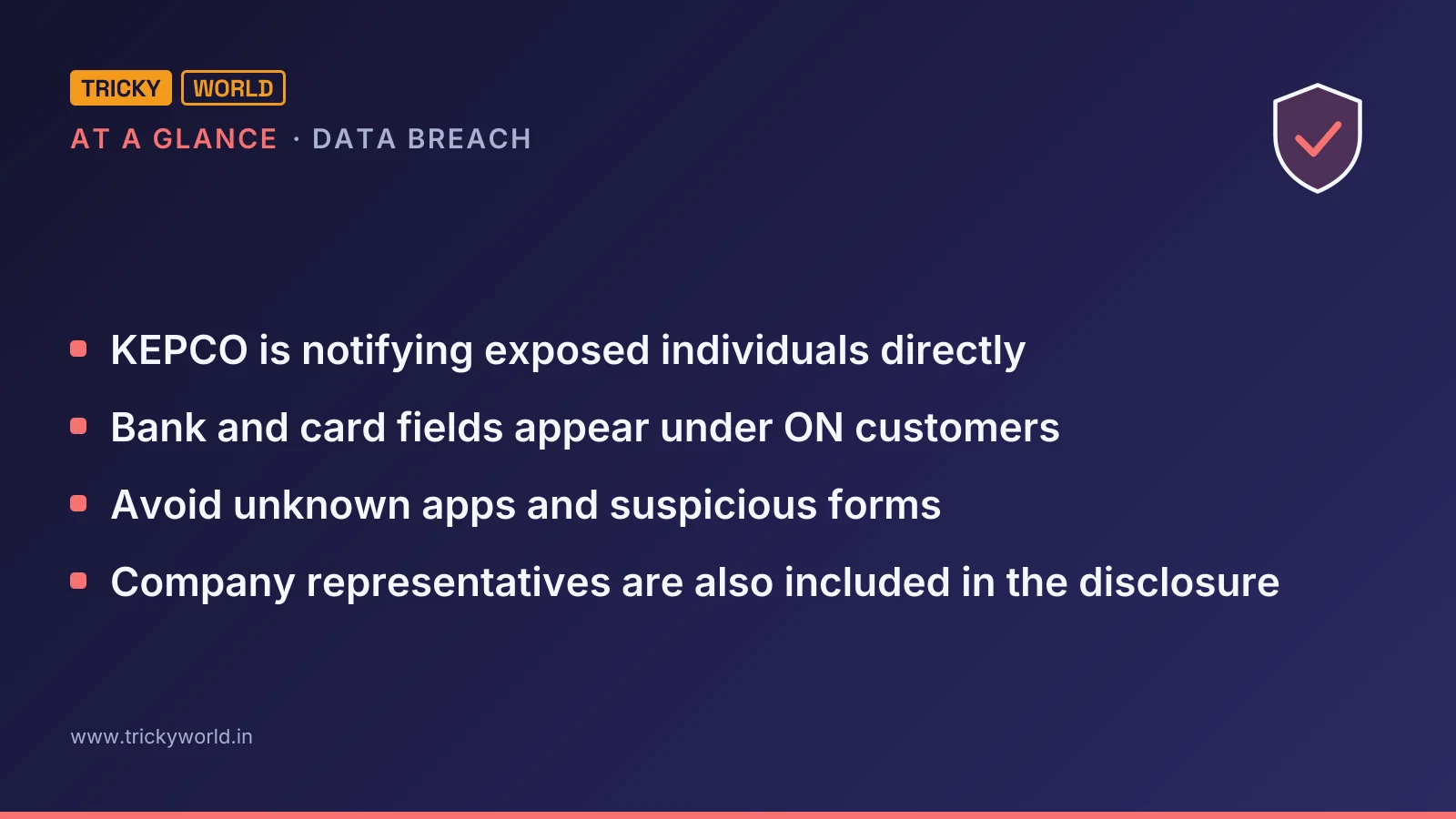
KEPCO is notifying exposed individuals directly. Start with that notice to understand which information concerns you. The company has listed different exposed fields for different groups; it has not said that the same set of information was exposed for every person. That difference matters before you act on a general warning about the breach.
Check whether the notice identifies you as an ON customer, a company representative or an employee, then compare it with the categories below. I'd start with the notice's own data categories, rather than assume that every affected person lost every field mentioned anywhere in the announcement.
Do not provide sensitive information or verification codes in response to unexpected calls or texts. The published advice recommends not sharing those details through these channels. Even if a request mentions your electricity bill or your workplace, assess it by what the caller or message asks you to do.
Avoid unknown apps and suspicious forms; the published advice covers both. In practical terms, a message claiming that an app installation or a completed form is necessary to resolve this breach is not, on its own, a reason to do either.
Report suspected phishing or impersonation to the police or Korea's Internet and Security Agency, as the breach advice recommends. South Korea's Personal Information Protection Commission also lists 118 as its privacy-infringement reporting number. The number does not need an area code.
If you are handling these notices for an employer, do not limit the warning to employees who pay an electricity bill. Company representatives are also included in the disclosure. The incident involving the procurement system gives supplier-facing staff a reason to pay attention to the warning as well, rather than treating it solely as a customer-billing issue.
What did the KEPCO data breach expose?
KEPCO confirmed unauthorized access to two systems that do different jobs. Customers use ON to view and pay their electricity bills; SRM handles procurement and contracting services. As reported by BleepingComputer, the company's announcement identifies the following groups, counts and exposed information.
| Affected group | Reported count | Exposed information |
|---|---|---|
| KEPCO ON customers | 650,487 | Names, ID information, phone numbers, addresses, bank names, bank account numbers, account holder names, card issuers, card numbers, cardholder names, and electricity charge and billing information. |
| Company representatives | 426,827 | Names, ID information, email addresses and company addresses. |
| KEPCO employees | 442,934 | Names, affiliation, employee ID numbers, mobile phone numbers, email addresses and company phone numbers. |
Bank and card fields appear under ON customers. The company-representative category instead lists identity and contact information, while the employee category includes workplace identifiers and contact details. Those are meaningful differences for someone reading a notice and deciding what questions to ask. The headline total describes the scale of the breach, not the exact exposure of each individual included in it.
From the forum claim to KEPCO's service suspension
The public claim of data theft came before KEPCO confirmed unauthorized access. DailySecu's initial investigation of the forum advertisement reported that an account using the alias Noiem posted claims about KEPCO data on November 19, 2026. There was also a theft claim sent directly to the company. BleepingComputer separately reports that South Korea's Personal Information Protection Commission confirmed KEPCO had received an email from a hacker claiming data theft on November 19. At that point, the advertisement was a claim to investigate, not a confirmed account of how the systems had been accessed.
The advertisement described user information, supplier records, and bidding or contract material. DailySecu initially considered a connection to SRM possible because the advertised information overlapped with the procurement system's work. It had not yet established which system the files came from, though, or how the person posting the advertisement had obtained them.
KEPCO detected the attack on November 20 and then confirmed unauthorized access to ON and SRM. BleepingComputer reports that the company blocked access from external IP addresses and suspended the affected services. KEPCO also reported the incident to data-protection authorities and began sending notifications to the individuals whose information had been exposed.
KEPCO's later announcement changes the status of one part of the earlier reporting. KEPCO confirmed unauthorized access to SRM, its electronic procurement system. I would not extend that confirmation to everything in the advertisement, however. Confirmation of the KEPCO data breach does not independently authenticate every advertised document, and it does not establish who carried out the intrusion.
Why SRM records could make payment fraud convincing
DailySecu describes a specific potential misuse of the information: supplier contact details, combined with non-public bidding or contract information, could help someone impersonate a contract representative or request a change to a payment account. This is a warning about what could happen. It is not a report that a fraudulent payment has already occurred.
The work SRM handles explains why that warning focuses on contracts and payments. DailySecu describes the system as covering procurement notices, participation applications, bids, evaluations, successful-bidder selection and contracts for materials, construction and services. Supplier and pricing material advertised by the forum poster overlaps with those activities. The origin of those particular files still needs verification, even with that overlap.
Consider the request from the supplier's side: someone asks to change the account used for a contract payment and can refer to a real procurement relationship. That reference may make the message appear more credible than an unrelated demand for money. This is an illustration of DailySecu's warning, not a description of a confirmed attack following the KEPCO data breach.
A correct contract reference should not, by itself, authorise a payment change. I would verify the proposed change using contact details already held in the supplier record, not a phone number or address included in the request asking for the change. The same reasoning applies to a person who claims to be resolving a billing problem.
For IT professionals supporting procurement teams, the distinction is worth spelling out in the warning to staff. Knowing about a transaction and having authority to redirect its payment are separate things. The reported exposure makes that distinction relevant now; it does not require the team to assume that the attacker's entire advertised collection is genuine before questioning a payment-change request.
The access method and attacker identity remain unconfirmed
KEPCO has not provided a technical explanation of the initial access method or the attack chain. The company attributes the breach to advanced technology, including artificial intelligence (AI). The published account, however, does not explain what role that technology allegedly played in the intrusion, leaving the reference without an accompanying technical account.
KEPCO supplied no technical evidence for the AI claim.
The attacker's identity is unresolved as well. Noiem claimed responsibility and advertised material consistent with the reported incident, but BleepingComputer explicitly says attribution to that alias is unconfirmed. An advertisement and a theft email establish that claims were made. They do not establish that the same person carried out every part of the intrusion.
The advertised record counts come with their own unresolved questions. DailySecu says it had not established the overlap between supplier lists, so adding those lists together would not produce a supported count of affected businesses. It also says the relationship between the claimed internal-user information and a separate employee-related file was unexplained. Nor did the initial report establish whether the advertised external users were electricity customers, procurement users or partner-company contacts.
Those gaps are reasons to keep the company's confirmed disclosure separate from the forum claims, not reasons to dismiss the breach itself. KEPCO has confirmed unauthorized access and described the information exposed. What is still uncertain is how the intrusion worked, who carried it out, and how much of the full advertised collection can be authenticated.
Put KEPCO-linked payment requests under extra scrutiny
KEPCO's disclosure includes identity, contact and financial information, so the advice to affected people concerns specific requests they may receive. Use the direct notification to identify the relevant exposure. Refuse unexpected requests for sensitive details or verification codes, avoid unknown apps and suspicious forms, and report suspected impersonation rather than responding as though a familiar detail proves the sender's identity.
DailySecu identifies that exact potential misuse of supplier and contract information. An internal warning should explain which request staff need to question and why a correct contract reference is not enough, rather than leave them with only the breach headline and a general instruction to be careful.
KEPCO has restricted external access, suspended services, sent notifications and coordinated with authorities. Those actions do not require readers to make assumptions about the unconfirmed attacker identity or the unexplained AI claim. Work from the exposure described in the notice. Verify unexpected financial requests independently, and verify supplier payment changes using the contact details already held in the supplier record, not the details supplied with the request.
Frequently asked questions
Is the November incident linked to KEPCO's October breach notices?
DailySecu reported that KEPCO issued a correction and additional privacy notice on October 8, followed by another notice on October 29. It had not established the relationship between those earlier disclosures and the material advertised in November, including when the datasets were created or how much they overlapped.
Do the claimed military and government records prove those organisations were breached?
No. DailySecu reported that the advertisement mentioned military- and government-related supplier and bidding records, but did not provide enough information to establish their originating institutions or disclosure status. Their appearance in the advertisement does not establish a breach of military or government systems.
What did the attacker's 560M CSV label mean?
DailySecu reported that the poster used the label 560M CSV without explaining its precise size or scale. It should not be interpreted as a verified file size, record count or number of affected people.
Sources
Primary sources
- Write-up[단독] 다크웹에 ‘한전 개인정보·입찰자료 확보’ 주장…전자조달시스템 SRM 관련 가능성 조사 필요 · dailysecu.com
- Write-upEnterprise Email Security Assessment · adaptivesecurity.com
- Write-up개인정보보호위원회 · pipc.go.kr
Reports of the story
- News reportSouth Korea’s power giant KEPCO confirms data breach impacting 1.5 million · bleepingcomputer.com
How this article was made: drafted with AI from the sources above and fact-checked against them, then reviewed by Vishal on . How we write and check articles.

About the author
Vishal · Software & security engineerVishal writes Trickyworld's tutorials and interview-preparation guides on programming, databases, cyber security and AI. Vishal has been shipping production software long enough to have firm opinions about Python, PHP, Node.js, and JavaScript, and to have been wrong about each of them at least once. The work has run the whole stack: Drupal and Laravel applications, React front ends, MySQL and MongoDB underneath, Redis and Memcached for the things that had to be fast, Apache Solr for the things that had to be findable. That last part turned out to matter more than anyone expected. Tune a Solr index for a season, then watch a language model confidently retrieve the wrong document, and you recognise an old problem wearing new clothes. Most of what is hard about AI systems is not the model. It is retrieval, caching, latency budgets, and deciding what the system does when the answer comes back wrong — which is work he has been doing since well before anyone called it AI engineering. He plays a lot of games, which is less a hobby disclosure than an admission of where a good share of his engineering instinct came from. Real-time systems with a frame budget. State that has to stay coherent while a player does something no designer anticipated. The permanent question of what happens when the frame cannot finish in time. Those habits carry over more directly than they have any right to. He has written several books on programming, all built on the same conviction: most technical writing is unclear because the author never decided what to leave out. More from Vishal → · Editorial policy