CVE-2026-123158 (sshole): Alpine password bypass
CVE-2026-123158, called sshole, lets a password between 257 and 1024 characters log in to accounts whose password field is "*" on Alpine Linux and other musl systems running sshd without PAM, once another account has a $5$ or $6$ hash. OpenSSH 10.6p2 fixes it, as do Alpine's openssh 10.3_p1-r2 on 3.24, 10.2_p1-r1 on 3.23 and 10.0_p1-r11 on 3.22, and sshd must be restarted after the upgrade. GreyNoise saw the first successful exploitation on 7 November 2026.

At a glanceCVE-2026-123158
CVE-2026-123158 has a CVSS 3.1 base score of 8.1 (High) from MITRE. It is fixed in OpenSSH 10.6. Debian forky, sid fixed it in openssh 1:10.6p2-1.
| Severity | 8.1 High (CVSS 3.1, MITRE) |
|---|---|
| Fixed in | OpenSSH 10.6 |
| Affected | OpenSSH before 10.6; 10.6 |
| Exploited | Yes: in CISA's Known Exploited Vulnerabilities catalog since November 9, 2026 |
| EPSS | 17% chance of exploitation in the next 30 days (FIRST, November 10, 2026) |
| Public exploit | github.com, github.com · 31 GitHub repositories name it: proofs of concept, scanners, detections. Unverified: some are fake or malicious. |
| Vector | CVSS:3.1/AV:N/AC:H/PR:N/UI:N/S:U/C:H/I:H/A:H |
| Weakness | CWE-394 |
| Ubuntu | 26.04 resolute openssh: Not affected · 24.04 noble openssh: Not affected · 24.04 noble openssh-ssh1: Won't be fixed · 22.04 jammy openssh: Not affected · 22.04 jammy openssh-ssh1: Won't be fixed · 20.04 focal openssh: Not affected |
| Debian | bookworm openssh: Vulnerable · trixie openssh: Vulnerable · forky, sid openssh: Fixed (1:10.6p2-1) · forky, sid openssh-gssapi: Fixed (1:10.6p2-1) |
| Red Hat | Severity Critical, no package status yet |
Is there a public exploit for CVE-2026-123158?
Yes: CVE-2026-123158 is exploited in the wild. CISA added it to its Known Exploited Vulnerabilities catalog on November 9, 2026. NVD links 2 exploit references and 31 public GitHub repositories name it: proofs of concept, scanners and detections. None of it is verified: some such repositories are fake or carry malware, so read the code before running it, and only against systems you own. FIRST's EPSS puts the chance of exploitation in the next 30 days at 17%, higher than 97% of scored CVEs.
From NVD, Ubuntu, Debian, Red Hat · checked November 11, 2026
On an Alpine Linux server that accepts SSH passwords, a password between 257 and 1024 characters long can log in to an account that has no password at all. CVE-2026-123158, nicknamed sshole, is in OpenSSH's sshd on Linux systems that use musl libc without PAM. OpenSSH 10.6p2 fixes it, and Alpine's patched packages are openssh 10.3_p1-r2 on 3.24, 10.2_p1-r1 on 3.23 and 10.0_p1-r11 on 3.22.
It is already being used. GreyNoise saw the first successful exploitation on 7 November 2026, two days after the fix, and CISA gave US federal agencies until 12 November to act. Alpine's advisory puts it bluntly: an attacker who can reach the SSH port "can log in without knowing any password", in one connection that "works every time". Alpine's own cloud images can be exposed too, as the root section below explains.
Check an Alpine server for CVE-2026-123158
Four read-only commands answer the question. Run them as root on each Alpine host that runs sshd:
# 1. Installed openssh-server version; compare it with the table below
grep -A1 '^P:openssh-server$' /lib/apk/db/installed

# 2. Is password login on? (from Alpine's advisory)
sshd -T | grep -i passwordauthentication

# 3. Accounts whose password field is just "*"
awk -F: '$2 == "*" {print $1}' /etc/shadow

# 4. Accounts with a $5$ or $6$ hash: one of them makes every "*" account reachable
awk -F: '$2 ~ /^\$[56]\$/ {print $1}' /etc/shadow
A host is exposed when all four line up: an older openssh-server, passwordauthentication yes, at least one * account, and at least one $5$ or $6$ account.
The fixed versions come from Alpine's advisory. The live package indexes for edge and 3.21 to 3.24 list the same versions:
Alpine branch | Fixed openssh version |
|---|---|
edge | 10.6_p2-r0 |
3.24 | 10.3_p1-r2 |
3.23 | 10.2_p1-r1 |
3.22 | 10.0_p1-r11 |
3.21 | 9.9_p2-r1 |
3.20 | 9.7_p1-r6 |
3.19 | 9.6_p1-r3 |
3.18 | 9.3_p2-r4 |
3.17 | 9.1_p1-r7 |
3.16 | 9.0_p1-r6 |
Two setups are safe as they stand. Alpine's openssh-server-pam package with UsePAM yes isn't affected, and neither is a container that doesn't run sshd at all.
How a 257-character password matches a missing one
Without PAM, sshd checks a password itself. It hashes the attempt with the C library's crypt() and compares the result with the account's stored password field. For a stored field too short to hold a salt, such as *, sshd borrows the salt of another account. That is why the attack needs one account with a real $5$ or $6$ hash.
Then musl takes over. Its SHA-512 crypt source sets KEY_MAX to 256 and rejects any longer key, and the file's own header states the rule: "on error "*" is returned." The SHA-256 version has the same limit and the same error value.
So a 257-byte password fails to hash and comes back as *. That string is exactly what the stored field holds for every account without a password, and the comparison passes. Alpine's advisory gives the working range as 257 to 1024 bytes.
OpenSSH's maintainers don't see this as their bug. The OpenSSH 10.6p2 release notes call it "a critical security workaround": "We consider the root cause of this bug to be outside sshd, but it is exploitable via sshd and can be avoided there." The fix in sshd refuses to match a stored password field shorter than four characters, which rules out * whatever crypt() returns.
Damien Miller's release announcement also draws the boundary of who can ignore it:
“This vulnerability does not exist on non-Linux systems, Linux/glibc systems and Linux systems that use PAM for password authentication.”
— Damien Miller, OpenSSH
Is root reachable through sshole?
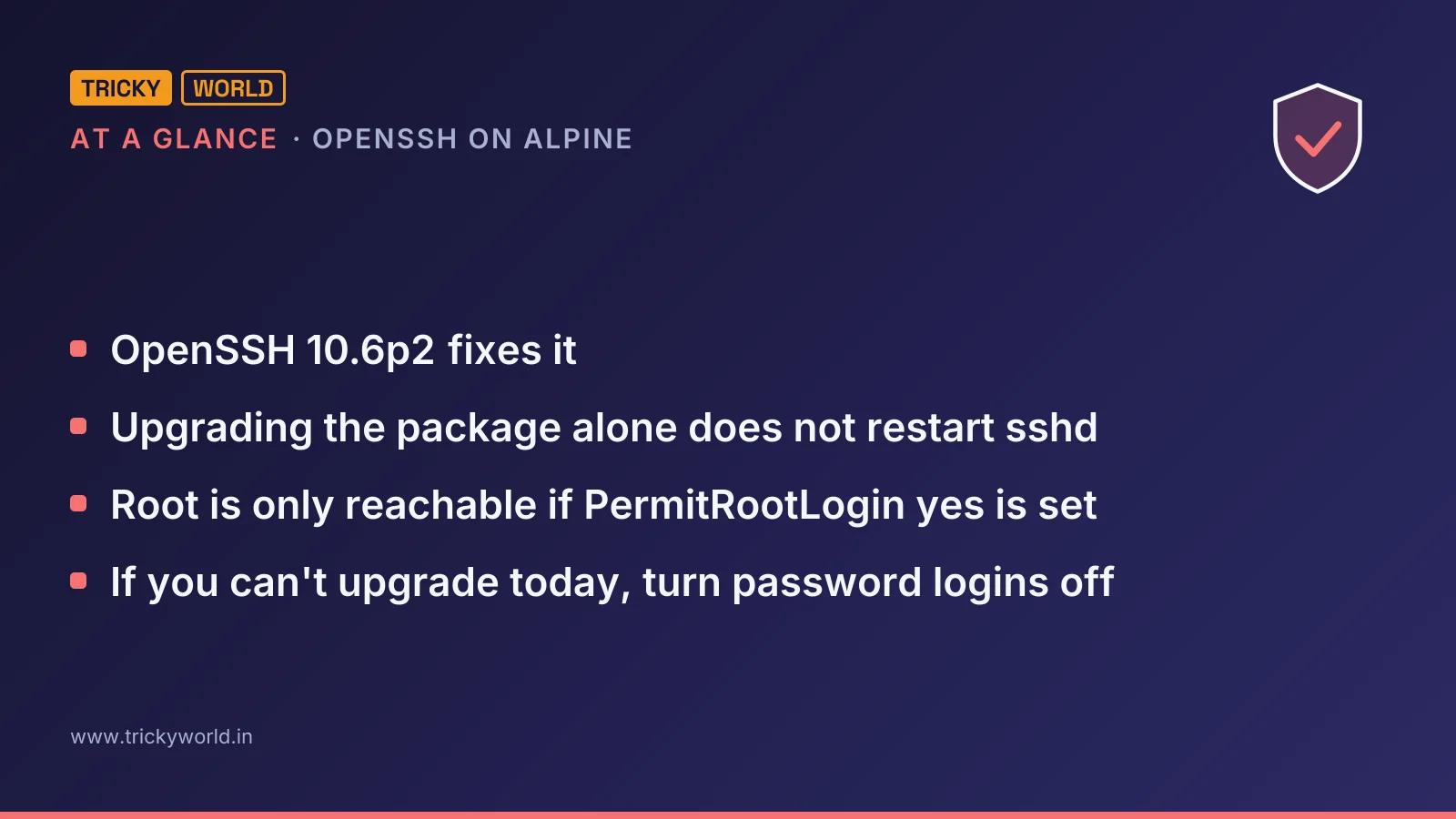
Directly, only if you allowed it. Alpine's base image ships root as root:*, and the 3.24.4 minirootfs released on 5 November still has that line. OpenSSH's default PermitRootLogin prohibit-password, the commented default in the sshd_config Alpine ships, blocks password logins for root. Alpine is clear that "root is only reachable if PermitRootLogin yes is set."
Indirectly, root is one step away on many machines. Any * account that can become root through doas is enough. Alpine's tiny-cloud images from 3.18.11 through 3.24.3 ship an alpine user with a * password field and passwordless doas. They are safe on first boot. Once anyone sets a $6$ password, for a console login or a user added through user-data, an attacker gets a shell as alpine and then root.
Key-only users are the other common victims. Alpine names any user added with adduser and no password, and directory-service users that come through musl-nscd. Images configured by cloud-init are the exception, because cloud-init writes PasswordAuthentication no.
Who is exploiting CVE-2026-123158?
Exploitation was fast and narrow. GreyNoise's tracking page lays out the timeline:
5 November 2026, 09:01 UTC: OpenSSH 10.6p2 released.
5 November, 13:16 UTC: the first public exploit appeared on GitHub, about four hours later.
7 November, 00:46 UTC: the first successful exploitation GreyNoise observed.
9 November: CISA added CVE-2026-123158 to its Known Exploited Vulnerabilities catalog.
Most of the traffic is ordinary scanning. Since 5 November GreyNoise counted 47.9 million SYN scans of port 22 but only five possible exploitation attempts. It confirmed 33 post-exploitation actions from nine attacker addresses. One cluster it tracks dropped a Python runtime and a "TAC Agent", talked to a command-and-control host at tac.vpnla.org, and set up a startup service to persist.
CISA's catalog entry sets 12 November 2026 as the due date and requires forensic triage. I'd apply that second part everywhere, not just at US agencies: a patched server that was open last week may already have someone on it.
NVD's record scores it 8.1 (High), and CISA's assessment there marks exploitation as active and the technical impact as total.
Fix CVE-2026-123158 and look for a break-in
To fix CVE-2026-123158, upgrade, then restart sshd. Upgrading the package alone does not restart sshd, so the old binary keeps answering until you do:
apk upgrade -U -a
rc-service sshd restart
If you can't upgrade today, turn password logins off. Make sure key login works first and keep your current session open. This is a shortened form of Alpine's drop-in, which needs Alpine 3.19 or later; on older releases, use the full sed command in Alpine's advisory:
mkdir -p /etc/ssh/sshd_config.d
echo 'PasswordAuthentication no' > /etc/ssh/sshd_config.d/00-no-passwords.conf
sshd -t && rc-service sshd restart
sshd -T | grep -i passwordauthentication
The last command should print passwordauthentication no.
Don't change * to ! on key-only accounts as a quick fix. Alpine notes that locked accounts can't log in with a password or a key, so you would lock those users out.
Then look for a login that shouldn't exist. Alpine's advice is to search /var/log/messages for an "Accepted password for" line naming an account that has no password, such as alpine, root or a key-only user:
grep 'Accepted password for' /var/log/messagesReview doas use, new users, new files and authorized_keys on any exposed machine. Alpine's rule is the right one: "If you cannot rule out a login, treat the machine as compromised."
What the Alpine update doesn't cover
Alpine's packages fix CVE-2026-123158 on Alpine only. The researchers who found the bug list other musl-based systems without PAM: sshhole.com names OpenWrt, Buildroot, Yocto "and a lot of the docker images you've pulled". Each of those needs its own updated sshd, and a container image with sshd baked in needs rebuilding, not just restarting.
Support status doesn't help either. Alpine 3.21 reached end of support on 1 November 2026, yet Alpine published fixed packages back to 3.16. I'd take that as a hint to move off unsupported releases while the fixes are still being backported for you.
The root cause also stays in musl. OpenSSH avoided it in sshd, but any other program that compares crypt() output against a stored field could hit the same *. If you run custom login code on musl, I'd check it for the same comparison.
This isn't the first time a C library turned a small check into root. Looney Tunables in glibc did it locally in 2023, and OpenSSH had its own remote code execution flaw, CVE-2023-38408, that year.
The quickest win this week is the one Damien Miller asked for: on every musl host you can't patch today, turn password authentication off.
Frequently asked questions
Who found sshole?
Özgün Kültekin of Wakefield reported it, according to the OpenSSH 10.6p2 release notes and Alpine's advisory. Alpine credits Damien Miller and Darren Tucker of OpenSSH for the fix, Timo Teräs for help analysing it, and Natanael Copa for building and uploading the updated packages.
Is Dropbear affected by CVE-2026-123158?
The researchers list Dropbear among the setups that aren't affected, along with glibc systems, systems using PAM and OpenBSD. The flaw needs OpenSSH's sshd checking passwords itself on a musl-based Linux system.
Why don't the first advisories mention CVE-2026-123158?
The ID came after the fix. Alpine's advisory of 5 November says no CVE identifier had been assigned at the time of writing; GreyNoise's timeline shows the ID reserved at 15:46 UTC that day and published to NVD at 16:17 UTC, about seven hours after OpenSSH 10.6p2.
Sources
- Write-upSecurity advisory: openssh-server password authentication bypass · alpinelinux.org
- Write-upmusl libc source: src/crypt/crypt_sha512.c · git.musl-libc.org
- Release notesOpenSSH: Release Notes (10.6p2) · openssh.org
- Codeavoid password authn bypass (openssh-portable commit 4353fdc) · github.com
- Write-upurgent security release: 10.6p2 (openssh-unix-dev) · marc.info
- Write-upSSHole (CVE-2026-123158) Activity 2026 (GreyNoise) · sshole.events.greynoise.io
- CVE recordCVE-2026-123158 Detail (NVD) · nvd.nist.gov
- Write-up*sshole · sshhole.com · sshhole.com

About the author
Vishal · Software & security engineerVishal writes Trickyworld's tutorials and interview-preparation guides on programming, databases, cyber security and AI. Vishal has been shipping production software long enough to have firm opinions about Python, PHP, Node.js, and JavaScript, and to have been wrong about each of them at least once. The work has run the whole stack: Drupal and Laravel applications, React front ends, MySQL and MongoDB underneath, Redis and Memcached for the things that had to be fast, Apache Solr for the things that had to be findable. That last part turned out to matter more than anyone expected. Tune a Solr index for a season, then watch a language model confidently retrieve the wrong document, and you recognise an old problem wearing new clothes. Most of what is hard about AI systems is not the model. It is retrieval, caching, latency budgets, and deciding what the system does when the answer comes back wrong — which is work he has been doing since well before anyone called it AI engineering. He plays a lot of games, which is less a hobby disclosure than an admission of where a good share of his engineering instinct came from. Real-time systems with a frame budget. State that has to stay coherent while a player does something no designer anticipated. The permanent question of what happens when the frame cannot finish in time. Those habits carry over more directly than they have any right to. He has written several books on programming, all built on the same conviction: most technical writing is unclear because the author never decided what to leave out. More from Vishal → · Editorial policy