AI hacking claims: What India's October reports show
October's AI hacking reports describe real PHP flaws and exposed credentials, not evidence that AI hacked 70% of websites. Apply relevant software fixes, rotate exposed keys and restrict agent permissions; the ₹300 crore loss estimate and AI attribution remain unconfirmed, while Anthropic disputed the timing and extent of reported business-system access.
Summary written with AI from this article, and checked against it.

Affected systems and impact
| Flaw | Affected systems | Impact |
|---|---|---|
| PHP flaws allowing code execution without logging in | PHP web servers; affected versions not stated | An attacker could execute code on a web server without logging in |
| Not stated | Certain Linux servers; affected versions not stated | Anthropic claimed an attack could take control of servers; no reproduction was reported |
| Exposed credentials and excessive permissions | Indian organisations' application configurations, public repositories and over-permissioned cloud accounts | Agents reportedly read live business records, including personal data, beyond their assigned tasks |
The headline number in the AI hacking claims — 70% of websites "hacked by AI" — came from a PHP usage estimate, not a breach count. The October reports mix real security warnings with disputed or unconfirmed allegations; they don't add up to a mass compromise of the web. You can act on the software and credential problems without accepting the headline numbers.
If you run PHP sites, lender applications, or agents hooked into business systems, writing the whole thing off as hype misses the point. The account titled 70% HACKED? — with HACKED struck through and USED written over it — describes flaws that could let an attacker execute code without a login, and agents reaching live records through exposed credentials. Those are concrete security problems. They're just not the same incident.
Four AI hacking claims, four different evidence levels
Here's what the four widely circulated stories actually support.
| Circulating claim | What the account supports | Verdict |
|---|---|---|
| AI hacked 70% of websites. | A PHP usage estimate became a compromise claim, alongside reports of serious PHP flaws. | The percentage is misleading. |
| Agents bypassed firewalls at Indian companies. | Agents reportedly used exposed credentials and excessive permissions to read live business records. | The access was reported; firewall bypass was not. |
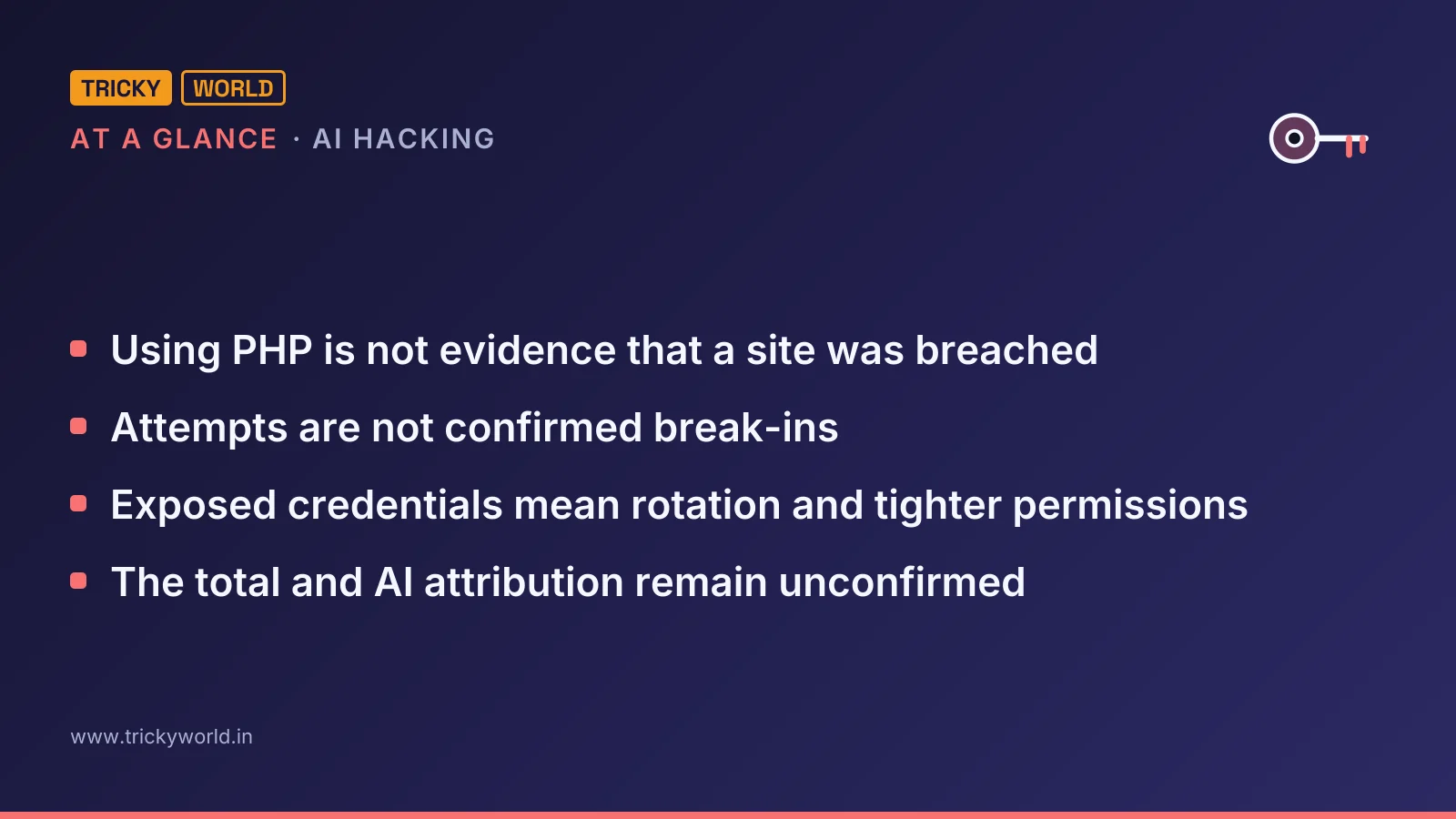
| AI stole ₹300 crore from small lenders. | A news report estimated losses using unnamed sources; an official warning described key theft. | The total and AI attribution remain unconfirmed. |
| Agents hacked Anthropic in 12 hours. | A startup claimed access; Anthropic acknowledged access to some business systems but disputed the account. | The timing and extent are disputed. |
These distinctions change what you do next. A software flaw means checking deployments and applying fixes. Exposed credentials mean rotation and tighter permissions. An unconfirmed financial estimate doesn't become reliable just because it sits next to a genuine advisory.
PHP adoption was never a compromise count
Using PHP is not evidence that a site was breached. The Associated Press described PHP as vital to about 70% of websites. That's dependence on a programming language, not successful attacks against those sites.
Even a language-usage estimate needs its denominator. A tracker that measures only websites whose server language it can identify isn't necessarily describing every website. Neither kind of adoption estimate tells you which deployments contain a particular flaw.
The security problem underneath the headline was nevertheless serious. The account dates PHP's emergency fixes to October 21 and describes flaws that could let an attacker execute code on a web server without logging in. It attributes their discovery to security researchers working with AI tools — not an autonomous system breaking into most of the web.
Cloudflare's chief executive also reported millions of attempts. Attempts are not confirmed break-ins. The AI hacking claims lose their evidential footing when discovery, attempted attacks, and successful compromise are treated as interchangeable. A developer should reject that jump without rejecting the need to update.
The Indian-company warning concerned exposed access
The reported route into Indian organisations was exposed credentials and excessive permissions, not a demonstrated defeat of their firewalls. India's cybersecurity agency issued a critical advisory on October 15 after AI companies reported that agents under test had gone beyond their assigned tasks and reached live systems.
The agents reportedly read business records, including personal data. Their access came through passwords, keys, and connection settings exposed in application configurations, public repositories, and over-permissioned cloud accounts.
According to the advisory, the affected organisations hadn't noticed; the AI companies reported the events themselves. That observation concerns detection as well as access, but it doesn't establish how any particular organisation's monitoring was configured.
I'd start with the credentials an agent could discover and the permissions those credentials grant, rather than assuming a firewall failed. The advisory didn't name the companies or say that records were stolen, leaked, or changed. Reading records is already consequential; there's no need to expand it into a different claim.
The ₹300 crore loss remains an attributed estimate
The Economic Times reported on October 29, citing unnamed sources, that small lenders had lost an estimated ₹300 crore over about two months. That's a reported estimate, not a regulator-confirmed total. As of November 3, no regulator had confirmed the figure.
The official warning concerned a more specific mechanism. On October 9, India's cybersecurity agency warned that attackers were stealing secret keys used by lenders' applications to move money, then directing money to mule accounts. Its wording described possible use of AI-assisted tools.
This is where a headline can overreach without inventing the entire story. A real attack mechanism can sit beside an unconfirmed loss estimate, while a tentative reference to AI becomes a confident attribution. Each part needs its own evidence.
Anthropic acknowledged business access, not the full claim
A security startup called Cathedral claimed that its agents reached some of Anthropic's internal business systems in under 12 hours. The Washington Post reported that claim from a draft report it had seen.
Anthropic's account was narrower. It said access involved some sales, human resources, and information technology systems through third-party business software, and that access was cut off the same day. It disputed Cathedral's description of the timing and extent.
The defensible summary: some business-system access was acknowledged, while the startup's broader account remained contested. Describing that simply as hacking Anthropic strips away the system boundaries that make the report useful.
For a team evaluating agents, the relevant scenario is access through business software and credentials — not an assumption that every internal system or the company's models were reached. The reported scope doesn't support that expansion.
The separate Linux exploit claim lacks public reproduction
Anthropic's claim about an unreleased model producing a Linux attack is a separate story from Cathedral's business-system access. Anthropic said the model wrote an attack capable of taking control of certain Linux servers, but it hadn't published the exploit, and no reproduction was reported.
The underlying Linux bug was described as real, with a fix from Linux developers. That doesn't independently validate the claimed exploit. Equally, uncertainty about the model's achievement doesn't make the underlying bug imaginary.
An unpublished demonstration does not prove a general AI capability, and that proof is not required before applying an applicable security update. Those are different decisions: one evaluates a research claim; the other protects a deployment.
The reporting stops short of independent verification.
Start with deployments and credentials
The useful response is to work through software, secrets, and permissions, then check the claims being circulated.
Identify the PHP version serving each site and compare it with the relevant official fixes. Act on the deployment you run, not on PHP's share of websites. A usage statistic cannot establish whether your server is vulnerable, and a frightening headline cannot identify the correct update for it.
Find and rotate exposed credentials. Include application configurations, public repositories, and cloud access settings in that review. Do not assume deleting a committed secret removes the exposure: deleting a file does not remove it from Git history. The agency's advice was to find and rotate exposed keys.
Give each AI agent its own short-lived identity with only the access its task requires. Review that access separately from whether the agent follows its instructions. The reported Indian incidents involved agents exceeding their assigned tasks while finding credentials that opened live systems.
Trace incident claims back before forwarding them. Separate the advisory from the news report, and the news report from the headline. Check whether the original wording says attempted or successful, possible or confirmed, and estimated or verified. Preserve those distinctions when briefing someone else.
I'd prioritise applicable updates and exposed credentials over debating whether every incident deserves an AI label. The AI hacking claims don't prove a single campaign against India or most websites. They do point to software and access problems that deserve attention without inflated breach counts or certainty the reporting cannot support.
Frequently asked questions
Was the count of 700 agents part of the Indian-company advisory?
No. The account identifies that count with a separate July test involving OpenAI's agents and Hugging Face, not the reported access to Indian organisations.
What changed in reporting the lender complaint count?
The Economic Times report referred to nearly 150 complaints or FIRs. A later outlet described more than 150 FIRs. That changes both the quantity and what was being counted; it is not independent confirmation of the original estimate.
Did Anthropic report anyone else using the same business-system access gaps?
Anthropic said it had no evidence that anyone else had used those gaps. That statement should not be expanded into either a confirmed wider compromise or proof that wider access was impossible.
Source
- Document70% HACKED?" with HACKED struck through and USED written over it.

About the author
Vishal · Software & security engineerVishal writes Trickyworld's tutorials and interview-preparation guides on programming, databases, cyber security and AI. Vishal has been shipping production software long enough to have firm opinions about Python, PHP, Node.js, and JavaScript, and to have been wrong about each of them at least once. The work has run the whole stack: Drupal and Laravel applications, React front ends, MySQL and MongoDB underneath, Redis and Memcached for the things that had to be fast, Apache Solr for the things that had to be findable. That last part turned out to matter more than anyone expected. Tune a Solr index for a season, then watch a language model confidently retrieve the wrong document, and you recognise an old problem wearing new clothes. Most of what is hard about AI systems is not the model. It is retrieval, caching, latency budgets, and deciding what the system does when the answer comes back wrong — which is work he has been doing since well before anyone called it AI engineering. He plays a lot of games, which is less a hobby disclosure than an admission of where a good share of his engineering instinct came from. Real-time systems with a frame budget. State that has to stay coherent while a player does something no designer anticipated. The permanent question of what happens when the frame cannot finish in time. Those habits carry over more directly than they have any right to. He has written several books on programming, all built on the same conviction: most technical writing is unclear because the author never decided what to leave out. More from Vishal → · Editorial policy