Factoring in P: Is the AI Encryption Rumor True?
Scott Aaronson says he has heard many rumors that OpenAI or Anthropic can factor in polynomial time, but what he is virtually certain of falls well short of Factoring in P, and neither lab has published anything. Google's AI-written factoring papers prove old speed limits and break nothing deployed. AI's real results so far hit a withdrawn signature candidate and weakened test versions of ciphers.

Affected systems and impact
| Flaw | Affected systems | Impact |
|---|---|---|
| HAWK-256A symmetry in its lattice cuts its key strength in half | HAWK, a lattice-based signature candidate in NIST's third round, withdrawn by its designers | Practical key recovery on the small HAWK-256 keys; HAWK was never deployed |
| 7-round AES-128An attack 200 to 800 times faster than the best earlier one | AES-128 cut down to 7 of its 10 rounds, not the full cipher | None in practice: Anthropic calls it completely impractical |
| RSA-1024GPU number field sieve software built by AI coding agents, with no new algorithm | Any RSA-1024 key still in use, such as old SSH host keys and DKIM email keys | Factoring costs on the order of $30 million per number, by Cognition's estimate |
Late on 24 November, a reader asked Scott Aaronson on his blog what the odds were that factoring is in P. The computer scientist answered within minutes: "I've now heard many, many rumors that one or both labs are sitting on Factoring in P." The labs were OpenAI and Anthropic, whose new proofs his post was about.
Factoring in P would mean an ordinary computer could quickly split the huge numbers behind RSA encryption. By the next day the comment was travelling on X without the sentences around it. On 26 November, Nature asked: "Has AI just cracked Internet encryption?" Aaronson has since added a note asking people to stop citing him as evidence, because "a rumor is a rumor is a rumor".
This article separates the rumor from what has actually been published. Nothing public breaks the encryption you use today. Google's AI-written factoring papers prove old speed limits, and AI's real attacks so far hit a withdrawn signature candidate and weakened test versions of ciphers. TrickyWorld also checked what can be checked: the published factors, a 25-year-old curve mystery, and which Indian sites already use post-quantum encryption.
What is the AI encryption rumor?
It is the claim that OpenAI or Anthropic holds an unpublished algorithm that factors large numbers in polynomial time, which would break RSA; no lab has confirmed it, and no paper or factored number backs it.
Most coverage traces the rumor to one public source. In comment 23 under his 24 November post, Aaronson wrote that he didn't know how much to credit the factoring rumors. He went on: "While I'm virtually certain that the labs are, indeed, sitting on one or more bombshells for cryptography, it's possible that the exact nature of those bombshells has gotten distorted via a game of Telephone."
His next post, on 25 November, said the same thing more carefully. He was "virtually certain, from multiple reliable sources" that the labs were "sitting on one or more bombshells" in cryptography. But until he saw details, he felt "much, much less confident about the specific nature of those bombshells". Later he added a note to the original comment. The parts he is "virtually certain" about, it says, "fall well short of Factoring in P".
That note came too late to slow anything down. Ledger's chief technology officer, Charles Guillemet, posted on 25 November that he was "hearing several rumors that frontier labs have broken some major cryptographic primitives". The first on his list was factoring, and he added: "Still, I don't think factoring is in P." A day later, Nature's news story reported that the rumoured algorithms target RSA "as well as more-advanced technologies", and said the rumours could not be confirmed.
Neither lab has commented on the rumor in public. OpenAI's public math repository holds 730 AI-written manuscripts, and the only one about factoring integers describes a quantum circuit. Anthropic's formal-math repository holds proofs about the Riemann zeta function, complexity theory and algorithms, none of them about cryptography.
What does "factoring in P" mean?
It means an ordinary computer could find the prime factors of any number in time that grows only polynomially with its number of digits, so making a key longer would no longer buy much safety.
An RSA public key contains a large number, the modulus, which is the product of two secret primes. Whoever finds those two primes can rebuild the private key. The usual key size today, RSA-2048, has a modulus 617 digits long.
The best known method, the general number field sieve, is much faster than trying divisors but still super-polynomial. Its running time is written L[1/3, 1.923], a formula that rests on unproven assumptions, and the method has set every large factoring record. Read literally, it puts RSA-2048 at about 2117 operations. That is far out of reach.
A polynomial-time algorithm would change the shape of that curve, though not necessarily the cost overnight. Nature's article points out that an algorithm needing n10000 steps would be useless in practice. Aaronson's answer, as Nature quotes it: "The issue is that the idea that [the problem] was hard — because of needing exponential time — is dead."
Factoring is already known to be easy for one kind of machine. Shor's algorithm factors in polynomial time on a large quantum computer, and that is the reason governments are replacing RSA. The rumor is about doing the same on ordinary hardware.
Would factoring in P mean P = NP?
It wouldn't, because factoring isn't known to be NP-complete: a fast factoring algorithm wouldn't settle P versus NP, and a proof that P ≠ NP wouldn't make RSA safe on its own.
A reader asked Aaronson about exactly this mix-up. Many people, the reader wrote, treat "P = NP" as the same thing as all public-key cryptography collapsing. Aaronson's reply was "It's not." If P = NP, all public-key cryptography would be broken in theory. If P ≠ NP, he explained, "there's still a further question of whether we have public-key crypto, or even private-key crypto for that matter."
Factoring sits in an odd middle ground. Its decision version is in both NP and co-NP, so if it were NP-complete, NP would equal co-NP, which almost nobody believes. It is also solvable by a quantum computer, which most researchers doubt holds for NP-complete problems. So breaking RSA needs far less than P = NP. That is why the rumor is taken seriously at all.
What did Google's AI factoring papers actually prove?
They claim proofs, with no unproven assumptions, of factoring speeds the number field sieve has only been believed to reach; nothing gets factored faster, and with the papers' own constants the bounds are far slower for real key sizes.
On 25 November, Google Research added six papers to its public GitHub repository. All six were produced by Cogentic, an agent system running on Gemini 4. The readme says "there was no human interaction other than the initial prompt". It also says Lean proofs of all six "will be released in a companion submission". None has been peer reviewed. The timing, one day after Aaronson's comment, is why many people linked the two.
Two of the papers are about factoring:
The first claims a randomized method that factors any number in expected time L[1/3, 105]. Its abstract says this "establishes the number-field-sieve exponent 1/3 unconditionally", improving the L[1/2, 1] that Lenstra and Pomerance proved in 1992.
The second claims the first deterministic method that runs in subexponential time, exp(3(ln N)3/4). The best deterministic bound before it was exponential: roughly the fifth root of N.
TrickyWorld plugged RSA-2048 into each formula, ignoring the lower-order terms the notation hides. Here is what each one gives, in operations:
Number field sieve, heuristic: about 2117.
Lenstra and Pomerance's proven 1992 bound: about 2146.
Cogentic's deterministic bound: about 21,001.
Trial division, the schoolbook method: 21,024.
Cogentic's randomized L[1/3, 105] bound: about 26,382.
The constant 105 is what makes the difference. With it, the new bound only beats the 1992 bound for numbers longer than about 60 trillion bits. The authors say they chose "transparent explicit constants (105 and 40) rather than optimizing them", so a tuned version could do much better. Still, these are proofs about the shape of the curve, not faster programs, and neither one is factoring in P. Aaronson's own reading of the repository, in a 25 November comment, found "big theoretical results" but "nothing of practical relevance for cryptography".
Do the discrete-log and ETH papers threaten encryption?
They don't: Google's discrete-log paper covers fields of small characteristic, which practical cryptography stopped relying on after a 2014 algorithm weakened them, and OpenAI's ETH paper says itself that it doesn't rule out ordinary one-way functions.
The third relevant Google paper claims to solve discrete logarithms in finite fields of small characteristic faster than any earlier proof. Those fields were already known to be weak. A heuristic quasi-polynomial algorithm for them dates from 2014, and proven versions followed in 2022. RSA, Diffie-Hellman over prime fields and elliptic-curve cryptography rest on different problems. After reading the batch, Guillemet said the results alone don't require resetting RSA's recommended key lengths, according to the Korean outlet Digital Today.
The biggest complexity result of the autumn came a month earlier. In late October, OpenAI posted The Exponential Time Hypothesis is False. It solves 3-SAT, the textbook hard logic problem, in time that grows more slowly than 2cn for any constant c, which the hypothesis said was impossible. OpenAI says a working group led by Russell Impagliazzo, Ramamohan Paturi and Ryan Williams will examine the proof, and Anthropic has posted a Lean proof of a similar result.
The paper spells out what this means for cryptography. It applies to constant-locality versions of Goldreich's candidate one-way functions, a family of theoretical constructions. The paper then adds a caveat: "This does not rule out one-wayness against polynomial-time algorithms." RSA, AES and ML-KEM are not built on that hypothesis.
AI proofs can also be wrong. OpenAI's readme warns that its unformalized results "could have issues", and about 42% of its top-line results have Lean proofs. On 7 October it withdrew three manuscripts after a sign error broke a key argument.
What has AI actually broken in cryptography?
Real but contained things: in July, Anthropic's Claude Mythos Preview cut the cost of recovering a HAWK-256 key from 264 to 238 operations and sped up attacks on 7-round AES, and neither result touches deployed systems.
HAWK is a lattice-based signature scheme that reached the third round of NIST's search for additional post-quantum signatures in May. According to Anthropic's 28 July post, Mythos found a symmetry in HAWK's lattice that no earlier attack had exploited. Finding and verifying the attack took about 60 hours and roughly $100,000 in API costs. Anthropic describes the effect as "effectively cutting its key strength in half". It says the attack is specific to HAWK and doesn't affect lattice cryptography in general.
HAWK's designers withdrew it from NIST's process the next day. The HAWK website now opens with a warning: "Hawk is insecure and should not be used."
The AES result is narrower. It works on AES-128 cut down to 7 of its 10 rounds, not the full cipher, and it runs 200 to 800 times faster than the best earlier attack on that version. It still needs 2105 chosen plaintexts, which Anthropic calls "completely impractical". Two researchers spent nearly a month confirming a result Mythos found in a week.
The same post lists smaller results:
A practical key recovery on LEA, a lightweight block cipher, reduced to 13 of its 24 rounds.
A practical key recovery on 6 of Serpent-128's 32 rounds.
Gains under ten times on Salsa20, the Poseidon hash and SHA-1.
Anthropic called the HAWK and AES attacks "the strongest attacks we have found to date", and it shared advance copies with US government and industry partners. It also raised the question behind the current rumor. In its words, "it would be prudent to consider how researchers should react if a language model were to discover vulnerabilities in cryptosystems where attacks do have an immediate real-world impact."
Did AI find a backdoor in the NIST curves?
No, it found the opposite: in October, Claude traced the unexplained seeds behind NIST's P-256 and related curves to a 1990s random-number generator seeded with clock times, which makes a planted weakness less plausible.
The NIST curves sign a large share of web certificates: 11 of the 37 Indian sites in our scan below present a P-256 one. Their seeds were a mystery for 25 years. An NSA employee, Jerry Solinas, supplied them in 1997 without saying how they were chosen. After the Dual_EC_DRBG scandal, some cryptographers asked whether the seeds hid a weakness only the NSA knew. Solinas later recalled hashing a humorous phrase, but nobody could find it.
According to Anthropic's 16 October post, an internal model solved it "in under half an hour". The seeds were never hashes. They are raw output of the C library's lrand48 generator, started from Unix timestamps between May 1997 and April 1998. P-256's seed, for example, is the 1,842nd candidate of a run started at 01:52:34 UTC on 16 August 1997. Anthropic stresses that "this is not a cryptographic break, new attack, or weakness". The $36,864 bounty will go to the Internet Security Research Group.
Some questions are still open. One binary-curve seed, B-163, fits nothing tried so far, and nobody knows why some usable candidates were skipped.
TrickyWorld didn't take the finding on trust. Our tool implements lrand48 from its POSIX definition, matched against the C library. It regenerates each seed from the reported timestamp and compares it with NIST's FIPS 186-4. Then it runs the standard's SHA-1 procedure to confirm that each curve follows from its seed:
$ python3 -m claimcheck seeds
  P-256  1997-08-16 01:52:34 #1842  c49d360886e704936a6678e1139d26b7819f7e90  MATCH
         SHA-1(seed) gives the published c: yes; b^2*c = -27 mod p: yes
  B-163  85e25bfe5c86226cdb12016f7553f9d0e693a268  still unexplained (no timestamp reported)
All nine seeds Anthropic explained for the NIST P- and B-curves came back identical. All five P-curves follow from their seeds.
Did AI help factor record RSA numbers?
Yes, but with the old algorithm: AI coding agents built the GPU software that factored RSA-260 on 3 September and RSA-896 on 19 September, and both teams say they found no algorithmic shortcut.
Eric Lu at Cognition drove the company's Devin agents to rewrite the open-source CADO-NFS factoring software for GPUs. His write-up says plainly: "I report essentially no algorithmic advancements." RSA-260 took about 4,900 GPU-days, roughly $400,000 at market prices. It beat the previous record, RSA-250, set in February 2020. Lu says hyperscalers or frontier AI labs could factor RSA-1024 "at a cost on the order of $30 million per number". RSA-2048, he adds, "remains roughly a billion times harder than RSA-1024".
Sixteen days later, Anthropic's Steve Weis used Claude for the same kind of port and factored RSA-896. His post says the run used up to 2,048 GPUs in idle time over ten days, about 30 GPU-years. It "does not impact the security of deployed RSA-2048 keys". It does show, he writes, that "RSA-1024 keys are vulnerable to many actors with data center-level fleets of GPUs."
A factoring result is the easiest claim in cryptography to check. TrickyWorld multiplied the published primes and tested each one:
$ python3 -m claimcheck factors RSA-896
RSA-896: 896 bits, 270 digits
  factor   448 bits  6366067297...9200557919
  factor   448 bits  6472181611...4752513489
  VALID: the product equals N and every factor is prime (17.8 ms)
RSA-260 and the 2020 record RSA-250 check out the same way.
What would break if factoring were in P?
RSA would break directly: RSA certificates and signatures could be forged, and recorded sessions that used RSA key transport could be decrypted, while elliptic-curve and lattice cryptography would fall only if the method carried over.
Aaronson put it in three steps in a reader reply: "If factoring is in P then RSA is broken—that's all, directly. But it's not unlikely that related techniques would solve discrete log, which would also give Diffie-Hellman. And if they extended to elliptic curve groups, then ECC as well."
Two kinds of damage would follow, on different clocks:
Forgery, from the day the method works. Whoever ran the method could impersonate a site whose certificate, or whose certificate authority, uses an RSA key.
Decryption of the past. Modern HTTPS agrees on session keys with elliptic-curve Diffie-Hellman, so factoring alone opens no recorded sessions. The exception is RSA key transport, an old TLS mode that sends the session key encrypted to the certificate's RSA key.
Plenty would survive. AES and SHA-256 are not built on number theory, and NIST's final transition plan, IR 8547, says it "does not expect to need to transition away from" its symmetric standards. ML-KEM and ML-DSA, the new post-quantum standards, rest on lattice problems that factoring doesn't touch.
How is this different from the quantum threat?
It targets the same two families, RSA and elliptic curves, but would need no new hardware, while the quantum route needs a large error-corrected quantum computer that nobody has built yet.
The quantum route is an engineering race, and estimates of the machine needed keep falling, as our breakdown of the 22,593-qubit RSA-2048 estimate shows. NIST IR 8547, published in October, deprecates quantum-vulnerable public-key cryptography after 2030 and disallows it under NIST standards after 2035. Factoring in P would remove the hardware hurdle for RSA, though not for elliptic curves unless the method carried over.
The defence is identical for both threats. Key exchange moves to ML-KEM, usually as the hybrid X25519MLKEM768 standardised in RFC 10024, and signatures move to ML-DSA. A hybrid key exchange stays sealed unless both X25519 and ML-KEM fall, so it covers a classical break, a quantum one and a flaw in the newer algorithm. Our guide to quantum-safe encryption in Laravel covers the server settings.
Have rumors like this been wrong before?
Yes, several times: a 2021 preprint said it "destroys the RSA cryptosystem", a 2022 paper claimed 372 qubits could challenge RSA-2048, and a 2024 lattice algorithm collapsed in eight days; real breaks ran on ordinary computers.
March 2021: Claus Peter Schnorr's preprint Fast Factoring Integers by SVP Algorithms claimed 800-bit numbers in 8.4 × 10¹⁰ operations and ended "This destroys the RSA cryptosystem." Léo Ducas tested it and found no factoring relation in 1,000 trials on a 400-bit number.
December 2022: a Chinese team's paper estimated that "372 physical qubits" could challenge RSA-2048, after factoring a 48-bit number. Aaronson's review was "No. Just No." in a post titled Cargo Cult Quantum Factoring.
April 2024: Yilei Chen posted a quantum algorithm for lattice problems, the family behind ML-KEM. Eight days later his note read: "Step 9 of the algorithm contains a bug, which I don't know how to fix."
Real breaks look different. In February 2022, Ward Beullens showed that breaking Rainbow takes a weekend on a laptop, about 53 hours. In July 2022, Wouter Castryck and Thomas Decru published a key recovery attack on SIDH that broke SIKE, a fourth-round NIST candidate. Both attacks ran on ordinary computers, and both hit candidates, not deployed standards.
For more on overclaimed AI cryptanalysis, see our fact-check of the paper that claimed a neural network could reverse SHA-256.
How would we know if the rumor were true?
A factoring break is easy to prove: publish the two prime factors of RSA-2048, a 617-digit challenge number nobody has factored in public, and anyone can check them in milliseconds.
No proof of that kind exists. The RSA challenge list still shows RSA-1024 and RSA-2048 unfactored, and our tool says so:
$ python3 -m claimcheck factors RSA-2048
RSA-2048: no factors given, and none have been published. A real break would post them here.
$ python3 -m claimcheck factors RSA-2048 <p> <q>    # checks anyone's claim
Silence doesn't settle it either way. A lab holding a working break might tell governments before the public, as Anthropic did with its July results. A purely theoretical result, like Google's, is checked differently: through peer review and machine-checked Lean proofs, and Google's Lean files aren't public yet. So the honest status on 27 November is "unproven", not "false".
Are Indian websites ready for a break?
Most are partly ready: on 27 November, 26 of the 37 Indian bank, government and commerce sites that answered our probe negotiated the post-quantum hybrid X25519MLKEM768 with a browser-like client.
TrickyWorld ran the tool's TLS check against 38 major Indian sites and seven global ones, one handshake per probe. The hybrid group showed up on:
Banks: 9 of the 14 bank sites that answered. Union Bank of India's site didn't answer from our connection.
Government and regulators: 7 of 12, including the income tax portal, DigiLocker, IRCTC, NPCI and the Reserve Bank of India.
Payments, shopping and telecom: 10 of 11.
The other 11 settled on classical elliptic curves. They include SBI's online banking site, Punjab National Bank, Bank of Baroda, UIDAI, EPFO and CERT-In, India's own cyber security agency. Four sites stop at TLS 1.2, where the hybrid group isn't available: ICICI Bank's net banking host, the GST portal, Passport Seva and Jio.
Six of the 37 still accept RSA key transport for clients that ask for it: SBI's main site, UIDAI, PhonePe, Amazon India, Swiggy and Jio. Google, Cloudflare, Microsoft and Apple do too. TLS 1.3 dropped that mode, and the four TLS 1.2 sites chose elliptic-curve key exchange for our browser-like client. The exposure is limited to old phones, terminals and scripts that ask for RSA. Certificates lean on RSA as well: 26 of the 37 sites present an RSA-2048 certificate.
$ python3 -m claimcheck tls www.amazon.in
www.amazon.in:443
  TLS TLS 1.3, key exchange X25519MLKEM768 (post-quantum hybrid)
  RSA key transport: ACCEPTED (TLS_RSA_WITH_AES_128_GCM_SHA256, RSA 2048 bits certificate)
  certificate: RSA 2048 bits, signed with RSA with SHA-256 by Amazon RSA 2048 M01
These results come from one connection in India on one day, and big sites sit behind networks that can answer differently elsewhere. Classical X25519 isn't broken either. The hybrid matters for traffic someone records today and tries to decrypt years from now. To check your own sites, the claimcheck tool on GitHub needs only Python 3.10.
What should you do now?
If you only browse, nothing: the useful steps are for people who run servers, and they are the same ones the quantum threat already called for.
Turn on hybrid key exchange. With OpenSSL 3.5 or later, X25519MLKEM768 is the default group; remove any old curve list that pins classical groups. Sites behind Cloudflare already offer it to visitors.
Stop accepting RSA key transport once old clients no longer need it. Offer only ECDHE suites in TLS 1.2, and check payment terminals and old apps first.
Retire RSA-1024 everywhere, including old SSH host keys, DKIM email keys and internal certificates. Cognition's $30 million estimate is a price, not a wall.
List where you use RSA and elliptic-curve signatures, so you can move them to ML-DSA when your software supports it.
Keep AES-256 and SHA-256: nothing published comes close to them.
Judge future claims by their evidence: factors, code or a checked proof.
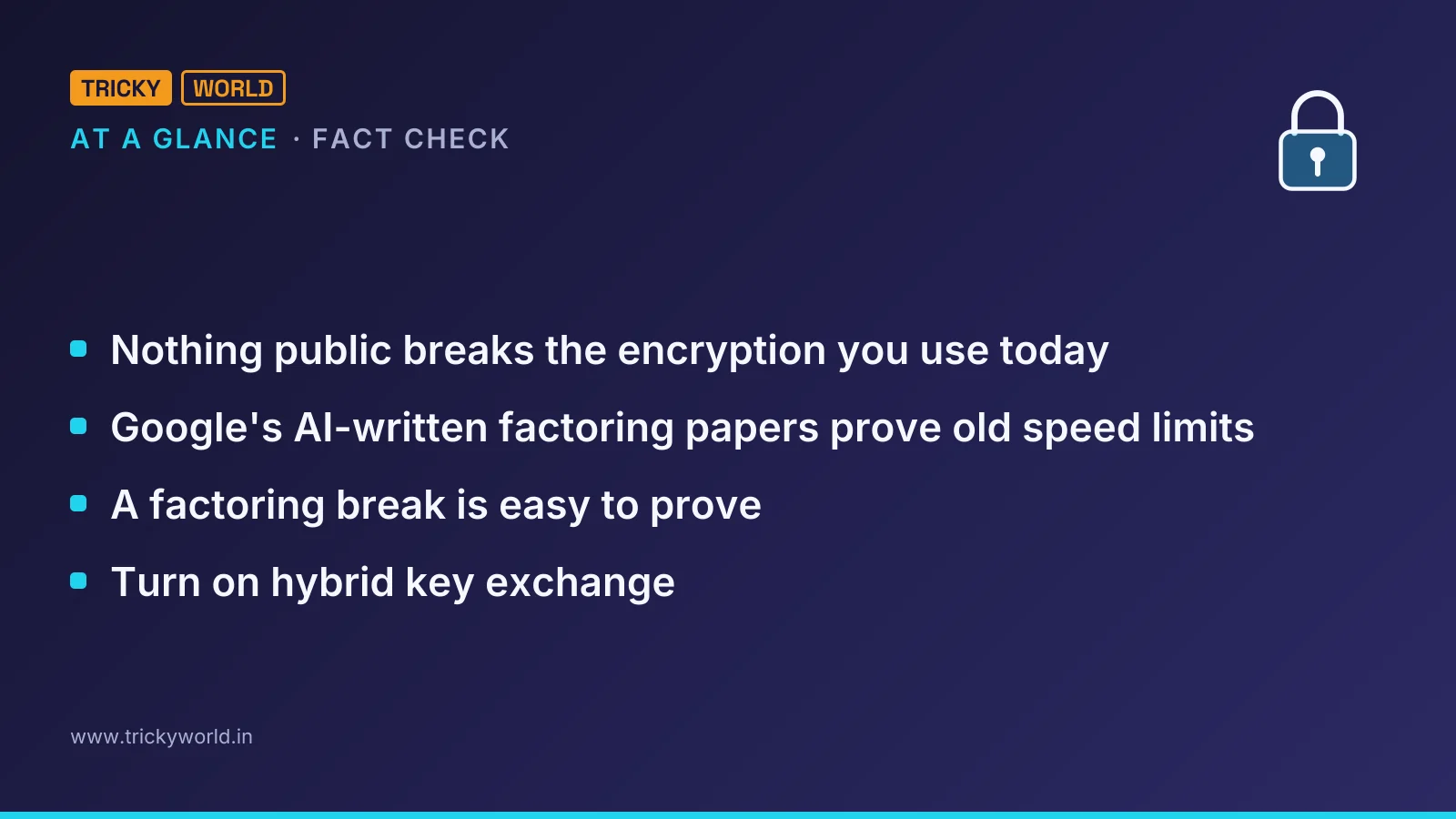
AI is now good enough at mathematics that a cryptographic shock is no longer unthinkable, and Aaronson's caution cuts both ways. Until someone posts factors, code or a checked proof, the rumor stays a rumor. The protection against the day it isn't is already standardised and switched on at many of the sites you use.
Frequently asked questions
Would a longer RSA key protect me if factoring were in P?
Not for long. Against today's number field sieve, RSA-4096 costs roughly 2^40 times more work than RSA-2048, going by the bare formula. A polynomial-time algorithm grows so slowly that doubling a key multiplies the work only by a fixed factor. Moving to ML-KEM and ML-DSA, which don't depend on factoring, is the real fix.
Is Bitcoin at risk from the factoring rumor?
Not directly. Bitcoin signs transactions with elliptic-curve keys and mines with SHA-256, so a factoring algorithm on its own wouldn't touch it. An elliptic-curve break, or a large quantum computer, would put at risk the coins whose public keys are already visible on the blockchain.
How can I see whether a website uses post-quantum encryption?
In Chrome, open DevTools, go to the Security tab and look at the connection's key exchange. X25519MLKEM768 means the post-quantum hybrid is in use; X25519 on its own means a classical key exchange.
Should I change my passwords because of this rumor?
No. Nothing published breaks the encryption that carries your password to a website or the hashing that sites use to store it, so a new password protects nothing that the old one doesn't.

About the author
Vishal · Software & security engineerVishal writes Trickyworld's tutorials and interview-preparation guides on programming, databases, cyber security and AI. Vishal has been shipping production software long enough to have firm opinions about Python, PHP, Node.js, and JavaScript, and to have been wrong about each of them at least once. The work has run the whole stack: Drupal and Laravel applications, React front ends, MySQL and MongoDB underneath, Redis and Memcached for the things that had to be fast, Apache Solr for the things that had to be findable. That last part turned out to matter more than anyone expected. Tune a Solr index for a season, then watch a language model confidently retrieve the wrong document, and you recognise an old problem wearing new clothes. Most of what is hard about AI systems is not the model. It is retrieval, caching, latency budgets, and deciding what the system does when the answer comes back wrong — which is work he has been doing since well before anyone called it AI engineering. He plays a lot of games, which is less a hobby disclosure than an admission of where a good share of his engineering instinct came from. Real-time systems with a frame budget. State that has to stay coherent while a player does something no designer anticipated. The permanent question of what happens when the frame cannot finish in time. Those habits carry over more directly than they have any right to. He has written several books on programming, all built on the same conviction: most technical writing is unclear because the author never decided what to leave out. More from Vishal → · Editorial policy