Claude managed services: Cognizant commits over 25,000
Cognizant has committed more than 25,000 professionals to Claude client delivery and introduced managed services to run clients’ production systems. The model combines licensed Claude access, operations and governance; prices, spending caps and detailed service-level commitments are not published and must be defined in the agreement.
Summary written with AI from this article, and checked against it.

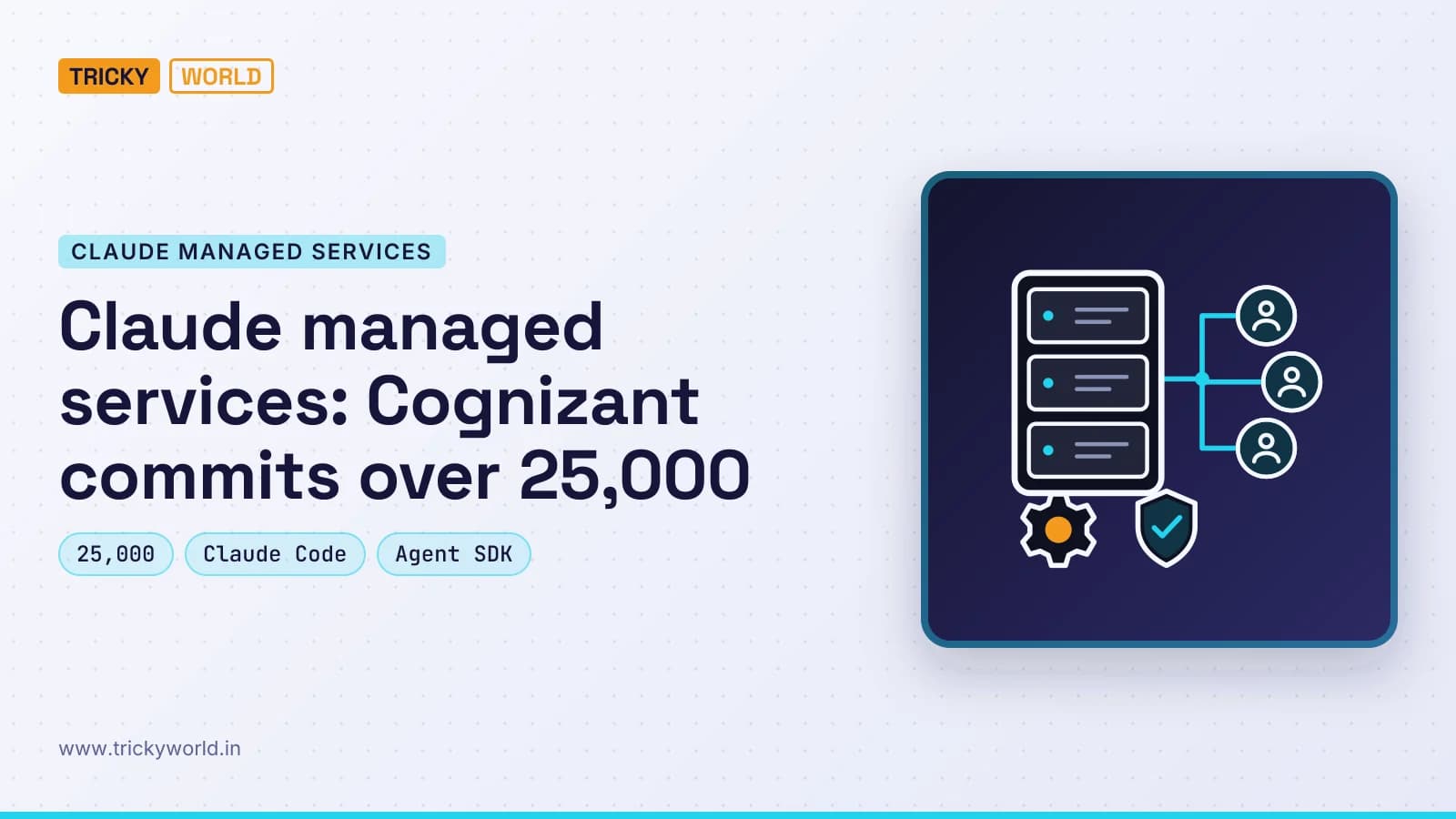
Cognizant has committed more than 25,000 professionals to building and running clients’ Claude-powered systems. Announced on November 10, 2026, its Claude managed services model combines production operations, licensed Claude access and governance under one delivery partner. Here’s what the commitment covers, how it differs from Cognizant’s internal Claude rollout, and what to ask before handing over a production workflow.
For teams modernising legacy code or connecting agents to business systems, the question is who runs the result once the pilot is over. In Cognizant’s announcement, the company says it will operate those systems on clients’ behalf, with controls tailored to their connectivity, architecture and risk requirements. Whether Claude can perform a task is only part of that decision. The other part is whether the proposed operating arrangement fits the workflow your team needs to hand over.
What changes with Claude managed services?
There are two pieces to the announcement: a dedicated delivery organisation and a service for operating production systems. The new Claude Frontier Capability Group brings together more than 25,000 professionals focused on client delivery. The managed services model is a separate piece, packaging dedicated talent, licensed Claude access and Cognizant’s own delivery intellectual property. Both can support the same deployment, but the group identifies who is available to deliver the work, while the managed service describes how Cognizant intends to take responsibility for running it.
Cognizant also says the model offers more predictable spending and enterprise security and governance controls. Production responsibility is the consequential change. The company is offering to operate Claude-powered systems inside client businesses, rather than finish at implementation. If your team is preparing to hand over an agent-backed workflow, the scope of those operations belongs at the centre of the buying decision, not at the edge of the proposal.
The employee rollout and delivery group have different scopes
The new model builds on an earlier partnership; it does not replace it. Cognizant’s November 4, 2025 announcement described an internal Claude rollout and plans to incorporate Anthropic’s capabilities into its engineering offerings. According to the November 2026 announcement, that workforce deployment is continuing.
Cognizant gives several workforce figures. Keep them separate when reading the announcement, because each describes a different population or commitment.
| Figure | What it describes | Status stated by Cognizant |
|---|---|---|
| More than 25,000 professionals | Claude Frontier Capability Group | Dedicated client delivery organisation announced November 10, 2026 |
| More than 44,000 associates | Claude skills across business units and corporate functions | Already trained or certified |
| Up to 350,000 associates | Internal access across corporate functions, engineering and delivery teams | Rollout planned in the November 2025 announcement |
The figures are not interchangeable. A population scheduled to receive access is not a count of people already trained, and the training count is not the size of the dedicated delivery group. Nor does any of these labels mean that Cognizant has hired that many new employees. The distinction is between access, skills and an organisation assigned to client delivery.
Anthropic’s partnership description also lays out plans to align Claude models, Claude Code, the Model Context Protocol (MCP) and the Agent SDK with Cognizant’s engineering platforms. The intended workflow includes access to existing data and applications, multi-step work and human oversight. Those plans describe the integration direction; the new operating model adds an offer to run production services on top of that work.
Where the new Claude group will focus
Coding assistance is only part of the group’s initial remit. Cognizant identifies four areas, covering changes to business processes, work on existing systems and the operations that follow deployment:
- Business-domain redesign: The group will work on reorganising business domains around AI, rather than simply adding assistance to a process that otherwise stays unchanged.
- System building and modernisation: Cognizant plans to build and modernise supporting systems. It says purpose-built Claude agents accelerate the analysis and refactoring of legacy and mainframe code.
- Agent operations: The group will focus on running agents securely at scale, making their operation part of its stated remit.
- Cognizant intends to make AI-native software engineering, including coding, testing, documentation and DevOps workflows, a core capability in how it delivers work.
The earlier partnership describes the intended engineering work in more detail. It includes coding, testing, documentation and DevOps workflows, alongside agents governed by explicit policies, approvals and human-in-the-loop controls. These are plans for integration and delivery. They are not instructions for configuring a particular application, and they do not provide that level of implementation detail.
Which of these areas does the Claude managed services contract cover? Modernising a codebase and operating a business-facing agent may use the same model family. That does not make them the same delivery assignment, or make a description of one a sufficient scope for the other.
What Cognizant reports from existing client deployments
Cognizant reports the following outcomes from its client work. Each figure belongs to a different business activity, so the workflow beside the number matters as much as the number itself.
| Client setting | Claude-powered work | Result reported by Cognizant |
|---|---|---|
| Global pharmaceutical manufacturer | Shop-floor agents | Downtime reduced by 35%; troubleshooting moved from 90–120 minutes to 10–15 minutes |
| Media and entertainment company | Automated requirement data sheet creation | Time to market moved from 3–4 weeks to about 15 minutes |
| North American insurer | Campaign brief generation and retirement plan support | Work accelerated by 40%–60% |
These examples help explain why Cognizant is positioning the group around core operations, not just developer productivity. The work ranges from a manufacturing workflow to document preparation and insurance-related support. Coding assistance alone would not describe that set of engagements.
Use the examples to choose what to measure, not to forecast a matching percentage for another deployment. Troubleshooting duration is useful for one workflow; requirement-sheet preparation needs its own baseline. In a production evaluation, the measure needs to stay tied to the task being changed.
Evaluate a Claude production handover with Cognizant
For an enterprise considering this model, start with a bounded workflow and a written operating scope. The checks below turn the announcement’s commitments into questions for a delivery proposal. They keep the discussion attached to the system being handed over, rather than to the service description alone.
Choose the workflow and its outcome first. Pick a specific process within the announced remit, such as legacy-code analysis or requirement data sheet creation. Record how the process works today, then state what improvement would justify changing it. A broad ambition such as adopting agents is not a useful acceptance condition for that particular piece of work.
Separate implementation from production operation. Have the proposal spell out what Cognizant will build, what it will run after deployment and what your team will still own. The announcement promises an accountable operating partner. The engagement needs to translate that promise into a concrete description of responsibility for the selected system, including the work that stays with you.
Map connectivity and approval boundaries. Ask how the proposed system will connect to existing applications and data, which actions need approval and where people remain involved. Those questions follow the partnership’s stated direction of explicit policies, approvals and human oversight. Request an explanation for the workflow under discussion; a general description of governance does not answer the same questions.
Evaluate spending alongside the business result. Request the proposed scope for licensed access and production operations, then compare that scope with the outcome you intend to measure. In a Claude managed services proposal, the commercial discussion needs to cover the operating arrangement as well as the model access included in it. Keep both parts in view when assessing the proposal.
Predictable spending is not a published price or service guarantee
The announcement describes spending predictability. It does not publish prices, a spending cap or detailed service-level commitments, so those terms still have to come from the proposal and agreement. The security and governance description has the same limitation: Cognizant says controls will be customised, but it does not provide an implementation specification that a reader can assess.
The client figures have limits too. The announcement does not include enough evaluation detail to reproduce those results from its description alone. It establishes what Cognizant reports achieving in particular engagements, not an expected return for every enterprise deployment. Faster performance on one activity does not, on its own, tell you the economics of a different workflow.
For an individual developer choosing a coding assistant, this is an enterprise delivery announcement, not a new setup procedure. The earlier plans involving Claude Code, MCP and the Agent SDK still provide relevant context. Nothing in this announcement, though, asks developers to migrate an application or change a configuration. The announcements supply no commands or application configuration that would let a reader reproduce the managed service. The work available to a team at this stage is to define the handover and its acceptance conditions, before agreeing to expand the scope.
Shortlist the offer for a team that wants an external partner to operate a defined Claude-powered business process, rather than merely help build it. Operating responsibility is the useful commitment here, and the decision depends on how precisely the agreement defines it. If ownership, approval boundaries or commercial terms are still unclear, keep the scope narrow and get written answers to those questions before agreeing to expand it.
Frequently asked questions
How many Claude certifications does Cognizant report?
Cognizant says it holds more than 26,000 Claude certifications and ranks first globally for Claude Certified Architect: Foundations.
Which industry was the initial focus for the partnership’s vertical solutions?
The November 2025 partnership announcement named Financial Services as the starting point for vertical solutions embedding agentic workflows in regulated enterprise environments.
How did Cognizant plan to begin client engagements?
The earlier partnership announcement said Cognizant planned to engage clients through workshops, reference patterns and platform integrations to identify high-value use cases and move them into production.
Sources
Primary sources
- Write-upCognizant dedicates more than 25,000 professionals to Claude delivery, introduces managed services model to run Claude at the core of enterprise operations · prnewswire.com
- Write-upCognizant brings Claude to 350,000 employees · anthropic.com
- Write-upCognizant Adopts Anthropic's Claude to Accelerate Enterprise AI Adoption at Scale and Deploys Claude to Drive Internal AI Transformation · edge.prnewswire.com
Reports of the story
- News report#cognizant #anthropic #claudeai #enterpriseai #artificialintelligence | AIM · linkedin.com
How this article was made: drafted with AI from the sources above and fact-checked against them, then reviewed by Vishal on . How we write and check articles.

About the author
Vishal · Software & security engineerVishal writes Trickyworld's tutorials and interview-preparation guides on programming, databases, cyber security and AI. Vishal has been shipping production software long enough to have firm opinions about Python, PHP, Node.js, and JavaScript, and to have been wrong about each of them at least once. The work has run the whole stack: Drupal and Laravel applications, React front ends, MySQL and MongoDB underneath, Redis and Memcached for the things that had to be fast, Apache Solr for the things that had to be findable. That last part turned out to matter more than anyone expected. Tune a Solr index for a season, then watch a language model confidently retrieve the wrong document, and you recognise an old problem wearing new clothes. Most of what is hard about AI systems is not the model. It is retrieval, caching, latency budgets, and deciding what the system does when the answer comes back wrong — which is work he has been doing since well before anyone called it AI engineering. He plays a lot of games, which is less a hobby disclosure than an admission of where a good share of his engineering instinct came from. Real-time systems with a frame budget. State that has to stay coherent while a player does something no designer anticipated. The permanent question of what happens when the frame cannot finish in time. Those habits carry over more directly than they have any right to. He has written several books on programming, all built on the same conviction: most technical writing is unclear because the author never decided what to leave out. More from Vishal → · Editorial policy