CVE-2026-125350: Chrome XML flaw needs an update
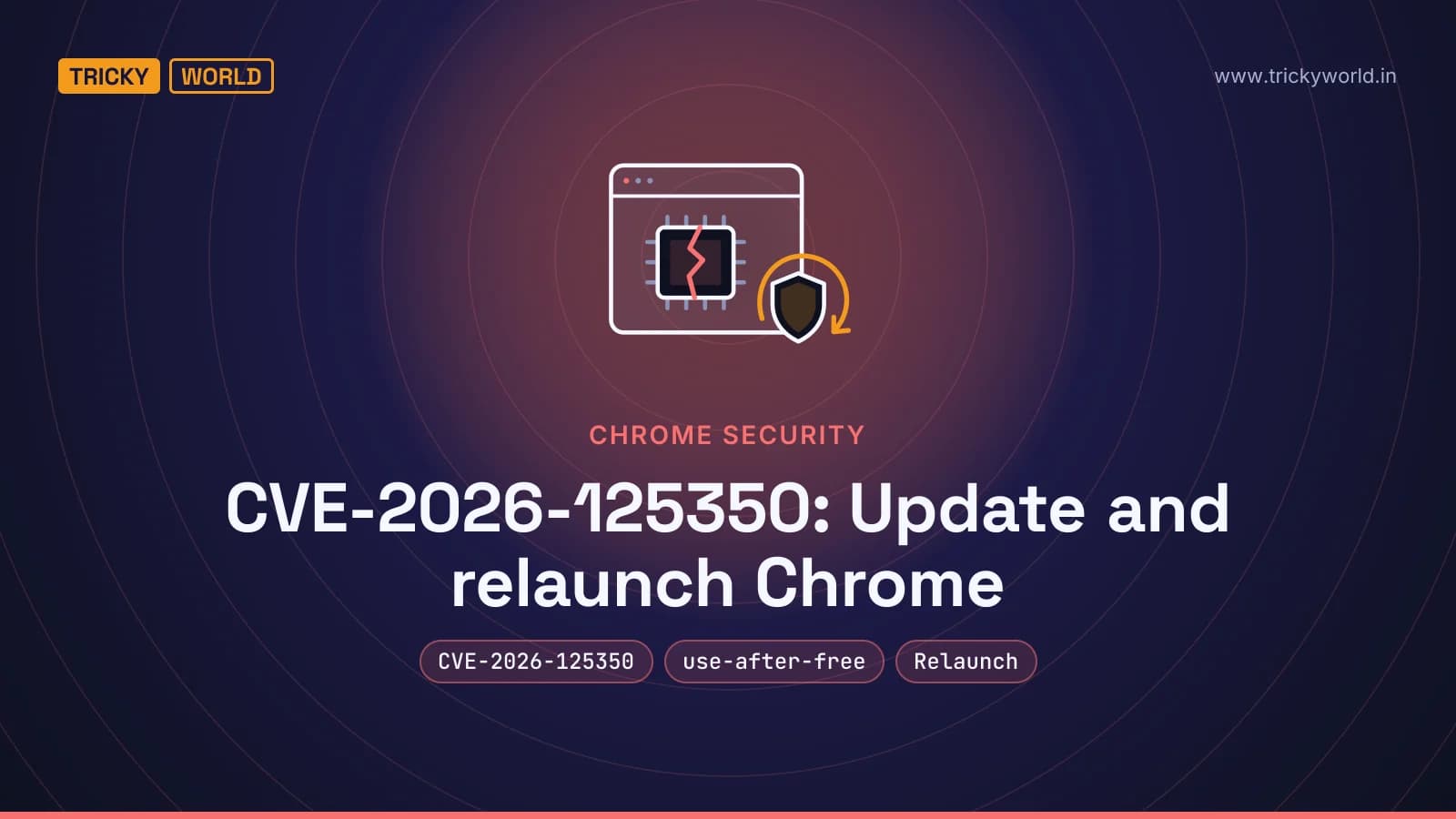
Google says an exploit exists in the wild for CVE-2026-125350, a use-after-free flaw in Chrome’s XML component. On Windows, macOS and Linux, check More > Help > About Google Chrome, install available updates and select Relaunch. The reported update targets are recommendations; checked advisory records publish no confirmed fixed version.
Summary written with AI from this article, and checked against it.

At a glanceCVE-2026-125350
CVE-2026-125350 has no CVSS score yet: NVD has no record of it so far. No fixed version has been published yet.
| Severity | Not scored yet: NVD has no record of it yet |
|---|---|
| Fixed in | No fixed version published yet |
| Affected | Not published yet |
| Exploited | Not in CISA's Known Exploited Vulnerabilities catalog |
| Public exploit | None reported |
| Ubuntu | Not tracked yet |
| Debian | Not tracked yet |
| Red Hat | Not tracked yet |
Is there a public exploit for CVE-2026-125350?
No public exploit is listed as of November 10, 2026: NVD has no record of it yet, no public GitHub repository names it, and it is not in CISA's Known Exploited Vulnerabilities catalog.
From NVD · checked November 10, 2026
Google says an exploit exists in the wild for a use-after-free flaw in Chrome’s XML component, tracked as CVE-2026-125350. Check More > Help > About Google Chrome and select Relaunch to install available updates. There is a caveat to the version numbers: as of November 10, 2026, NVD has no record, and the checked advisory records publish no fixed version. The update targets below are recommendations from The Hacker News, while the checked NVD and distribution data publish no fixed version for CVE-2026-125350.
The Hacker News report says Google released updates to patch nine security vulnerabilities, including the high-severity XML use-after-free flaw. For developers and teams managing company laptops, the reason to act on CVE-2026-125350 is concrete. Successful exploitation of use-after-free bugs can corrupt data, crash a program or allow arbitrary code execution. Prioritise the browser update rather than wait for a numerical severity score.
Check Chrome for CVE-2026-125350 and relaunch
Start with Chrome’s update page. An older security notice is not evidence that this update has been applied, even if it concerns another Chrome vulnerability. The report gives a menu-based check and does not supply a terminal command. Use that documented route rather than substitute an unverified command.
Open Chrome’s version and update page through the following menu path.
More > Help > About Google Chrome- Inspect the displayed version and check for the available Chrome update. Treat the platform-specific recommendations below as the report’s update targets, rather than as independently confirmed boundaries between affected and fixed versions.
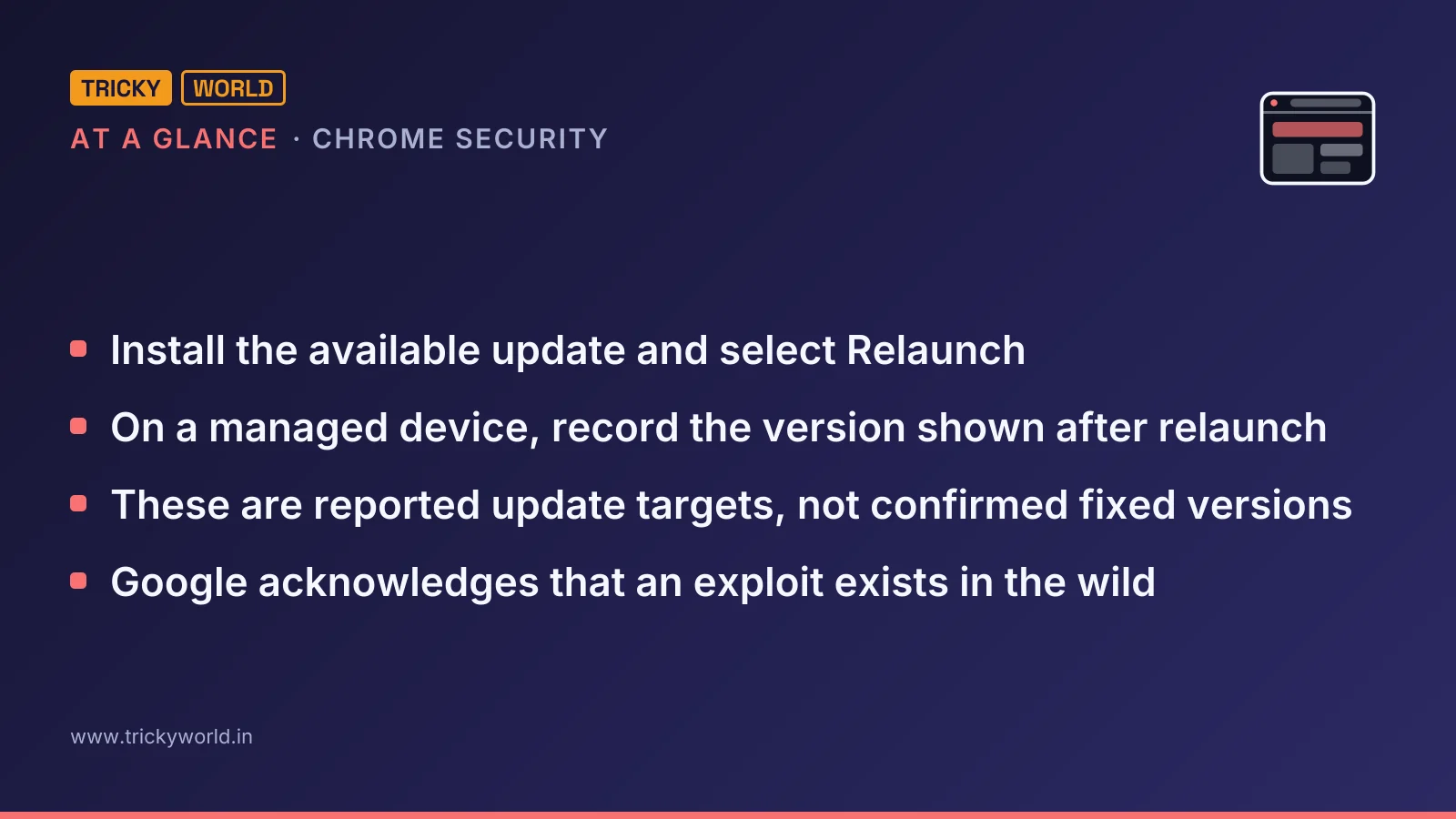
- Install the available update and select Relaunch. On a managed device, record the version shown after relaunch. Do not close the task simply because Chrome has offered an update.
The Hacker News advises users to update to the following Chrome versions for their operating system.
| Platform | Reported update target |
|---|---|
| Windows | 157.0.8103.50/.51 |
| Apple macOS | 157.0.8103.50/.51 |
| Linux | 157.0.8103.50 |
These are reported update targets, not confirmed fixed versions. They come from the news report; the advisory and distribution-tracker records checked on November 10 do not publish a fixed version for CVE-2026-125350. The builds are useful update recommendations. They are not an NVD-confirmed answer to the separate question of exactly which versions are vulnerable and which are fixed.
The XML flaw concerns memory lifetime, not malformed data alone
A use-after-free bug occurs when a program attempts to access memory after that memory has been freed. That is the defect class reported for Chrome’s XML component. The problem is an invalid memory access, not simply an XML document failing validation. Describing it only as malformed data would miss the memory-lifetime issue.
The report explains that successful exploitation of this class of bug can lead to data corruption, program crashes or arbitrary code execution. Those are possible consequences of use-after-free vulnerabilities in general. The report does not establish which of those consequences occurred in attacks involving CVE-2026-125350.
Keep that distinction explicit when explaining the alert to a development team. Calling this only a browser crash issue would understate the reported potential impact; calling it a demonstrated takeover of every vulnerable laptop would go beyond what has been published. The supported description sits between those claims: this is a high-severity memory-safety issue, and Google acknowledges that an exploit exists in the wild.
Check browser installations across Windows, macOS and Linux laptop fleets. Its practical task is to check each browser installation and apply the update available for that installation. Nothing in the published account establishes that changing the team’s own application code would address the Chrome defect. The update work belongs with the browser installations, rather than with an assumed application-code fix.
Prioritise the Chrome rollout without inventing a deadline
Google’s acknowledgement of an exploit is the reason to move this ahead of routine browser housekeeping. The report describes an exploit already existing in the wild, not only a hypothetical problem found during development. It does not publish an organisation-wide deployment deadline, though. The reason for urgency and the absence of a stated deadline both need to stay in the account.
My recommendation is to make this an expedited browser-update task and tie completion to the version check after relaunch. That is an operational judgement, not a deadline issued by Google or CISA. It also gives the task a concrete completion check: an update notification alone is not evidence that the running browser has been updated.
For a company laptop fleet, the completion record should distinguish between these two sets of browser checks:
- For Chrome installations, record the operating system, the displayed browser version and whether the update-and-relaunch check has been completed.
- For other Chromium-based browsers, record the browser product and the status of its own vendor’s fix. Do not assign a Chrome build number to a different browser.
This records a narrower result than a claim that every device has been proved safe. The available information supports checking browsers and applying their updates. It does not supply an affected-version range for CVE-2026-125350, an exposure assessment for a particular organisation or evidence about what happened on any particular endpoint. A completed update task should not silently become a claim about all three.
If the reported build is not available on a device, keep that device’s update task unresolved and check the browser’s available update again. There is no source-backed configuration workaround here to use in place of the update. An invented setting would not resolve that gap; treating it as protection would create more confidence than the evidence warrants.
The attack path and confirmed fix record remain unpublished
The main gap is between the Chrome update described in the report and the advisory records available for CVE-2026-125350. NVD has no record yet, and no CVSS score has been published. The checked advisory and distribution records publish no fixed version either. Those records therefore do not provide the information needed to state a precise affected-version range.
The Hacker News names recommended update builds, but the presence of those numbers does not settle the discrepancy. For a confirmed fixed-version claim, follow the advisory and tracker status, keeping the caveat alongside the report’s build numbers. That leaves room to report the useful update recommendation without hiding it or claiming more verification than it has.
CISA does not list CVE-2026-125350 in its Known Exploited Vulnerabilities catalog as of the November 10 check. That tells us about the catalog’s contents at that check; it is not proof that exploitation is absent. Google separately acknowledges that an exploit exists in the wild. Neither fact needs to be stretched to accommodate the other.
Google has not disclosed how the flaw is being abused or who is behind the attacks. Its explanation for restricting bug information is that details may remain unavailable until most users have updated. Google also says restrictions can continue when an affected third-party library is shared with projects that have not yet fixed it. That describes a conditional policy, not confirmation that this particular flaw reaches those other projects.
The published material gives no temporary mitigation for users who cannot update. Recommending a browser flag, an extension or a procedure for disabling XML would therefore be speculation, rather than a documented alternative. The supported advice is to apply the available browser update and relaunch, with the unconfirmed version boundary stated plainly rather than lost from the instructions.
Keep other Chromium browsers on their own patch track
The report also advises users of Microsoft Edge, Brave, Opera and Vivaldi to apply fixes for CVE-2026-125350 as they become available. It does not name fixed releases for those browsers. Nor does it say that every one of those vendors has already delivered an update, so the advice should not be read as a release confirmation.
For a mixed-browser estate, keep the Chrome rollout separate from the other browsers’ update tasks. The Chrome versions in the table are not published fix targets for Edge, Brave, Opera or Vivaldi. A completed Chrome check answers the Chrome task; it should not also close a task for an unrelated browser installed on the same estate. Advice to apply fixes when available is not confirmation that a fix is available now. For each named browser, use its available vendor update. There is no supported version number or release date in this account to attach to those other browsers, and the Chrome table does not supply one.
The report’s recommendation extends to other Chromium-based browsers generally, with those named products given as examples. It does not provide a tested workaround or a complete inventory of other affected software. That leaves no basis for expanding this alert into a claim about every application that handles XML. The component name alone does not supply the missing inventory.
Separate this Chrome alert from earlier zero-day findings
The Hacker News describes this as the eighth actively exploited Chrome zero-day addressed during 2026. Its earlier examples include CVE-2026-2441, CVE-2026-3909 and CVE-2026-3910. That history gives context for the update, but it does not establish the affected or fixed versions of CVE-2026-125350. Those still have to be treated as separate questions.
The older identifiers have more developed records. NVD has analysed all three, and CISA’s catalog lists CVE-2026-3909 and CVE-2026-3910 as known exploited vulnerabilities since March 13, 2026. They cannot be borrowed to fill the gaps in the current alert, even though all of the identifiers concern Chrome.
A device record showing that an earlier Chrome vulnerability was addressed answers an earlier patching question. By itself, it does not answer whether the newly reported update has been applied. Keeping the identifiers separate makes the deployment record more useful: it avoids attaching an older fix to a newer issue and leaves the current update check visible as its own task.
Apply the available Chrome update now, relaunch, and record the version actually shown. In that change record, keep Google’s acknowledgement that an exploit exists alongside the report’s recommended update targets, and note that the checked advisory records do not yet confirm a fixed version. Leave that version-boundary caveat attached to the build numbers while following the advisory and tracker status.
Frequently asked questions
Who discovered and reported the Chrome XML flaw?
The Hacker News credits an anonymous security researcher with discovering and reporting the flaw on November 6, 2026.
Which Chrome versions fixed the earlier CVE-2026-2441?
NVD lists 145.0.7632.75 and 145.0.7632.76 as fixed versions for CVE-2026-2441. NVD scores that older vulnerability 8.8 High under CVSS 3.1, and CISA has listed it in its Known Exploited Vulnerabilities catalog since February 17, 2026. Those details apply to the older identifier, not the new XML flaw.
Which Debian bookworm Chromium package is marked fixed for CVE-2026-2441?
Debian’s tracker marks bookworm’s chromium package as fixed in 150.0.7871.100-1~deb12u1 for CVE-2026-2441. That distribution-specific status does not establish a fix for CVE-2026-125350.
Sources
Primary sources
- DocumentNVD and distribution data for CVE-2026-125350, CVE-2026-2441, CVE-2026-3909, CVE-2026-3910 (checked 2026-11-10)
- CVE recordCVE-2026-125350 in the National Vulnerability Database · nvd.nist.gov
Reports of the story
- News reportGoogle Issues Chrome Security Update for Eighth Actively Exploited Zero-Day of 2026 · thehackernews.com
How this article was made: drafted with AI from the sources above and fact-checked against them, then reviewed by Vishal on . How we write and check articles.

About the author
Vishal · Software & security engineerVishal writes Trickyworld's tutorials and interview-preparation guides on programming, databases, cyber security and AI. Vishal has been shipping production software long enough to have firm opinions about Python, PHP, Node.js, and JavaScript, and to have been wrong about each of them at least once. The work has run the whole stack: Drupal and Laravel applications, React front ends, MySQL and MongoDB underneath, Redis and Memcached for the things that had to be fast, Apache Solr for the things that had to be findable. That last part turned out to matter more than anyone expected. Tune a Solr index for a season, then watch a language model confidently retrieve the wrong document, and you recognise an old problem wearing new clothes. Most of what is hard about AI systems is not the model. It is retrieval, caching, latency budgets, and deciding what the system does when the answer comes back wrong — which is work he has been doing since well before anyone called it AI engineering. He plays a lot of games, which is less a hobby disclosure than an admission of where a good share of his engineering instinct came from. Real-time systems with a frame budget. State that has to stay coherent while a player does something no designer anticipated. The permanent question of what happens when the frame cannot finish in time. Those habits carry over more directly than they have any right to. He has written several books on programming, all built on the same conviction: most technical writing is unclear because the author never decided what to leave out. More from Vishal → · Editorial policy