Claude Code extension backdoor: Check 2.1.313 hosts
The compromised Claude Code extension anthropic.claude-code 2.1.313 installed an SSH backdoor and persistence. Anthropic published 2.1.314, but affected hosts still need isolation, unauthorized SSH-key and persistence removal, and credential and session rotation. Failed SSH-service activation on most macOS and Windows hosts did not prevent persistence or host-data transmission.
Summary written with AI from this article, and checked against it.

Affected systems and impact
| Flaw | Affected systems | Impact |
|---|---|---|
| Malicious loader prepended to the legitimate extension's main JavaScript bundle | Claude Code extension anthropic.claude-code 2.1.313 | Adds an attacker SSH key, installs persistence and sends host details; successful SSH access permits commands and file transfers. |
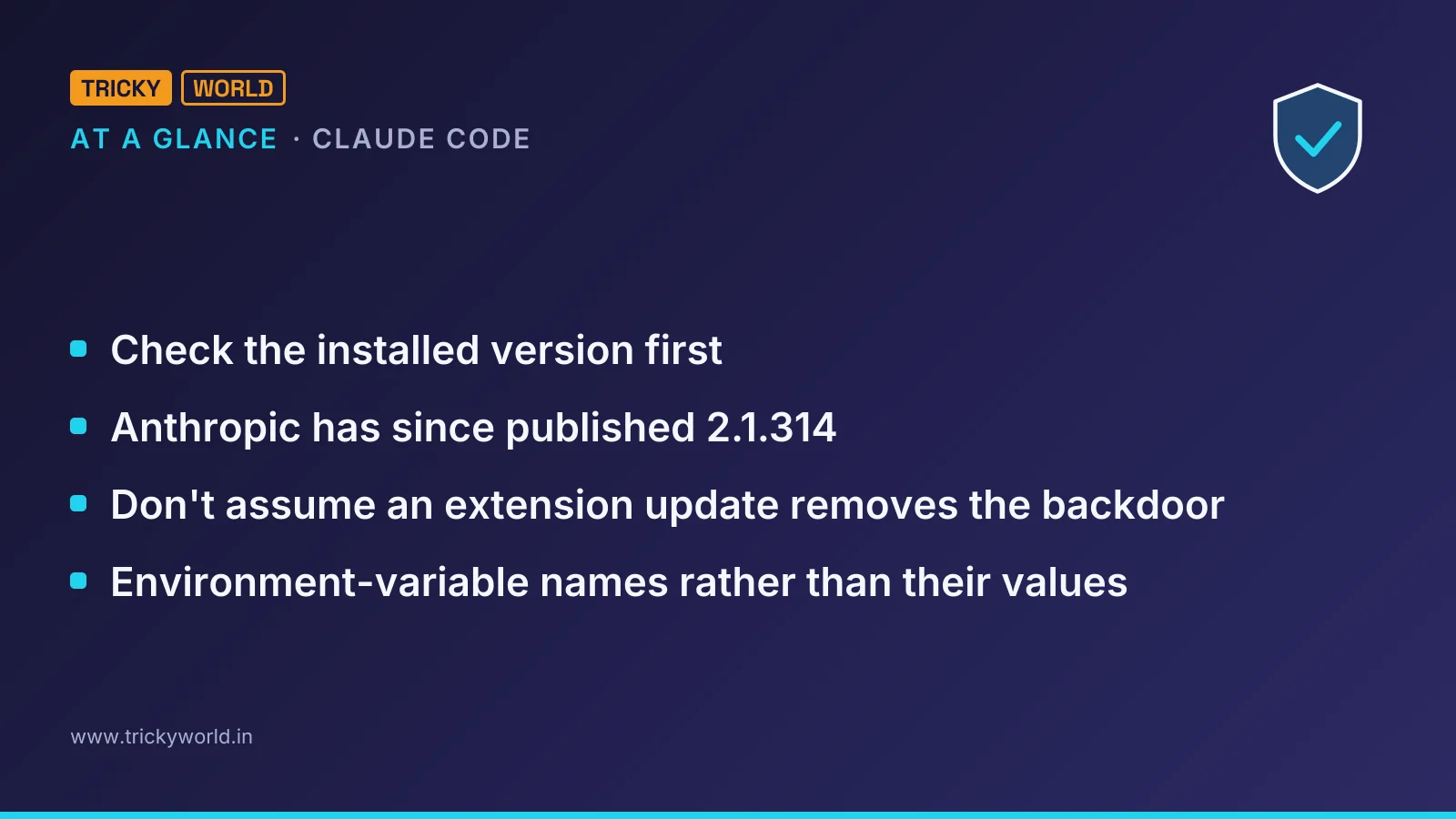
The compromised Claude Code extension identified itself as anthropic.claude-code version 2.1.313, and it could install persistence even when it failed to enable the host's SSH service. Anthropic has since published 2.1.314. Check the installed version first, then investigate the host — don't assume an extension update removes the backdoor.
Cursor says at most 5,000 users installed the malicious version between roughly 2:27 a.m. and 1:35 p.m. PT on October 29, 2026, according to The Hacker News report. Cursor also says Anthropic did not develop this modified build. For a developer account carrying cloud or deployment credentials, the concern is potential account access, not merely a broken editor extension.
Check the Claude Code extension version on each host
The reported malicious package identifies itself as version 2.1.313. Start by checking the installed extension's package identity and version. Where installation or update history is available, compare it with Cursor's reported exposure window. An extension's current version alone does not establish what previously ran on the machine; the relevant identifier is anthropic.claude-code, and the suspicious version is 2.1.313.
As of October 30, 2026, The Hacker News reports that the malicious version has been removed and Anthropic has published 2.1.314 to both Open VSX and Microsoft VS Code Marketplace. That provides a replacement version; it does not establish that an already affected host has been cleaned.
For a laptop fleet, separate machines with confirmed installation evidence from machines whose earlier extension state is unknown, and record the installed version, available installation history, key findings and persistence findings for each device.
The loader preceded the legitimate extension code
OpenSourceMalware co-founder Jenn Gile identified a malicious 66-line loader placed before the legitimate code in the package's main JavaScript bundle. The extension was designed to activate after VS Code startup and when its webview opened. Its malicious behaviour therefore accompanied an extension that still contained legitimate functionality.
The Hacker News describes the compromised extension on Open VSX and traces the incident to a compromise of Cursor Marketplace. Cursor briefly took its marketplace service down to remove the malware. This is a distribution incident involving a modified package, not a report that Anthropic intentionally shipped the backdoor.
After activation, the malware added an attacker-controlled SSH key, attempted to make the host reachable, established a reverse tunnel, and installed persistence. These are the reported artifacts to check against host and network evidence:
| Artifact | Reported value | Role |
|---|---|---|
| SSH authorization file | ~/.ssh/authorized_keys | Received an attacker-controlled key |
| SSH key label | svc-telemetry | Used in an attempt to make the added key appear harmless |
| Reverse-tunnel destination | 134.209.82[.]225 | Provided a pathway to the victim's SSH service |
| Reconnaissance endpoint | 134.209.82[.]225:8099/beacon | Received host details over unencrypted HTTP |
The Claude Code extension package was the delivery mechanism, but the resulting changes extended beyond that package. The key, persistence mechanisms and tunnel explain why removing or replacing the extension cannot be treated as the entire response.
What the beacon exposed from a developer account
The reported beacon collected host and account reconnaissance, including environment-variable names rather than their values. That distinction limits what can be concluded about the initial transmission, but it does not make the information harmless.
The Hacker News reports the following collected fields:
| Category | Collected information |
|---|---|
| Public network address | Public IP address obtained from api.ipify[.]org |
| Machine and account | Hostname and local username |
| Platform | Operating system and CPU architecture |
| Filesystem context | Home directory and current working directory |
| Git identity | Global Git email |
| Environment | Names of up to 40 variables containing KEY, TOKEN, SECRET, PASS, AWS, or GCP |
git config --global user.emailSecurity researcher Paul McCarty explained the difference between the initial beacon and the consequences of successful access:
“Their names can still reveal which cloud providers, CI systems, and credential types are configured. More importantly, successful SSH access would allow the operator to inspect the account directly.”
— security researcher Paul McCarty
For response planning, separate information known to have been included in the beacon from information an operator might have reached through SSH. The report supports investigating both; it does not establish that every configured secret was stolen.
SSH access and the initial compromise remain partly unproven
Installing persistence did not guarantee a successful SSH login. Cursor says enabling the local SSH service requires administrator rights that the extension lacks on most macOS and Windows hosts. On those hosts, that step failed, and Cursor says the attacker could not have logged in through the tunnel.
That limitation does not clear the machine. Cursor says the extension still added the attacker's key, installed persistence and sent host details. Its advice is to perform remediation regardless of whether enabling SSH succeeded.
No other follow-on payloads have been observed, according to the report. This is an observation limit, not evidence that no further access occurred. The reverse tunnel supplied a pathway through which an operator could issue commands or transfer files if SSH access succeeded.
The report also does not explain the initial marketplace compromise in sufficient detail to reproduce it. It provides neither the loader source nor the complete attacker public key, persistence-entry names, or a discovery procedure. I would not present a guessed loader as a reproduction of this incident. The defensible investigation starts with the published artifacts and evidence from the affected host.
There is also no basis here for labelling every earlier extension version, every marketplace copy, or every Claude Code installation as malicious. The concrete package version and Cursor's installation window are the useful starting points for scoping this incident.
Remove Claude Code persistence before restoring the host
The reported remediation is to isolate affected hosts, remove the unauthorized key and persistence, and rotate credentials and sessions. I'd prioritise that host-level response over a routine extension upgrade because the reported changes survive outside the extension's own files.
Use the following sequence as a response checklist for a confirmed installation:
- Isolate the affected host. Follow the recommendation to separate the machine before returning it to normal development work. Do not treat a failed SSH-service activation as a reason to skip the rest of the response.
- Remove the unauthorized SSH key. Inspect the reported
~/.ssh/authorized_keysartifact and thesvc-telemetrylabel. The report does not publish the full public key, so the label alone is not a complete key fingerprint. - Remove the installed persistence mechanisms. The report identifies platform-specific persistence using a scheduled task, crontab and LaunchAgent. It does not provide their exact names or contents, so a verified deletion command cannot be supplied from the published details.
- Rotate credentials and sessions associated with the affected account. Do not restrict the review to values supposedly transmitted in the initial beacon: successful SSH access would have allowed inspection of the account itself.
- Replace the malicious extension with Anthropic's published
2.1.314. Keep this package replacement separate from confirming that the unauthorized key and persistence have been removed.
For the Claude Code extension, the practical distinction is between replacing the delivery package and undoing the host changes. Use the published replacement rather than retaining the reported malicious build, but restore an affected machine to normal use only after the key, persistence and credential response have been addressed.
Frequently asked questions
Could the malicious package have arrived through automatic updates?
Yes, potentially. OpenSourceMalware co-founder Jenn Gile said that users with Claude Code set to auto-update could have received the malware, despite the malicious package being removed quickly.
Will Cursor notify impacted users directly?
Cursor said it would reach out to impacted users directly. The report does not establish that those notifications have already been completed.
Source
- News reportOfficial Claude Code VS Code Extension Compromised to Install Persistent SSH Backdoor · thehackernews.com

About the author
Vishal · Software & security engineerVishal writes Trickyworld's tutorials and interview-preparation guides on programming, databases, cyber security and AI. Vishal has been shipping production software long enough to have firm opinions about Python, PHP, Node.js, and JavaScript, and to have been wrong about each of them at least once. The work has run the whole stack: Drupal and Laravel applications, React front ends, MySQL and MongoDB underneath, Redis and Memcached for the things that had to be fast, Apache Solr for the things that had to be findable. That last part turned out to matter more than anyone expected. Tune a Solr index for a season, then watch a language model confidently retrieve the wrong document, and you recognise an old problem wearing new clothes. Most of what is hard about AI systems is not the model. It is retrieval, caching, latency budgets, and deciding what the system does when the answer comes back wrong — which is work he has been doing since well before anyone called it AI engineering. He plays a lot of games, which is less a hobby disclosure than an admission of where a good share of his engineering instinct came from. Real-time systems with a frame budget. State that has to stay coherent while a player does something no designer anticipated. The permanent question of what happens when the frame cannot finish in time. Those habits carry over more directly than they have any right to. He has written several books on programming, all built on the same conviction: most technical writing is unclear because the author never decided what to leave out. More from Vishal → · Editorial policy