Custom 404 pages: Google says skip blanket redirects
Google says normal 404s do not harm healthy pages; use relevant redirects for replacement content and a helpful error page when none exists.


Google says normal 404 responses neither penalise your healthy pages nor drain your site's crawl capacity. Its guidance: use custom 404 pages for visitors, redirect only to genuine replacements, and return 404 or 410 when permanently removed content has no successor. Here is how I'd apply that distinction to a site's deleted URLs.
For a store, the concern is a shopper reaching a deleted product through an old link and leaving without finding an alternative. Search Engine Journal's coverage of Google's guidance reports that Gary Illyes and Cherry Sireetorn Prommawin frame this as a business and user-experience decision, not a requirement to repair every missing URL for search engine optimisation (SEO).
Missing pages don't drag down the rest of your site
A missing page is not evidence that the rest of a website is unhealthy. Google expects content to disappear: products are discontinued, events finish, and articles become outdated. When Googlebot encounters a 404, it recognises that the page is missing and eventually removes that URL from the index. According to Illyes, that does not penalise other healthy pages.
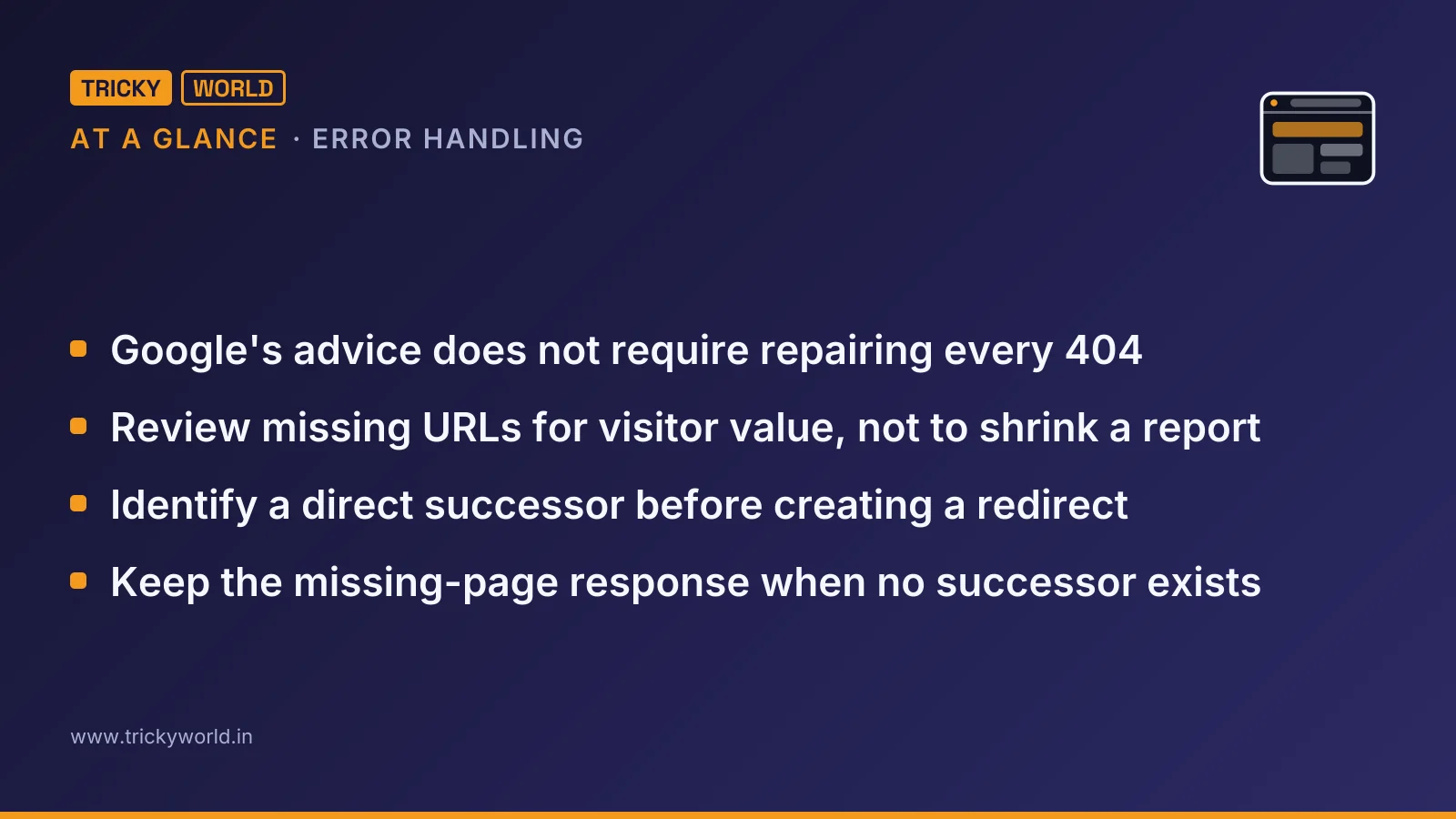
Review missing URLs for visitor value, not to shrink a report. The useful question is whether those missing URLs still serve a business purpose. A report can identify pages to review without establishing that each one needs a redirect, a replacement article, or restoration.
Search Engine Roundtable's account also describes the explanation as a recap rather than new information. This is clarification of existing guidance, not an announcement that Google has suddenly changed how missing pages work.
Redirects need a real successor, not just any landing page
A redirect needs a genuine destination, not merely an available one. Google's examples are specific: an updated version of the same article or a newer model of the same product. The relationship between the old content and its successor is what justifies sending visitors elsewhere.
Start with deleted URLs that still receive traffic or links, then apply the following decisions:
- Check the missing page's remaining value. Review whether people still arrive through existing links or social media, what they were looking for, and whether the page still matters to the business. Google's advice does not require repairing every 404. This review establishes whether there is a visitor problem worth addressing rather than assuming that an entry in Search Console is sufficient reason to act.
- Identify a direct successor before creating a redirect. For a replaced product, that means the relevant newer model. For an updated article, it means the corresponding updated content. Use a one-to-one mapping to that destination. A page elsewhere on the site is not automatically a suitable replacement simply because it remains available.
- Keep the missing-page response when no successor exists. If the content is permanently gone and there is no natural replacement, Google says returning 404 or 410 is appropriate. Allowing the URL to leave the index is part of the normal website lifecycle, not a failure that requires sending everyone somewhere else.
Say a shop removes an older product and sells its direct replacement. That fits Google's redirect example. If the shop stops selling the item entirely and has no replacement, the recommendation changes: retain the missing-page response and help visitors navigate from there.
Redirecting both situations to the homepage erases that distinction. Google's warning is practical: blanket homepage redirects can confuse people and make the resulting data confusing. They move the visitor, but they do not necessarily answer the reason that visitor followed the original link.
Make custom 404 pages useful exits, not dead ends
Custom 404 pages should acknowledge the missing content rather than disguise its absence. Google's recommendation is a friendly explanation followed by useful ways to continue. The page does not need to pretend that the original product or article still exists.
The suggested elements each have a purpose:
- A friendly message tells visitors that the requested page could not be found, instead of hiding the error.
- A search bar gives visitors a way to look for the product, topic, or other content they wanted.
- Links to relevant sections, top categories, or recent content offer routes back into the site without forcing a redirect.
This also separates navigation from replacement. A category link on an error page lets the visitor choose to explore it. A redirect decides the destination for them. Google's advice reserves the latter for a genuinely relevant successor; broader navigation belongs on the helpful missing-page screen.
The response and the visitor experience are therefore separate decisions. Returning 404 does not require leaving people with a blank, unhelpful page. Equally, improving the page does not require abandoning the missing-page response that Google says is appropriate.
Don't conflate 404s with server strain signals
Google says normal 404 responses do not reduce its capacity to crawl the rest of a site. That is different from responses indicating that a server is struggling or asking Google to reduce requests. Treating all of these as one generic error problem misses the distinction.
Google's explanation separates the responses this way:
| Response | What it communicates | Google's stated crawling response |
|---|---|---|
| 404 | The requested page was not found. | Normal 404s do not drain the site's crawl capacity. |
| 500-class errors | The server may be struggling. | Google may slow crawling to avoid making the situation worse. |
| 429 | The server is receiving too many requests. | Google treats this as a signal to slow crawling, similarly to server errors. |
The practical consequence is that a missing-content review and a server-health investigation answer different questions. For a 404, Google's framework asks whether the URL has a replacement and whether visitors need help. For server errors or request limits, its explanation concerns whether continued crawling would put more pressure on the server.
A collection of deleted pages is therefore not, by itself, evidence that Googlebot is losing interest in the healthy parts of a site. Nor should Google's reassurance about 404s be extended to every other error response. The status code and the condition it represents still matter.
A helpful 404 cannot resurrect a deleted product
A better error page offers another route; it does not supply the content someone originally requested. Google's business example is a deleted product page that may still attract potential buyers. Helping those visitors is sensible, but the guidance does not promise that navigation will recover a sale.
Keep the engineering policy narrow: redirect true replacements, retain 404 or 410 for permanently removed content without successors, and make the missing-page experience useful. For permanently deleted URLs with no replacement and no remaining business value, Google's guidance permits leaving them alone; where visitors still arrive, custom 404 pages address the human problem without inventing a replacement. The decision is about what helps those visitors—not making every deleted URL disappear from an error list or creating redirect work solely to eliminate a normal condition from a report.
Frequently asked questions
Does Google's explanation specify when to use 301 versus 302 redirects?
No. Gary Illyes deferred redirect mechanics, including 301 and 302 responses, to a separate discussion. This explanation focuses on whether a genuinely relevant replacement exists.
Where did Google discuss this missing-page guidance?
Google discussed it in The Non-Canonical Cabinet series. Search Engine Roundtable reports that the explanation runs for less than 10 minutes.
Sources

Vishal writes Trickyworld's tutorials and interview-preparation guides on programming, databases, cyber security and AI. Vishal has been shipping production software long enough to have firm opinions about Python, PHP, Node.js, and JavaScript, and to have been wrong about each of them at least once. The work has run the whole stack: Drupal and Laravel applications, React front ends, MySQL and MongoDB underneath, Redis and Memcached for the things that had to be fast, Apache Solr for the things that had to be findable. That last part turned out to matter more than anyone expected. Tune a Solr index for a season, then watch a language model confidently retrieve the wrong document, and you recognise an old problem wearing new clothes. Most of what is hard about AI systems is not the model. It is retrieval, caching, latency budgets, and deciding what the system does when the answer comes back wrong — which is work he has been doing since well before anyone called it AI engineering. He plays a lot of games, which is less a hobby disclosure than an admission of where a good share of his engineering instinct came from. Real-time systems with a frame budget. State that has to stay coherent while a player does something no designer anticipated. The permanent question of what happens when the frame cannot finish in time. Those habits carry over more directly than they have any right to. He has written several books on programming, all built on the same conviction: most technical writing is unclear because the author never decided what to leave out. More from Vishal → · Editorial policy