Gemini 4 Carbon targets cyber defense in staged rollout
Gemini 4 Carbon is planned for selected cyber defenders before wider access, with Google reporting gains in vulnerability detection and patching.

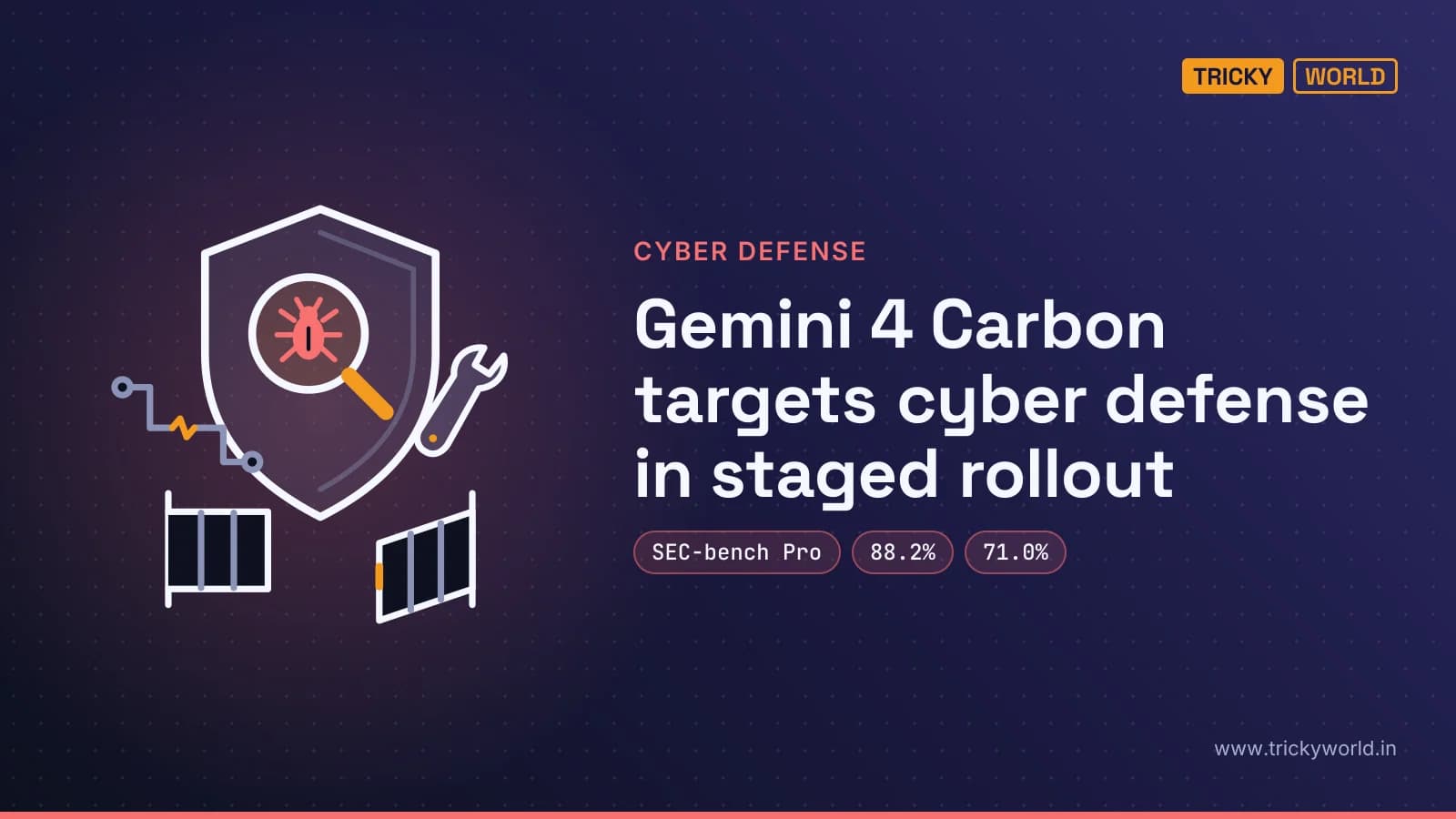
Google plans to make Gemini 4 Carbon available to a subset of cyber defenders starting the week of its announcement — broader developer access comes later. The model targets long-running engineering tasks: vulnerability discovery, validation, and patching. Here's what Google reports, how access works, and how I'd test it before handing it real engineering work.
For teams maintaining production services or large codebases, the claim that matters is sustained investigation, not another quick coding answer. In Google's Carbon announcement, internal teams describe the model working for days through multi-step engineering problems. That could matter for subtle bugs. But the announced rollout isn't an invitation to replace your current development workflow.
Access is staged — check where your team lands
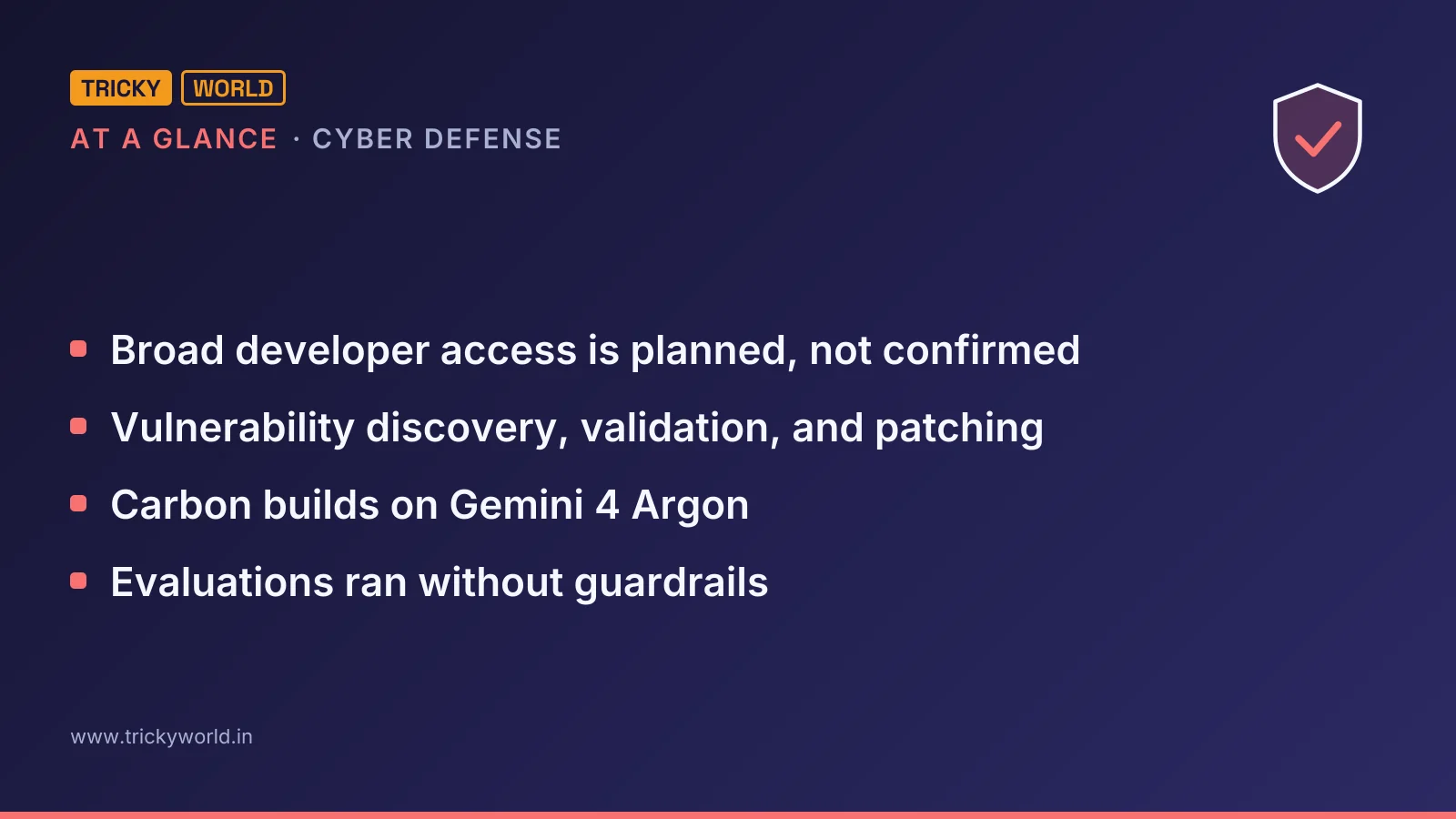
Broad developer access is planned, not confirmed. Google describes an initial rollout to a subset of cyber defenders, then additional trusted partners through its Fairwind Program. Developers, businesses, and consumers come later through Google's product surfaces.
The announcement schedules initial defender access for its publication week, without a calendar date for general availability.
Google also says it's participating in the U.S. government's voluntary pre-release model-testing process. That's an ongoing deployment process, not a statement that testing has finished.
No installation commands, API examples, or model-selection instructions exist in the announcement. There's no supported setup command to reproduce. The immediate decision is whether your team belongs to the intended early audience — not which configuration value to change.
What Gemini 4 Carbon adds over Argon
Carbon builds on Gemini 4 Argon. Google's stated focus spans coding, agentic work, scientific tasks, web development, and multimodal understanding. The concrete cybersecurity claims cover finding flaws, checking exploitability, and producing fixes.
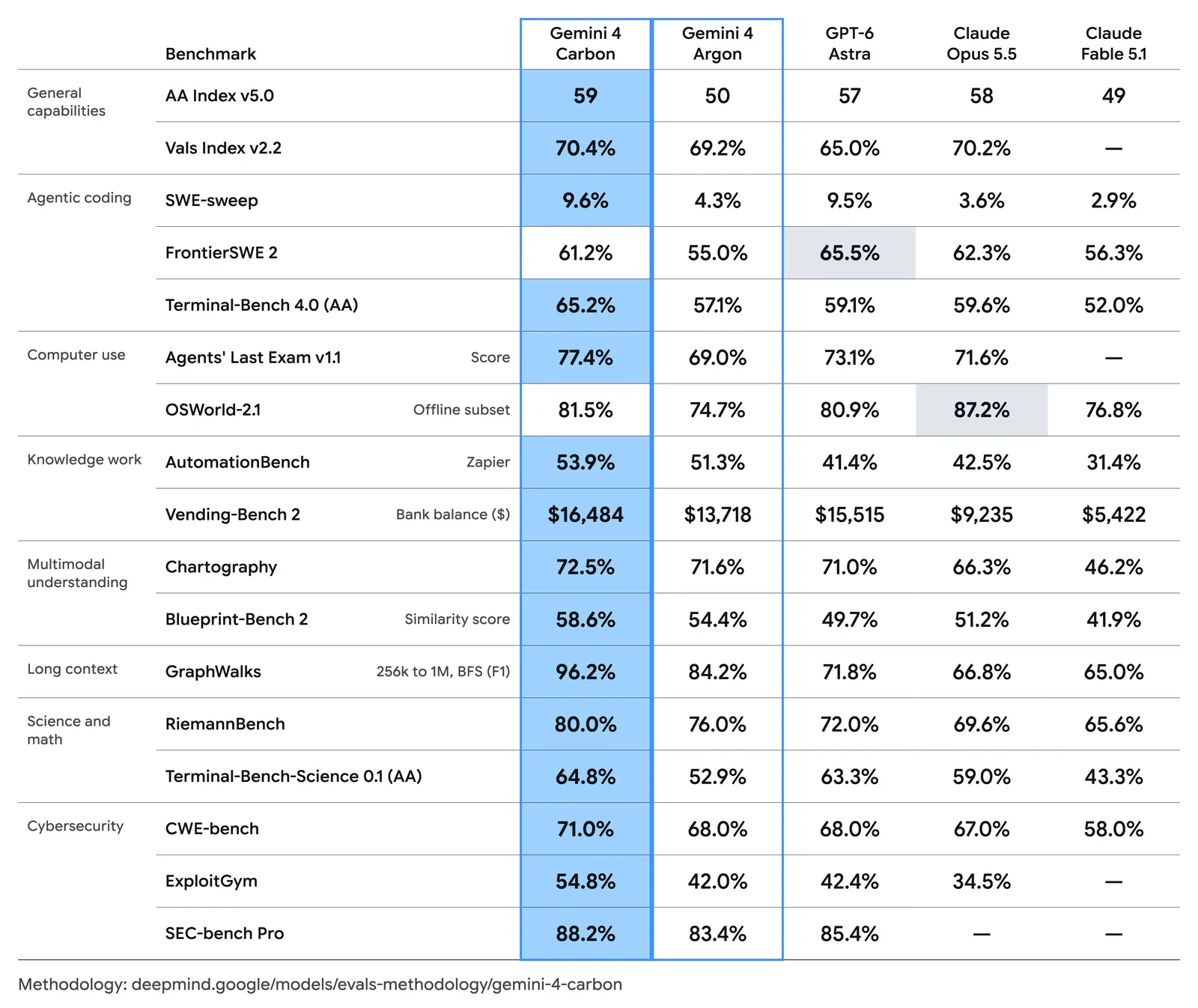
Google reports these external benchmark results, explicitly noting evaluations ran without guardrails.
Benchmark | Capability evaluated | Google-reported result |
|---|---|---|
SEC-bench Pro | Finding real vulnerabilities | 88.2% |
ExploitGym | Validating risk through exploitation | 54.8% |
Collinear's CWE-bench | Patching root causes | 71.0% |
The distinction between these tasks matters. Finding a suspicious code path differs from establishing exploitability, and neither equals fixing the underlying defect. Google presents Carbon as covering the whole sequence rather than specializing only in discovery.
Google also reports more than a 2x uplift over Argon in secure-code generation success on internal benchmarks. That's a separate claim from the external patching result: generating secure code and repairing an existing vulnerability are related but not interchangeable evaluations.
Where Carbon fits a repair workflow
Long-running investigation is the engineering use case behind the announcement. Google says its teams have seen Carbon persist through dead ends while root-causing and patching subtle bugs across large codebases and low-level systems.
Say your team maintains a large service with a difficult bug crossing several parts of the codebase. Evaluate Gemini 4 Carbon by asking it to investigate the cause, explain the evidence, and propose a patch. That scenario follows Google's described internal work — not evidence Carbon will solve your particular defect.
Cyber defenders have another angle: connecting discovery to prioritization. Google describes exploitation testing as a way to establish which findings warrant remediation. The intended benefit: a better-supported decision about a finding, followed by a patch addressing its root cause.
Behavior changes under pressure
Google says Carbon's development also targeted how the model behaves under pressure: whether it takes shortcuts, invents evidence, oversteps instructions, or handles ambiguity poorly. These are behavioral claims alongside the coding scores, not replacements for them.
Google reports these results from safety evaluations and internal coding environments.
Evaluation or behaviour | Reported result |
|---|---|
Terminal-Bench 4.0 cheating | 0.0% successful cheating; 0.4% cheating attempts |
High-severity misalignment alerts in internal live coding | Almost 80% reduction |
Unsupported claims in internal testing | Approximately 2x reduction compared with Argon |
Gray Swan's Indirect Prompt Injection benchmark | 0.0% attack success rate, compared with Argon's 0.7% |
Another stated change concerns incomplete or conflicting evidence. Google says Gemini 4 Carbon retrieves relevant sources and surfaces discrepancies before acting, rather than forcing a choice. It also describes the model placing methodological caveats in its deliverable or explaining which requirements remain unmet when an action is blocked.
For an engineering review, that behavior makes the distinction between completed work and unresolved work easier to inspect. Google's claim isn't merely that Carbon produces more code — it's that the model more accurately represents what it has and hasn't established.
Prepare a pilot around findings and patches
My suggested pilot follows the discovery-to-remediation sequence in Google's announcement, while keeping the model's deliverables separate from the team's acceptance decision.
Choose a bounded engineering task. Select a permitted codebase problem with clear scope — investigating a subtle bug or assessing a suspected vulnerability. Write down the project constraints and the evidence required for a useful result before asking the model to begin.
Require evidence for the finding.
Ask the evaluation to distinguish a suspected flaw from a validated risk. Where exploitability testing is permitted, keep it within that permission. Assess whether the model explains its reasoning and evidence rather than presenting every suspicious pattern as an established vulnerability.
Review the proposed root-cause fix.
Assess the explanation and patch together. The relevant question: does the change address the identified cause while respecting the task's constraints — not whether the model can produce a plausible-looking modification. Keep the team's review as the acceptance point.
Inspect the final account of the work.
Check whether Carbon identifies blocked actions, unresolved discrepancies, and missing evidence. Those are behaviors Google says it improved, so they belong in the evaluation alongside patch quality. Record unfinished requirements separately from completed work rather than treating the entire response as one successful result.
Unguarded benchmarks don't establish deployed safety
The external cybersecurity scores were measured without guardrails. They describe capability under those evaluation conditions. They don't, by themselves, establish which actions a guarded deployment will permit or how it will perform inside your team's workflow.
The internal comparisons also need their original scope. Google's Chrome team reports Carbon performed more than 10X better than another lab's large frontier model at generating high-quality patches. The announcement doesn't identify that competing model or provide enough methodological detail to turn the result into a general comparison against every coding assistant.
A zero attack-success result on Gray Swan's evaluated prompt-injection attempts is similarly bounded by that evaluation. Google itself describes continued feedback gathering and guardrail iteration before broader access. Strong benchmark results justify a careful evaluation; they don't establish that a model can be left to make unrestricted production changes.
No switch yet — wait for confirmed access
There's no general developer migration to perform based on this announcement. Google describes a staged release, and its stated introductory pricing is a plan for launch rather than confirmation of public availability.
Google says Carbon will launch at the same introductory rates as Argon:
Input will cost $2 per million tokens, with cached input tokens priced at 95% off the input-token price.
Output will cost $10 per million tokens.
For a proposed days-long engineering workflow, the practical budgeting question is how much input and output the task would require. Matching Argon's introductory rates doesn't tell a team the total cost of completing its own investigation.
Wait for confirmed access and documented integration instructions before scheduling a production switch. Teams outside the initial cyber-defender audience can leave their current setup unchanged. The useful preparation is a scoped evaluation case with explicit evidence and patch-review requirements, ready for when access is actually offered.
Frequently asked questions
Where does Carbon rank on the Artificial Analysis Intelligence Index?
Google reports that Carbon ranks first on version 5.0 of the Artificial Analysis Intelligence Index, with a score of 59.
What web-development improvement does Google report for Carbon?
Google reports a gain of 89 Elo points on WebDev Arena, placing Carbon fourth with a score of 1768. It connects that improvement to better web-development output and artifact quality.
Does Google report changes in overreach and incomplete task execution?
Yes. Google reports a 26% reduction in overreach and a 29% reduction in under-service, describing these as improvements in completing multi-step plans while respecting project constraints.
Source

Vishal writes Trickyworld's tutorials and interview-preparation guides on programming, databases, cyber security and AI. Vishal has been shipping production software long enough to have firm opinions about Python, PHP, Node.js, and JavaScript, and to have been wrong about each of them at least once. The work has run the whole stack: Drupal and Laravel applications, React front ends, MySQL and MongoDB underneath, Redis and Memcached for the things that had to be fast, Apache Solr for the things that had to be findable. That last part turned out to matter more than anyone expected. Tune a Solr index for a season, then watch a language model confidently retrieve the wrong document, and you recognise an old problem wearing new clothes. Most of what is hard about AI systems is not the model. It is retrieval, caching, latency budgets, and deciding what the system does when the answer comes back wrong — which is work he has been doing since well before anyone called it AI engineering. He plays a lot of games, which is less a hobby disclosure than an admission of where a good share of his engineering instinct came from. Real-time systems with a frame budget. State that has to stay coherent while a player does something no designer anticipated. The permanent question of what happens when the frame cannot finish in time. Those habits carry over more directly than they have any right to. He has written several books on programming, all built on the same conviction: most technical writing is unclear because the author never decided what to leave out. More from Vishal → · Editorial policy