Binance security breach halts deposits and withdrawals
Binance says a breach affected about $6.3 billion in assets; deposits and withdrawals are paused, nearly $3 billion is frozen, and it pledges to cover losses.

Roughly $6.3 billion in assets got caught up in the Binance security breach that forced the exchange to halt deposits and withdrawals. The initial investigation points to a compromised engineer's laptop as the possible starting point. If you rely on Binance, the first job is untangling three different things: whether transfers work, what's actually frozen, and the promise to cover losses.
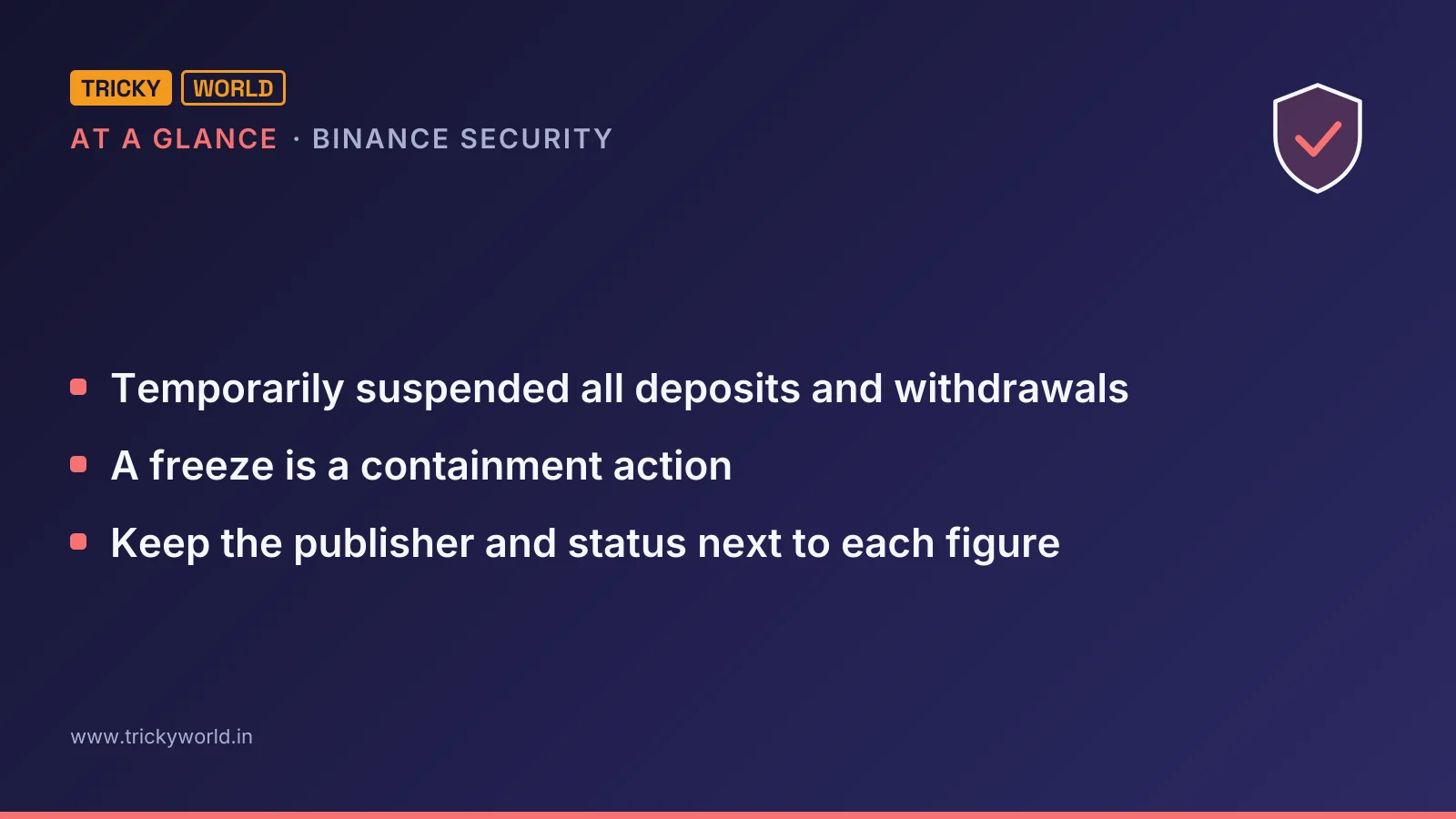
Binance said it had temporarily suspended all deposits and withdrawals while its security teams conducted checks. The final loss tally doesn't change that. The Hacker News reports Binance revoked the compromised address authorization and brought in law enforcement plus blockchain intelligence firms to trace and recover funds. These actions are containment measures. Not a signal that transfers are back.
What the Binance security breach investigation points to
Binance's preliminary explanation sketches a possible path from an engineer's laptop to unauthorized withdrawals. It's not a finished forensic account. The company says a compromised DevOps laptop may have let an attacker reach a service container.
The suspected sequence matters because it connects an employee endpoint with a system capable of submitting withdrawal transactions:
- A DevOps engineer's laptop may have been compromised, according to Binance's initial investigation.
- That compromise may have allowed the attacker to access a service container.
- The attacker then submitted unauthorized withdrawal transactions, Binance said.
That's more specific than "exchange hacked," but the investigation stays open. Binance hasn't locked in this sequence as the final story. The reporting doesn't say how the laptop got compromised or what permissions the container held.
For an engineering review, I'd start at the boundary between developer endpoints and services that can move assets. Binance's preliminary account points there as a review priority — not because a specific access-control flaw is confirmed, but because the real question is what an endpoint compromise can authorize beyond the endpoint itself.
The affected, stolen and frozen totals mean different things
These financial figures measure different things — they're not a single settled loss number. Binance estimates the total impact. Chainalysis estimates what was stolen at the moment of theft. Binance also reports what's frozen on-chain.
| Measurement | Reported amount | Who supplied it |
|---|---|---|
| Assets affected | About $6.3 billion | Binance |
| Estimated amount stolen at the time of theft | Approximately $5.912 billion | Chainalysis |
| Assets frozen on-chain | Nearly $3 billion | Binance |
The distinction matters. Affected assets answers one question; stolen assets answers another. A freeze is a containment action — not proof that amount made it back to customers. France 24, citing Reuters, says Binance located roughly $3 billion but hasn't updated on the other $3.3 billion.
Chainalysis and others say this could be the largest crypto heist on record. The Hacker News puts it against the $1.5 billion Bybit hack from February 2025 — later attributed to North Korea, which concerns Bybit, not this Binance case.
Don't swap the headline impact, the theft estimate, and the frozen amount in an incident report or customer update.
Which firms have frozen Binance-linked assets?
Several organizations have frozen funds tied to the Binance security breach. Their announcements show the containment effort, but they don't establish separate amounts to stack on top of Binance's aggregate figure.
The reported actions include the following:
| Organization | Reported amount | Attribution and status |
|---|---|---|
| Tether | More than 1.567 billion USDT | Tether said it had frozen assets linked to the incident. |
| Circle | More than $800 million | Circle reported freezing funds linked to the incident. |
| Arbitrum Security Council | About $30.5 million | The Hacker News reported that the council was said to have executed a freezing transaction. |
| World Liberty Financial and BitGo | $27 million in stablecoins and about $2 million in World Liberty tokens | World Liberty Financial reported working with BitGo; Binance co-founder Yi He supplied the amounts. |
| Ripple | Roughly $200 million | Yi He reported the amount. Ripple's Jack McDonald said the company was freezing affected funds and coordinating with relevant parties. |
Attribution matters, especially for Ripple. The amount comes from Yi He; McDonald's statement describes Ripple responding to reports of a potential exploit involving Binance. Don't merge those into a claim that Ripple independently confirmed the full amount.
For a treasury or incident update, the safest approach: keep the publisher and status next to each figure. Adding every organization's announcement to the exchange-wide total implies they're separate amounts, which the reporting doesn't support.
Binance promises SAFU and company funds for losses
Binance says it'll cover all losses using SAFU — the Secure Asset Fund for Users — plus its own funds. Co-founder Yi He reiterated the company would cover all hacking losses. That's a user commitment, separate from tracing and recovering assets.
France 24 notes Binance's site describes SAFU as a bitcoin-denominated reserve for protecting user assets during breaches. Citing both SAFU and company funds means Binance's stated response isn't limited to what's already traced or frozen.
Two tracks matter for account holders. The first track involves locating, freezing, and recovering funds with partners. The second track is Binance's commitment to absorb losses.
Plan around Binance's suspended transfers
The immediate constraint is that deposits and withdrawals are paused. Binance called it a precaution while teams check systems, secure wallet infrastructure, and trace affected assets. The statement lays out the details:
“As a precaution, all deposits and withdrawals are temporarily suspended while our security teams conduct checks, secure wallet infrastructure, and trace affected assets, with the close support of our law enforcement and industry partners.”
— Binance, as reported by France 24 with Reuters
My take: organize around that restriction, not around the assumption that a frozen-assets announcement means transfers work again. If you're an account holder or run a Binance-dependent workflow, here's what to check:
- Identify which exchange your account or workflow actually uses. Binance.US is a separate exchange and says it wasn't affected. Confirm whether you're on Binance or Binance.US before tying this incident to an account, service, or business process.
- Review anything that needs deposits or withdrawals. If a payment, treasury move, or app workflow requires a Binance transfer, treat that dependency as broken while the suspension stands. The question is whether the work needs funds to move — not whether Binance promised to cover losses.
- Keep your status items separate. Transfer availability, loss-coverage commitment, recovery announcements — track them independently. Otherwise a positive freeze update turns into an unsupported claim that withdrawals work or an account got reimbursed.
- Use a transfer-resumption announcement as your decision point for transfer-dependent work. A new tracing result, issuer freeze, or law-enforcement update answers a different question. Don't treat those as proof that deposits and withdrawals restarted.
I see this as an availability and dependency review for an engineering team — not a customer-side patch rollout. Binance's response is internal and through partners. The reporting gives no commands, config changes, or customer software updates to apply.
The entry point and final loss remain unconfirmed
The biggest open question in the Binance security breach: how the withdrawals became possible. Binance says there's no evidence of a wallet private-key leak. That statement has a precise scope — it reports absence of evidence, not proof that every wallet-access route is excluded.
The laptop-to-container story is also preliminary. It doesn't justify blaming phishing, malware, a specific software flaw, or an AI-assisted attack. None of those mechanisms appear in Binance's explanation. The attacker's identity is unconfirmed too.
The financial picture is unfinished. Mint reports the amount and status of remaining assets aren't fully confirmed. Binance statements via The Hacker News and Reuters give no timeline for deposits and withdrawals to resume. A loss-coverage promise doesn't fill that gap.
The next real update should confirm transfer availability, reconcile affected and recovered amounts, and nail down the attack path.
Frequently asked questions
Did Coinbase report an impact from the Binance incident?
Coinbase said it was unaffected and was monitoring the situation, according to France 24’s reporting with Reuters.
What happened to Bitcoin and ether after the breach was reported?
France 24 and Mint reported that, in early Asian trading on Friday, Bitcoin fell more than 3% to $76,368 and ether fell more than 3% to $2,178. Those were reported market levels at that time, not current price quotes.
Sources
Primary sources
- Write-upBinance security breach has $6.3 billion impact in potential record crypto heist · france24.com
Reports of the story
- News reportBinance Suffers Security Breach Affecting $6.3 Billion in Assets, Nearly $3 Billion Frozen · thehackernews.com
- News reportCrypto exchange Binance freezes assets after $6.3 billion security breach | Today News · livemint.com

About the author
Vishal · Software & security engineerVishal writes Trickyworld's tutorials and interview-preparation guides on programming, databases, cyber security and AI. Vishal has been shipping production software long enough to have firm opinions about Python, PHP, Node.js, and JavaScript, and to have been wrong about each of them at least once. The work has run the whole stack: Drupal and Laravel applications, React front ends, MySQL and MongoDB underneath, Redis and Memcached for the things that had to be fast, Apache Solr for the things that had to be findable. That last part turned out to matter more than anyone expected. Tune a Solr index for a season, then watch a language model confidently retrieve the wrong document, and you recognise an old problem wearing new clothes. Most of what is hard about AI systems is not the model. It is retrieval, caching, latency budgets, and deciding what the system does when the answer comes back wrong — which is work he has been doing since well before anyone called it AI engineering. He plays a lot of games, which is less a hobby disclosure than an admission of where a good share of his engineering instinct came from. Real-time systems with a frame budget. State that has to stay coherent while a player does something no designer anticipated. The permanent question of what happens when the frame cannot finish in time. Those habits carry over more directly than they have any right to. He has written several books on programming, all built on the same conviction: most technical writing is unclear because the author never decided what to leave out. More from Vishal → · Editorial policy