Fake GTA 6 downloads steal passwords and sessions
Fake GTA 6 downloads deliver malware that steals saved passwords and browser sessions, potentially exposing other users' accounts on shared computers. After running one, disconnect and reinstall the computer, then change passwords from a clean device and cancel existing sessions separately; password changes do not always invalidate stolen sessions.
Summary written with AI from this article, and checked against it.

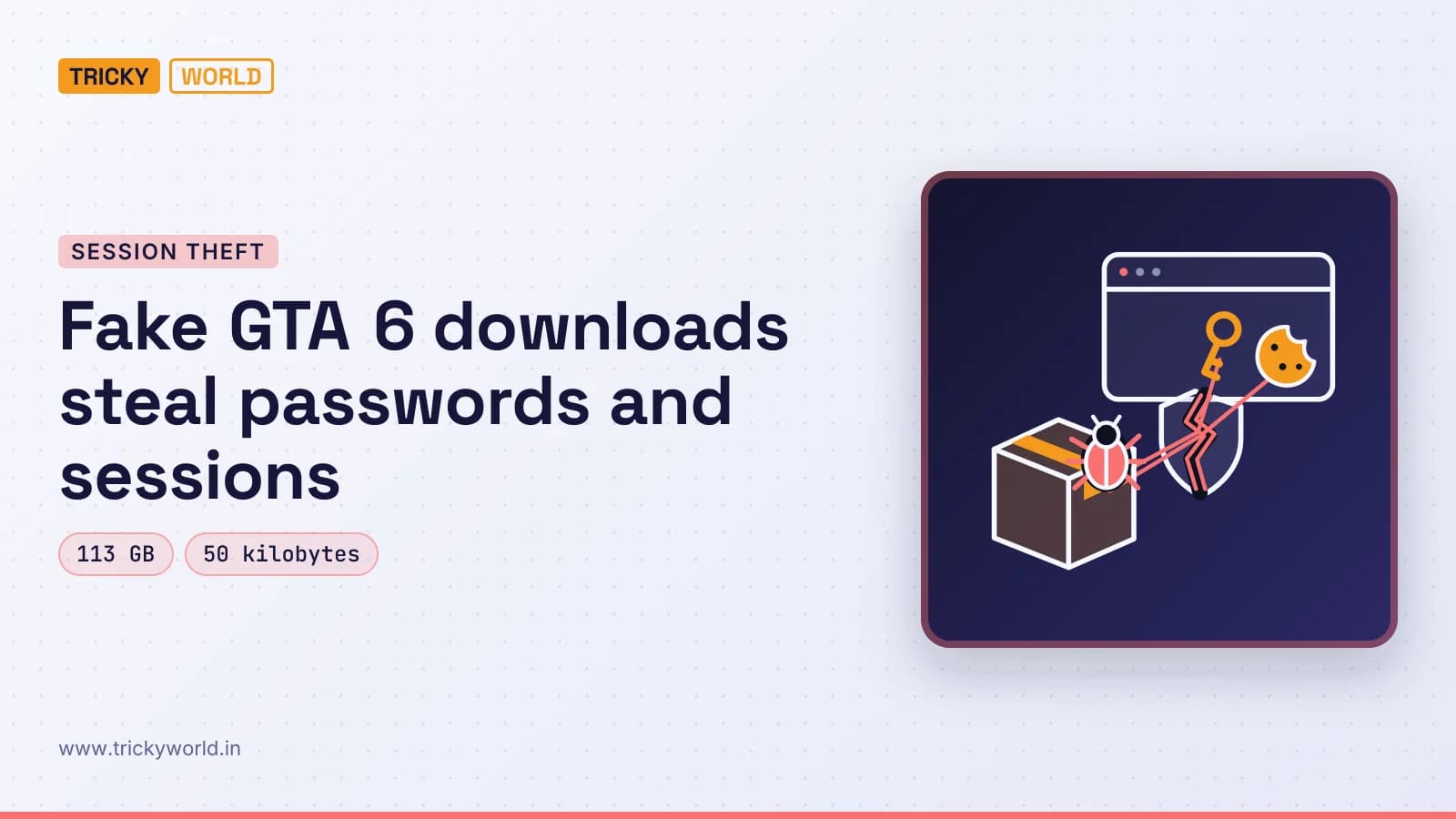
A supposed 113 GB copy of GTA 6 contained mostly empty space and a hidden program of about 50 kilobytes when a researcher examined it. These fake GTA 6 downloads steal passwords and browser sessions instead of delivering the game. Before downloading an offer—or trying to recover after running one—the checks that matter concern the publisher, the file and the accounts exposed to it.
The investigation described in Fake GTA 6 Downloads Are Stealing Gamers' Accounts shows why this is also a shared-computer problem. One person chooses the download, but saved accounts belonging to everyone using that browser can be exposed. On a family laptop, the stolen credentials could cover email, banking and shopping, not just the gaming login that prompted the download.
Fake GTA 6 downloads fail the publisher check
The Rockstar release information cited in the investigation lists PlayStation 5 and Xbox Series X and S. It lists no announced PC edition and reports no public demo or early release. Those are the release conditions the investigation covers, rather than a substitute for checking availability now. Before trusting a new claim, look at the publisher's current listing.
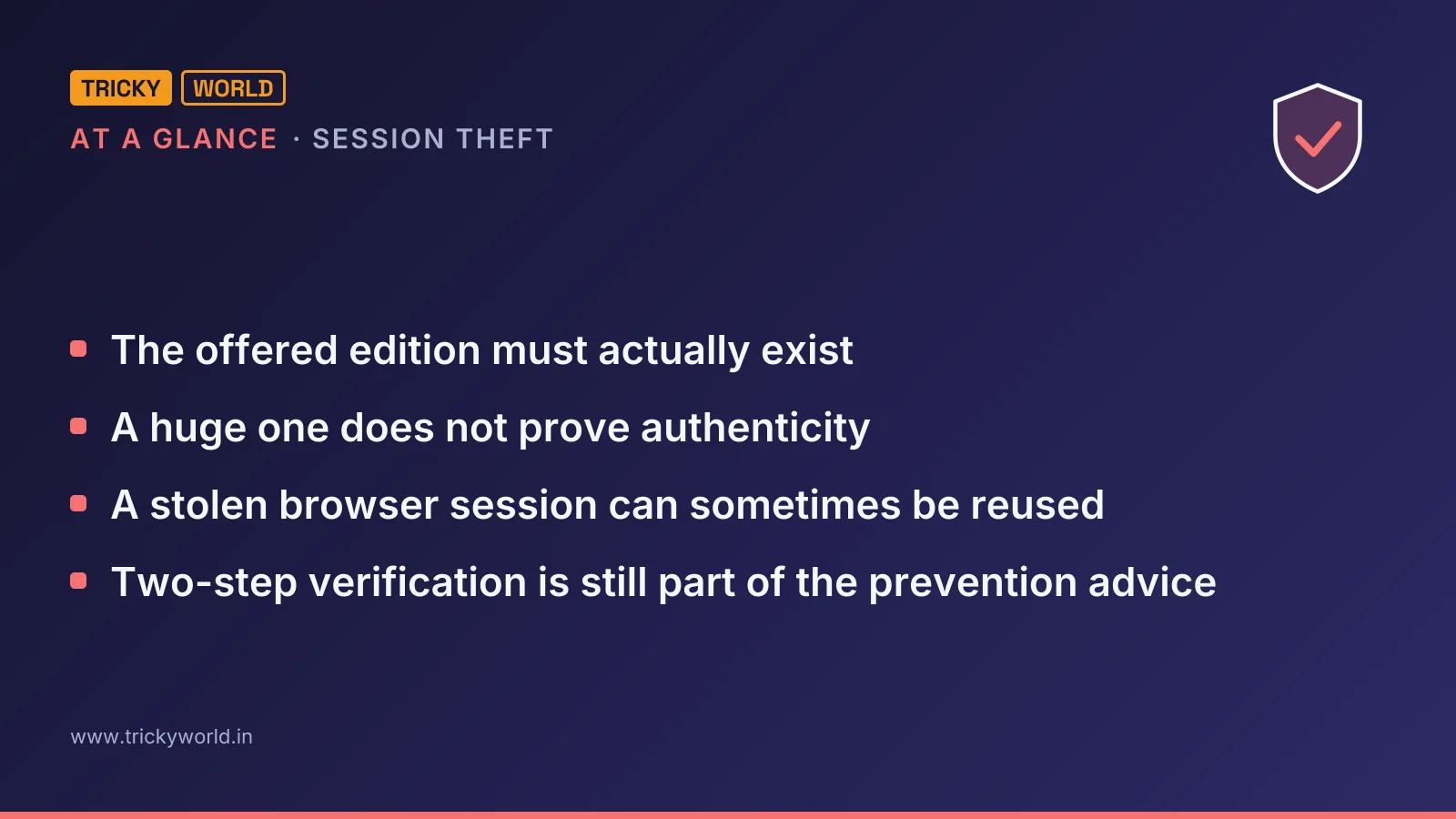
The offered edition must actually exist. However convincing a download page looks, it cannot establish that the publisher has released a PC version, opened a beta or made a demo available.
I'd check that before spending time on screenshots, store branding or the size of the download. The investigation describes real footage leaking online, but says security firms examining the download offers found no playable copy circulating. Someone having video of the game is one thing. The installer placed beside that video containing a playable game is quite another, and the footage does not establish it.
Four lures ask for different kinds of trust
Not every reported offer asks the victim to run malware. Some stores take payment and deliver nothing. Researchers uncovered counterfeit demo pages, while Netcraft found fake Rockstar stores accepting pre-orders. The request varies, but each offer asks the visitor to trust something the publisher has not established.
| Lure | What the offer looks like | Reported outcome |
|---|---|---|
| Fake demo | A Rockstar-style page appearing in demo searches, offering a download just over 1 megabyte | Researchers identified the download as an information stealer. |
| Giant fake download | A purported 113 GB copy circulated through forums, social media and torrent sites | A researcher found mostly empty space around a small malicious program. |
| Paid early access | A $250 VIP offer payable only in cryptocurrency, alongside other counterfeit pre-order stores | Buyers pay for access that does not arrive. |
| Mobile, login and wallet bait | A mobile app, a Rockstar-style login page or a supposed leaked copy requesting a wallet connection | Malware delivery, password collection or attempted wallet draining |
Neither a tiny download nor a huge one establishes authenticity. Both defeat the same shortcut, just from opposite directions: an implausibly small file is suspicious, but a huge one does not prove authenticity. Instead of asking whether the file looks big enough to be a game, ask where the offer came from and whether the publisher actually provides it.
The installer can steal more than a gaming login
Researchers identified the small demo download as an information stealer designed to collect data quietly. The investigation describes it stealing saved browser passwords, autofill details, browsing history and cookies. None of that requires an obvious crash or a warning screen to tell the person at the computer that something has gone wrong.
Huntress examined a separate fake copy that targeted Discord accounts and Minecraft and Roblox sessions. It also targeted screenshots and the computer's location. That package went beyond collecting information: it included remote-control tools and ransomware described as scrambling files without a real payment-based route to recovery.
A failed game launch does not mean the malicious installer failed. In the investigation, the installer warned that the game might not start and referred to a licence error. The victim therefore had an explanation for the missing playable game, even while the unwanted activity took place elsewhere on the computer.
Why two-step verification may not stop session theft
A stolen browser session can sometimes be reused without the criminal going through the normal login process. That is the particular problem with treating two-step verification as enough protection after an information stealer has already run on the computer.
When a website keeps you signed in, a browser cookie can represent the authenticated session. The investigation warns that criminals may be able to reuse that stolen session instead of supplying the password and completing the usual checks again. Two-step verification is still part of the prevention advice. It just may not block this route on its own.
Changing a password does not always cancel existing sessions. For account recovery, change the password and cancel existing sessions; one does not necessarily accomplish the other. The password change replaces a credential; the sign-out addresses sessions that may already be in someone else's possession. Completing one is not a reason to assume the other has happened.
The same distinction helps explain why the person who wanted the game is not the only person at risk. The stealer collects what is available in the browser. It does not limit itself to the accounts belonging to whoever opened the installer, leaving other people's saved accounts alone.
Check GTA 6 offers before downloading
- Verify the exact offer. Look at Rockstar's own listing for both the platform and the type of access being advertised. A legitimate console release does not validate a separate PC installer, demo or beta offered somewhere else.
- Go directly to the publisher or an official store. A forum post, social-media link or deceptive search ad is not a distribution channel to trust on appearance. Criminals can pay to put counterfeit pages in search results, so appearing there does not establish legitimacy.
- Do not substitute size or price for knowing where the offer came from. The investigation includes a tiny malicious download as well as a huge padded one. In these offers, cryptocurrency-only payment for supposed early access is another warning sign.
- Keep account and wallet access out of bonus offers. Do not enter a gaming password on a page promising free in-game money. Do not connect a cryptocurrency wallet to a page claiming to provide game access, either.
- Protect accounts before an incident happens. Give each account a different password and use a password manager to remember them. Turn on two-step verification for email, banking and gaming services, including Steam, Epic and Discord.
The investigation names Steam and the Epic Game Store as legitimate game stores generally. That is not a claim that GTA 6 is available through either store. The publisher check still comes first, even when the store itself is legitimate.
Recover accounts after running a fake GTA 6 installer
If you ran one of these files, stop using that computer for important activity. Deleting the supposed game is not the whole response to a fake GTA 6 download. The affected device, the credentials saved on it and the existing account sessions all need attention.
- Address the affected computer. Run a scan with a trusted security program and remove what it detects. Huntress recommends going further: disconnect the computer from the internet and perform a complete reinstall.
- Change important passwords using a different, clean device. Begin with the main email account, then work through banking, payment apps and accounts tied to your identity. Do not perform this recovery on the computer suspected of running the stealer.
- Cancel existing sessions separately. Look for each service's account-wide sign-out or active-session controls, and sign out other devices. Do not assume that changing the password has already cancelled those sessions for you.
- Inspect the accounts for changes. Look for unfamiliar email-forwarding rules, recovery phone numbers that have been altered and devices you do not recognise. Enable two-step verification wherever it is missing. Include Steam, Epic and Discord in this review.
- If you connected a cryptocurrency wallet, revoke the site's permissions and move any remaining assets into a brand-new wallet. The investigation recommends doing both of those things, not simply leaving the page that requested the connection.
For a computer that actually ran one of these installers, I'd favour Huntress's disconnect-and-reinstall advice over taking the absence of visible symptoms as reassurance. The package Huntress examined did not stop at collecting credentials. It also included remote-control capability and destructive file encryption, which makes a quiet-looking computer a poor basis for deciding that nothing happened.
Removing malware addresses the computer itself. Changing passwords, cancelling sessions and reviewing recovery settings address account access that may already have been stolen; those tasks do not become unnecessary once the malware is gone. Over the following weeks, keep checking the affected accounts.
Frequently asked questions
Could GTA 6 scams continue after the game becomes available?
Yes. Netcraft expects the pitch to shift from obtaining the game early to gaining an advantage inside it. The anticipated bait includes free in-game money offers that request Rockstar, PlayStation or Xbox credentials. That is an expectation, not confirmation that every predicted offer has appeared.
Are other games used as malware bait too?
Yes. The investigation also names Minecraft, Call of Duty, The Sims and Roblox as games used to attract people to malicious downloads. The publisher and official-store checks are therefore useful beyond GTA 6.
Source
- VideoFake GTA 6 Downloads Are Stealing Gamers' Accounts · youtube.com

About the author
Vishal · Software & security engineerVishal writes Trickyworld's tutorials and interview-preparation guides on programming, databases, cyber security and AI. Vishal has been shipping production software long enough to have firm opinions about Python, PHP, Node.js, and JavaScript, and to have been wrong about each of them at least once. The work has run the whole stack: Drupal and Laravel applications, React front ends, MySQL and MongoDB underneath, Redis and Memcached for the things that had to be fast, Apache Solr for the things that had to be findable. That last part turned out to matter more than anyone expected. Tune a Solr index for a season, then watch a language model confidently retrieve the wrong document, and you recognise an old problem wearing new clothes. Most of what is hard about AI systems is not the model. It is retrieval, caching, latency budgets, and deciding what the system does when the answer comes back wrong — which is work he has been doing since well before anyone called it AI engineering. He plays a lot of games, which is less a hobby disclosure than an admission of where a good share of his engineering instinct came from. Real-time systems with a frame budget. State that has to stay coherent while a player does something no designer anticipated. The permanent question of what happens when the frame cannot finish in time. Those habits carry over more directly than they have any right to. He has written several books on programming, all built on the same conviction: most technical writing is unclear because the author never decided what to leave out. More from Vishal → · Editorial policy