FBI ties Binance crypto heist to TraderTraitor
The FBI attributes more than $6 billion stolen in the Binance crypto heist to TraderTraitor; Binance says a compromised DevOps laptop enabled unauthorized withdrawals through a service container. Binance says it has covered approximately 95% of the impacted amount, with less-liquid tokens still being purchased; a complete withdrawal restart is not confirmed.
Summary written with AI from this article, and checked against it.


The FBI pins more than $6 billion stolen in the Binance crypto heist on North Korea's TraderTraitor group. Binance says a compromised DevOps laptop let attackers reach a service container and submit unauthorized withdrawals, and the exchange says it will cover the losses. I'd say the practical questions for engineering teams are how that workstation reached withdrawal infrastructure and what the recovery updates actually establish.
Binance linked the breach to a DevOps engineer's laptop that allowed attackers into a service container, where they submitted unauthorized withdrawals, according to BleepingComputer's report on the FBI attribution. I'd say for teams operating cryptocurrency infrastructure, the consequence is concrete: the compromise of an employee endpoint reached a system capable of moving funds.
The path from laptop to withdrawal service
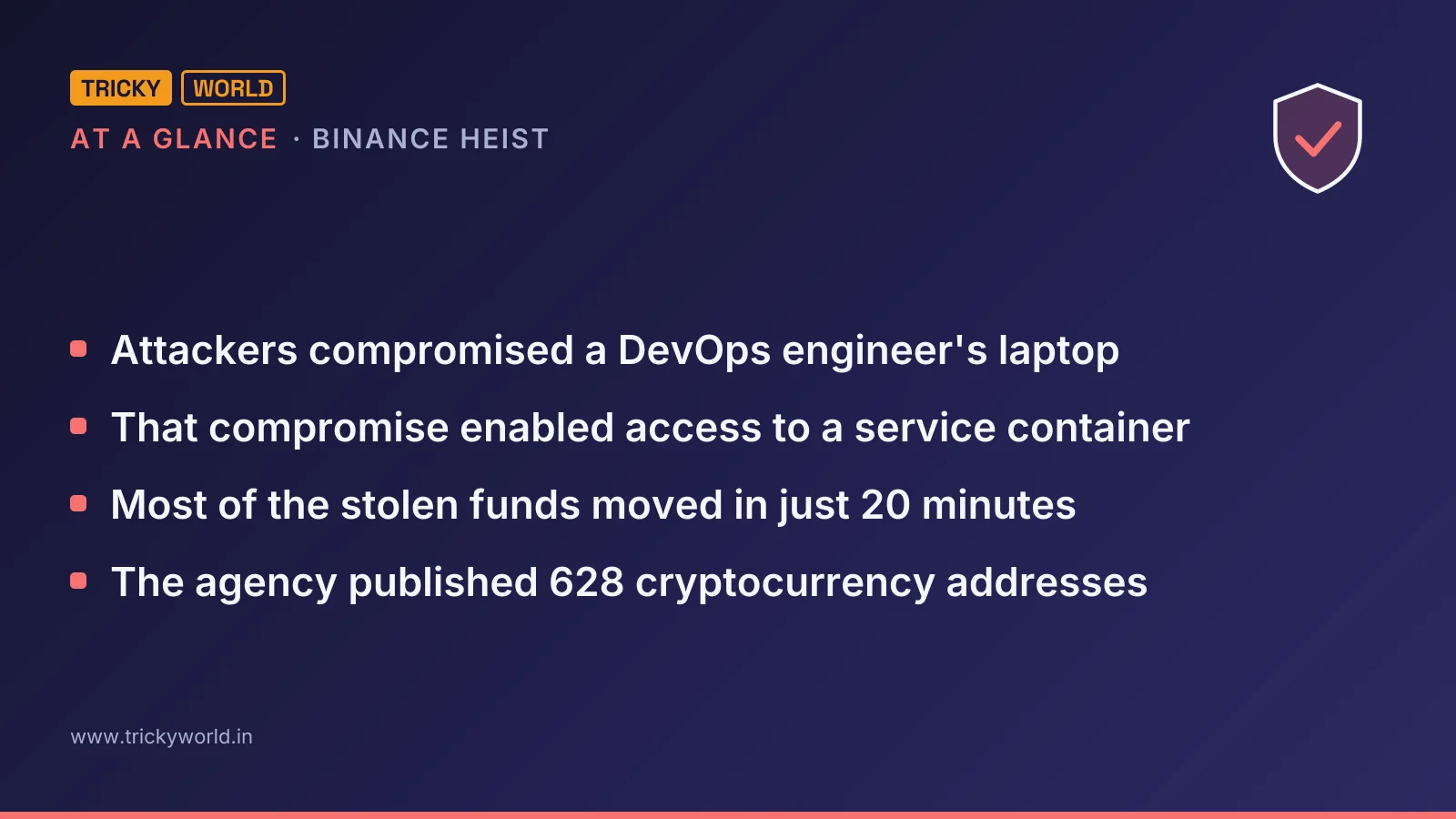
The reported attack path connects a developer workstation to unauthorized transactions. The FBI places the theft on or about October 29, 2026. BleepingComputer reports that most of the stolen funds moved in just 20 minutes.
Binance's account describes the following sequence:
- Attackers compromised a DevOps engineer's laptop.
- That compromise enabled access to a service container.
- The attackers submitted unauthorized withdrawal transactions through that access.
I'd argue the distinction between the laptop and the service container matters. I'd note that reviewing only the employee's device would address one part of the reported chain; reviewing only the withdrawal service would address another. I'd say the connection between them is the engineering issue worth examining.
I'd start by mapping that access path rather than assuming the exchange's wallet technology was the sole point of failure. I'd suggest the useful question for a team reviewing its own infrastructure is which workstation-accessible systems can reach transaction submission, and where a compromised developer session would encounter another control.
Recruitment lures reach beyond interview exercises
I'd say TraderTraitor's broader activity makes developer workflows relevant to this incident, although it does not establish the initial infection method at Binance.
BleepingComputer describes the long-running Operation DreamJob campaign, in which North Korean attackers impersonate recruiters and approach developers and cryptocurrency employees with fake opportunities. In the DMM Bitcoin case, an attacker posing as a LinkedIn recruiter persuaded an employee at wallet company Ginco to execute malicious Python code presented as a pre-employment test.
The recruitment pretext is not limited to a suspicious attachment. Reporting on research from SentinelOne, Zscaler ThreatLabz and Microsoft, The Hacker News describes TraderTraitor's developer-targeting activity involving front companies and trojanized Terraform providers.
In that activity, a poisoned provider delivers a Bash loader that selects malware for the victim's operating system. The reported chain includes FLATROOF, a cross-platform implant that uses a Python-based information stealer, followed by the ROOFDECK backdoor for remote control. The reporting describes affected workflows across macOS, Linux and Windows.
Microsoft also described tailored domains, social profiles and industry knowledge used to impersonate recruiters for a fictitious artificial intelligence-powered blockchain intelligence company. I'd say the convincing part of the approach was the surrounding professional context, not simply the code a victim eventually received.
I'd treat recruitment-related execution as a developer-security concern, not only an email-filtering problem. I'd say the broader lesson from the Binance crypto heist is to examine the authority available to an endpoint after someone has been persuaded to run code.
The FBI is tracking conversion and laundering addresses
The FBI says it observed TraderTraitor converting stolen assets primarily into Ethereum (ETH). Further laundering through decentralized finance (DeFi) platforms and instant cryptocurrency swap services is expected by the agency, rather than confirmed as a completed sequence.
The agency published 628 cryptocurrency addresses associated with the theft. Its reported breakdown is:
| Address network | Addresses published |
|---|---|
| Ethereum | 608 |
| Bitcoin | 19 |
| Solana | 1 |
The FBI, U.S. Secret Service and Internal Revenue Service Criminal Investigation are asking exchanges, blockchain operators and other virtual asset service providers to block transactions connected to addresses used to launder the stolen assets.
Separately, The Hacker News reports that $2.85 billion in assets was frozen on-chain by Tether, Circle, Ripple, Arbitrum and Optimism. That reported freeze concerns assets associated with the theft. Binance's statements about covering losses concern its own financial response; I'd say they should not be treated as interchangeable descriptions of recovery.
What the reporting doesn't confirm
Binance says it will absorb the financial impact. In its statement to BleepingComputer, the exchange said it had covered approximately 95% of the impacted amount, compared with 90% in its previous update. The remaining 5% consisted of less-liquid tokens it was continuing to purchase through market and over-the-counter channels.
"Our commitment remains unchanged: Binance will bear the financial impact of the stolen funds."
— Binance, in a statement to BleepingComputer
I'd note that commitment answers who Binance says will bear the losses. I'd also note it does not, by itself, confirm that every affected service has completed its security checks. Binance also said deposits remained unaffected.
BleepingComputer reported that Binance was preparing to resume the first withdrawal phase on November 1 between 06:00 and 09:00 UTC. I'd say an announced schedule alone does not prove completion. The Hacker News separately reports that phase one had resumed. I'd say the accounts therefore differ on whether that phase was still planned or already operating; neither establishes a complete withdrawal restart.
Reports of the Binance crypto heist also differ on the total amount and blockchain count:
| Publication | Reported stolen amount | Blockchains |
|---|---|---|
| BleepingComputer | Approximately $6.36 billion | 10 |
| The Hacker News | $6.43 billion | 11 |
I'd say the FBI's quoted attribution establishes responsibility for more than $6 billion in stolen virtual assets, but it does not resolve those differences. I'd say there is no basis in these accounts to silently combine the figures into a single reconciled total.
I'd note the reporting also does not establish that a recruiter lure, Terraform provider or named malware family caused the Binance laptop compromise. I'd say those details describe TraderTraitor's broader activity. I'd say they are useful investigation leads, not a confirmed reconstruction of this particular entry point.
Checks to run after the Binance crypto heist
For an engineering team reviewing the Binance crypto heist, I'd prioritise the following checks. I'd note these are recommendations based on the reported access chain, not a claim that Binance has published its complete remediation procedure.
- Trace workstation access to transaction submission. Identify which developer and DevOps endpoints can reach service containers or other systems involved in withdrawals. Record the access involved and the point at which an additional authorization decision occurs. I'd review the full path rather than considering endpoint access and transaction controls separately.
- Review recruitment-related execution on sensitive devices. Ask developers to flag job exercises, repositories and applications they have been asked to run, particularly where the same device has access to cryptocurrency infrastructure. I'd say the DMM example makes a plausible pre-employment Python exercise a specific scenario to examine, rather than treating unfamiliar executable attachments as the only concern.
- Inspect developer-tool and provider changes. Include Terraform providers and unfamiliar tooling in the review because the cited research identifies them as malware delivery routes. If suspicious execution is found, examine both the endpoint activity and the infrastructure access available from that endpoint. I'd avoid presuming that a particular named implant must be present.
- Apply the address request where your service handles transfers. I'd have exchanges, blockchain operators and other virtual asset service providers review the FBI's published addresses against their transaction controls. I'd keep the agency's observed conversions separate from its expectations about later laundering when documenting findings.
I'd advise Binance users or teams depending on its withdrawal service to distinguish an announcement about phase one from confirmation that the particular asset and service you need are available. I'd say a promise to cover losses and the operational availability of a withdrawal route answer different questions.
My priority would be the workstation-to-withdrawal boundary. I'd say official attribution identifies the actor, but the actionable engineering detail is the route from an employee laptop into a transaction-capable service. I'd say teams without cryptocurrency custody need not take on exchange-specific address screening; the recruitment and developer-tooling exposure is the part relevant to their own access review.
Frequently asked questions
Did blockchain analysts link the Binance theft to TraderTraitor before the FBI?
Yes. BleepingComputer reports that blockchain intelligence firms TRM Labs and Chainalysis had already linked the theft to TraderTraitor before the FBI’s official attribution.
How long has TraderTraitor been active?
The Hacker News reports that the cryptocurrency-focused group has been active since at least 2020.
Which Binance balances did the exchange say were fully backed?
Binance told BleepingComputer that BTC, ETH, USDT, BNB, SOL, USDC, XRP, USD1, RLUSD and ZEC balances were fully backed. This was the exchange’s statement about backing, not confirmation that every withdrawal service had resumed.
Sources
Primary sources
- Write-upEnterprise Email Security Assessment · adaptivesecurity.com
Reports of the story
- News reportFBI links $6.3 billion Binance crypto heist to North Korean hackers · bleepingcomputer.com
- News reportFBI Links North Korea's TraderTraitor to Record $6.43 Billion Binance Crypto Heist · thehackernews.com
How this article was made: drafted with AI from the sources above and fact-checked against them, then reviewed by Vishal on . How we write and check articles.

About the author
Vishal · Software & security engineerVishal writes Trickyworld's tutorials and interview-preparation guides on programming, databases, cyber security and AI. Vishal has been shipping production software long enough to have firm opinions about Python, PHP, Node.js, and JavaScript, and to have been wrong about each of them at least once. The work has run the whole stack: Drupal and Laravel applications, React front ends, MySQL and MongoDB underneath, Redis and Memcached for the things that had to be fast, Apache Solr for the things that had to be findable. That last part turned out to matter more than anyone expected. Tune a Solr index for a season, then watch a language model confidently retrieve the wrong document, and you recognise an old problem wearing new clothes. Most of what is hard about AI systems is not the model. It is retrieval, caching, latency budgets, and deciding what the system does when the answer comes back wrong — which is work he has been doing since well before anyone called it AI engineering. He plays a lot of games, which is less a hobby disclosure than an admission of where a good share of his engineering instinct came from. Real-time systems with a frame budget. State that has to stay coherent while a player does something no designer anticipated. The permanent question of what happens when the frame cannot finish in time. Those habits carry over more directly than they have any right to. He has written several books on programming, all built on the same conviction: most technical writing is unclear because the author never decided what to leave out. More from Vishal → · Editorial policy