CVE-2026-114713: UnrealIRCd report needs verification
CVE-2026-114713 is a reported UnrealIRCd command-injection flaw involving unescaped IRCv3 label tags on linked servers. Checks on November 15, 2026 found no NVD record, CISA listing or published fixed version. Inventory releases, links and hot patches, then obtain applicable project remediation instructions before marking the change complete.
Summary written with AI from this article, and checked against it.

At a glanceCVE-2026-114713
CVE-2026-114713 has a CVSS 3.1 base score of 8.6 (High) from MITRE. No fixed version has been published yet.
| Severity | 8.6 High (CVSS 3.1, MITRE) |
|---|---|
| Fixed in | No fixed version published yet |
| Affected | Not published yet |
| Exploited | Yes: in CISA's Known Exploited Vulnerabilities catalog since November 13, 2026 |
| EPSS | 0.5% chance of exploitation in the next 30 days (FIRST, November 14, 2026) |
| Public exploit | 3 GitHub repositories name it: proofs of concept, scanners, detections. Unverified: some are fake or malicious. |
| Vector | CVSS:3.1/AV:N/AC:L/PR:N/UI:N/S:C/C:N/I:H/A:N |
| Weakness | CWE-140 |
| Ubuntu | Not tracked yet |
| Debian | Listed, no packages yet |
| Red Hat | Severity Important, no package status yet |
Is there a public exploit for CVE-2026-114713?
Yes: CVE-2026-114713 is exploited in the wild. CISA added it to its Known Exploited Vulnerabilities catalog on November 13, 2026. 3 public GitHub repositories name it: proofs of concept, scanners and detections. None of it is verified: some such repositories are fake or carry malware, so read the code before running it, and only against systems you own. FIRST's EPSS puts the chance of exploitation in the next 30 days at 0.5%, higher than 43.8% of scored CVEs.
An ordinary IRC user could inject server-to-server commands through a reply tag, according to The Hacker News report on UnrealIRCd. But November 15, 2026 checks found no NVD record, CISA listing or published fixed version for CVE-2026-114713. Here’s how to inventory your UnrealIRCd deployment and server links, separate reported claims from verified guidance, and identify the project instructions needed before marking remediation complete.
If you administer an UnrealIRCd network, pay particular attention to linked servers. This CVE-2026-114713 report is not about every team running an application service. The Hacker News describes commands executing with server authority and relays maintainer Bram Matthys’s recommendation to update, hot-patch or deploy a spamfilter workaround. It does not supply a version-check command or the workaround configuration, though, and its claims about patches and exploitation conflict with the advisory records checked.
Check the UnrealIRCd build and server links
I would establish what is running before deciding which CVE-2026-114713 remediation applies. Neither account supplies an executable version-check command, so there is no source-supported command to reproduce here. Use the administrative and deployment procedures you already have. Guessing a flag or borrowing scanner instructions would not fill that source gap.
I’d start with the inventory below. Keep the running deployment distinct from an update that someone has downloaded or proposed but has not yet applied:
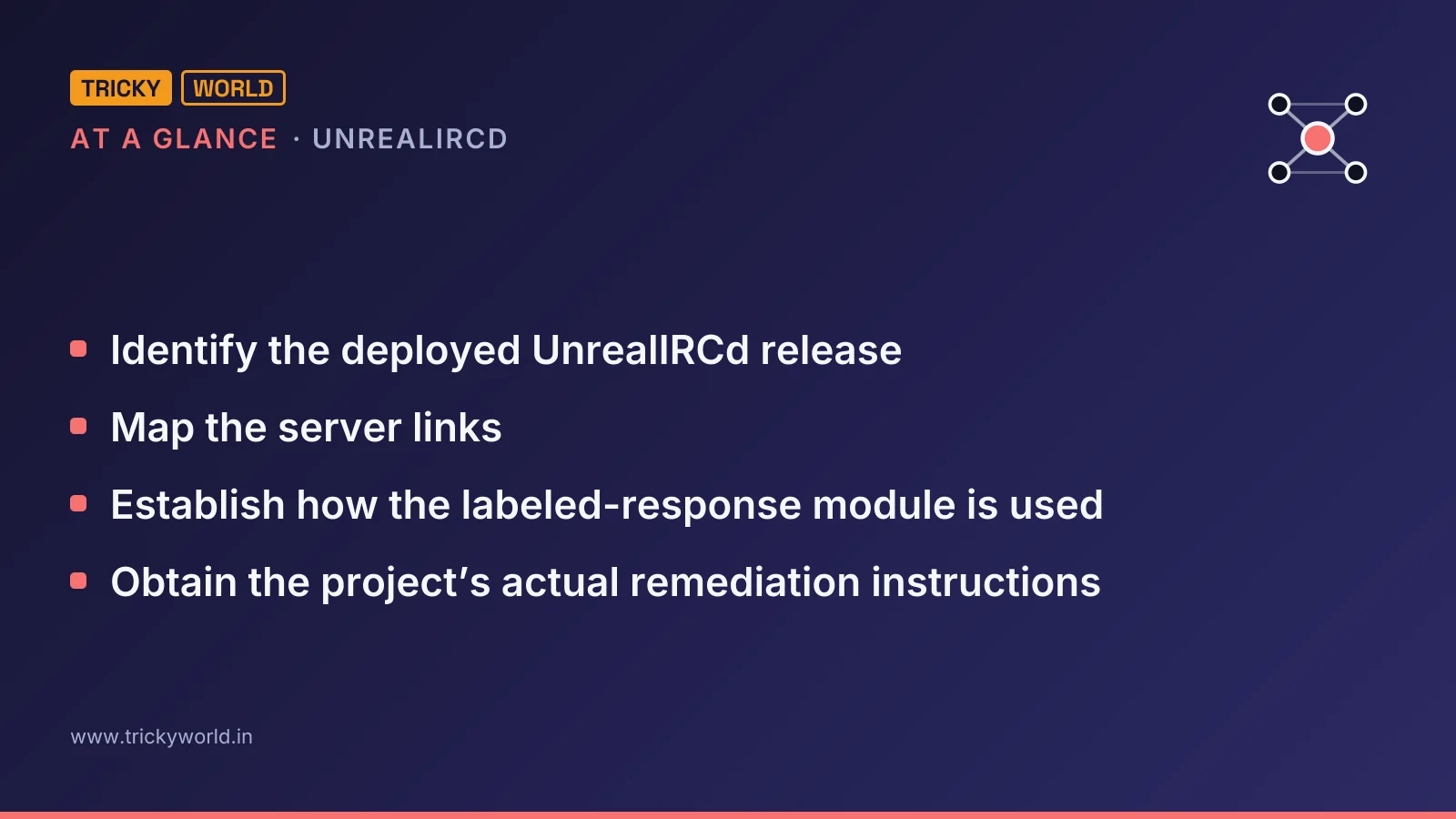
- Identify the deployed UnrealIRCd release. Record the release information available in your existing administration or deployment records. Put the hot-patch history beside that information, too. The maintainer’s reported advice treats hot-patching and updating as separate options, so I would not treat a release number alone as the whole record.
- Map the server links. The mechanism described by The Hacker News involves a network of two or more linked servers. Record which servers participate and who administers each one. Treating each server as an unrelated installation would leave those relationships out of the investigation.
- Establish how the labeled-response module is used. The report names this component specifically, so give it an explicit place in the investigation. I would not take an unfamiliar module name, by itself, as proof that your deployment is unaffected.
- Obtain the project’s actual remediation instructions. Ask for the applicable release or hot patch and, where needed, the exact spamfilter workaround. The report names all three options, but I would not treat naming an option as enough detail to implement it safely.
I would want the output to be a deployment record connecting the running release to its linked peers, patch history and proposed change. That record gives the release number its operational context. On its own, the number does not answer all the questions this particular report raises.
If your team does not operate UnrealIRCd, I see no basis in these accounts for changing an unrelated web runtime, database or laptop configuration. Keep the response attached to the software and mechanism actually named in the report, rather than extending it to unrelated services.
How CVE-2026-114713 could cross the server boundary
The reported CVE-2026-114713 failure concerns the IRCv3 label message tag. In The Hacker News account, the labeled-response module echoes that tag into replies without escaping it. User-controlled content can then become server-to-server commands, rather than remaining content in a reply.
The reported boundary crossing depends on this sequence. The claimed consequence goes beyond a reply that displays incorrectly:
- A user supplies a message that contains the
labeltag. - The labeled-response module puts that value into its reply without the escaping that the report describes as necessary.
- On a network with linked servers, the injected content is interpreted as server-to-server commands. Those commands execute with server authority.
The reported boundary crossing happens when input from an ordinary network user reaches a command path with greater authority. The article calls the resulting privileges server/IRCOp privileges. It does not restrict the claimed attacker to someone who already has operator access, which I consider an important part of the reported mechanism.
For me, that change in authority is the central engineering concern, not just the severity in the headline. Assessing a reply-processing feature only by whether its output looks correct misses the question raised here: what do the linked servers interpret that output to mean?
For a team responsible for a linked UnrealIRCd network, I would therefore make the investigation follow the whole reported path. Start with the user-controlled tag, follow it through the reply, and examine the server-to-server interpretation. Looking only at the client-facing symptom would leave the claimed server-authority consequence unexamined. I regard following that path as an investigation priority, not as evidence that a particular deployment has already been compromised.
The NVD and CISA confirmation gap
The exploitation report and the checked public records disagree. The Hacker News reports active exploitation and says the issue is included in the U.S. Cybersecurity and Infrastructure Security Agency’s Known Exploited Vulnerabilities catalog. It attributes the exploitation warning to UnrealIRCd project leader and maintainer Bram Matthys, also known as Syzop.
The November 15, 2026 check, however, finds no CVE-2026-114713 record in the National Vulnerability Database (NVD). CISA does not list the identifier in its catalog either. The checked advisory records publish neither a CVSS score nor a fixed version. I do not take those checks as establishing active exploitation or providing a verified version to upgrade to.
I also see an attribution problem with CVE-2026-114713. The Hacker News presents its technical description as coming from NVD, but the later NVD check reports no record. That limits how I can describe the mechanism here: it is something The Hacker News reports, not an independently verified NVD finding.
I do not take any of this as establishing that the reported flaw does not exist. My assessment is that the available accounts do not support the same degree of certainty. I would not convert the news report’s release claims into a definitive affected-version range, or tell an administrator that a particular version resolves the issue, without corroborating advisory information.
The Hacker News also says the details and objectives of the malicious activity are unknown. I read its description as a reported server-command-injection mechanism, not a demonstrated account of what attackers did after using it. I would not make claims about stolen data, installed malware or an operating-system shell takeover, because they would go beyond what these accounts establish.
I would not treat public repository names as filling that gap. PoC-in-GitHub lists three repositories naming CVE-2026-114713 and marks them as unverified. Their descriptions make scanning and proof-of-concept claims, but those descriptions do not verify that the code works or that exploitation has occurred. I would not treat repetition of a severity, release or catalog claim in a repository as independent substantiation of the claim.
Choose an UnrealIRCd response without guessing the fix
I treat taking inventory and choosing remediation as different decisions. Once the running deployment and its server links are understood, establish which project instruction applies to that deployment. I would not infer a safe version from a headline, even after the inventory work is complete.
The Hacker News relays three response options for CVE-2026-114713 from Matthys: updating, hot-patching or deploying a spamfilter workaround. I treat these as reported options, not interchangeable sets of instructions. Neither account includes the hot-patch procedure, the spamfilter rule or a complete method for validating the result. To me, that missing detail matters when moving from a reported recommendation to an actual change.
Obtain the maintainer’s applicable update or hot-patch instructions. Those instructions would allow a change that addresses the named component directly, with an explicit account of what is changing. If a workaround is needed instead, obtain its exact configuration and applicability. Do not invent a filter from the general description of the tag and treat it as the reported workaround.
Before treating a change as the applicable remediation, I would answer these two questions:
- Does the project explicitly identify this remediation as addressing the labeled-response issue in the deployment under assessment?
- Can the administrator establish that the intended release, hot patch or workaround is actually applied across the relevant linked servers, rather than merely selected for deployment?
I would keep investigation and completion separate in the change record until both questions have answers. An entry saying that someone read an advisory, obtained a package or found a repository records useful activity. It does not record the same decision as confirming that the applicable remediation has been deployed.
The unverified repositories are also a reason I would not copy a public scanner directly into a production workflow. The November 15 check identifies them as unverified; it does not establish that they are malicious or ineffective. I do not consider their names and descriptions enough grounds to trust their behaviour or to treat their output as authoritative.
Before declaring a specific version safe, check it against corroborating project instructions. I would not wait for that declaration to identify the running servers and their links. Record that inventory now, keep the reported mechanism and claimed exploitation separate from verified remediation status, and obtain the project’s applicable instructions before marking the change complete.
Frequently asked questions
Was artificial intelligence involved in finding the UnrealIRCd issue?
The Hacker News reports that UnrealIRCd’s maintainer released an update addressing multiple vulnerabilities identified with the help of artificial intelligence, including this identifier. It does not name a model or describe the discovery workflow.
What EPSS value is listed for CVE-2026-114713?
FIRST’s November 14, 2026 entry lists an EPSS value of 0.0051 and a percentile of 0.4390. That entry is separate from the missing NVD record and CISA catalog listing; it does not resolve the disagreement over exploitation or remediation.
Sources
Primary sources
- DocumentNVD and distribution data for CVE-2026-114713 (checked 2026-11-15)
- CVE recordCVE-2026-114713 in the National Vulnerability Database · nvd.nist.gov
Reports of the story
- News reportAttackers Exploit UnrealIRCd Flaw That Enables Server-Level Command Injection · thehackernews.com

About the author
Vishal · Software & security engineerVishal writes Trickyworld's tutorials and interview-preparation guides on programming, databases, cyber security and AI. Vishal has been shipping production software long enough to have firm opinions about Python, PHP, Node.js, and JavaScript, and to have been wrong about each of them at least once. The work has run the whole stack: Drupal and Laravel applications, React front ends, MySQL and MongoDB underneath, Redis and Memcached for the things that had to be fast, Apache Solr for the things that had to be findable. That last part turned out to matter more than anyone expected. Tune a Solr index for a season, then watch a language model confidently retrieve the wrong document, and you recognise an old problem wearing new clothes. Most of what is hard about AI systems is not the model. It is retrieval, caching, latency budgets, and deciding what the system does when the answer comes back wrong — which is work he has been doing since well before anyone called it AI engineering. He plays a lot of games, which is less a hobby disclosure than an admission of where a good share of his engineering instinct came from. Real-time systems with a frame budget. State that has to stay coherent while a player does something no designer anticipated. The permanent question of what happens when the frame cannot finish in time. Those habits carry over more directly than they have any right to. He has written several books on programming, all built on the same conviction: most technical writing is unclear because the author never decided what to leave out. More from Vishal → · Editorial policy