Phantom Framework Runs AI-Assisted Ransomware Intrusions
Phantom links human-approved AI intrusions to ransomware affiliates; check exposed gateways, prioritise exploited flaws and trace reused credentials.

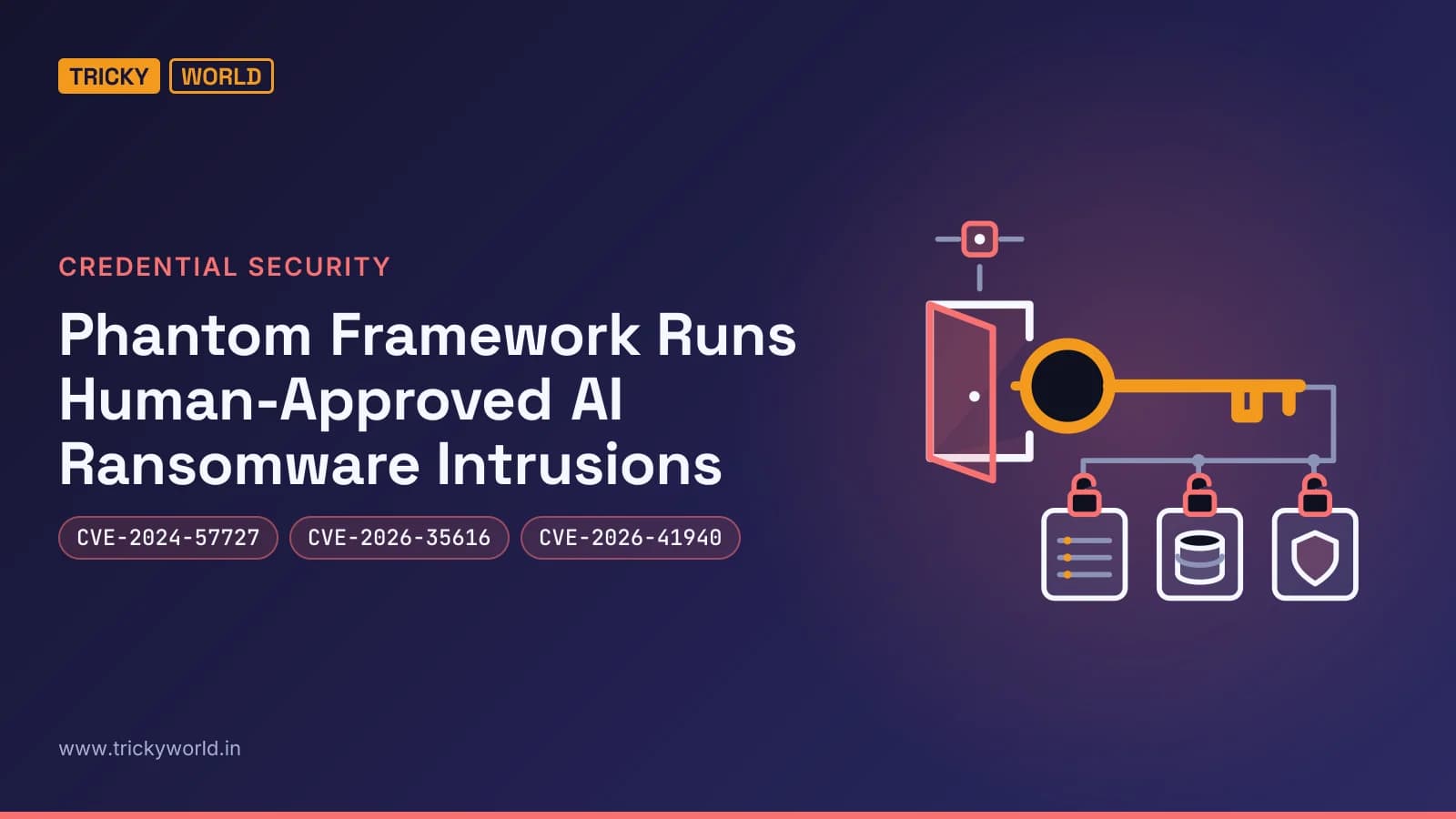
One reused password opened a victim's VPN, servers, remote management, backup and security management platforms to these operators. The Phantom ransomware campaign uses artificial intelligence (AI) to execute intrusions under human approval, supporting affiliates of INC and The Gentlemen. The checks below explain how to prioritise exposed systems, investigate credential overlap and distinguish confirmed exploitation from prepared tooling.
If you run internet-facing gateways, remote-access servers or hosting controls, the immediate problem is the access path, not the model brand. The reported intrusion sequence begins with exploitation of public-facing edge devices, followed by lateral movement, persistence, data theft and escalation toward ransomware deployment. An estimated 62 organisations were targeted, with four subsequently listed on INC or The Gentlemen leak sites. I'd treat this as a reason to review shared administrative access before buying another AI-labelled defence.
Phantom's Operating Model: Human-Approved, AI-Executed
Phantom's operating model is AI-executed, human-approved, not an unattended system choosing victims and carrying out an entire campaign independently. A human supplies a victim-specific prompt and reviews every step. OpenCode executes the intrusions using commercial models hosted through OpenRouter.
The exposed directory at 45.227.254[.]43 revealed activity spanning 8,257 messages across 133 sessions. When models refused requests, the operator rewrote them as authorised red-team assessments rather than simply switching models. That is the behaviour recorded here: a person adapting instructions while retaining approval over the operation.
Phantom also uses an agent that retrieves tasks from an external server, executes commands and returns outputs. Its 18 skill modules cover areas including reconnaissance, binary reverse engineering, exploit research, steganography, telemetry assessment and EDR fingerprinting.
The administrative side matters too. AI-managed knowledge bases tracked victims, stolen credentials and campaign progress. This was not just a model producing an isolated payload; the reported workflow also used AI to organise information across ongoing intrusions.
Exploited vs. Staged: What the Records Actually Show
The records distinguish active exploitation from preparation. SimpleHelp, Fortinet FortiClient and cPanel/WHM flaws were recorded as actively exploited. Other entries were staged, developed or referenced. Treating the whole list as confirmed compromise would erase a distinction the source explicitly makes.
| Identifier | Reported flaw | Recorded status |
|---|---|---|
| CVE-2024-57727 | SimpleHelp path traversal | Actively exploited |
| CVE-2026-35616 | Fortinet FortiClient authentication bypass | Actively exploited |
| CVE-2026-41940 | cPanel/WHM authentication bypass | Actively exploited |
| CVE-2026-15409 | SonicWall SMA 1000 SSRF | Staged for targeting, no confirmed compromise |
| CVE-2026-63030 | WordPress wp2shell | Developed |
| CVE-2026-42208 | LiteLLM SQL injection | Developed or referenced |
| CVE-2026-9082 | Drupal SQL injection | Developed or referenced |
The wider infrastructure review also identified targeting of Ivanti, Citrix, SonicWall and OpenVPN gateways, alongside FortiClient EMS, SimpleHelp and cPanel. Those product names describe the broader targeting surface; they do not establish an additional flaw identifier or successful compromise for every product.
For a production service owner, the practical starting point is therefore the infrastructure around the application. A gateway, remote-management server or hosting control can be the entry point even when the application itself is not the component named in the records.
One Password, Everything Unlocked
The recurring post-entry sequence was domain enumeration, escalation to domain administrator where possible, credential harvesting and collection of selected business files. SOCRadar identified credential reuse as the main force multiplier:
“Credential reuse was the main force multiplier; in one case, a single reused password unlocked the VPN, servers, RMM, backup and security management platforms at once.”
— SOCRadar
My priority would be to map that shared access before treating each affected system as an isolated cleanup task. The reported case gives a concrete reason to investigate the whole credential relationship rather than only the first exposed device.
RevSocks supplied reverse SOCKS5 access for pivoting inside victim networks and staging data for exfiltration. The operators prioritised finance, HR, legal and executive files, collecting material over reverse-SOCKS tunnels.
Endpoint activity included Ghost C2 implants that maintained persistent beacons and executed tasking. The toolkit also included a Quick Heal/Seqrite EDR killer abusing the Zemana driver, zam64.sys, in a BYOVD attack. For separate reading alongside this endpoint discussion, I'd suggest Sphynx ransomware and its tools.
Extortion Built on Stolen Files
The extortion workflow used the contents of stolen files to shape demands. Analysis of dozens of AI-authored extortion records showed operators examining financial information to estimate what a victim could pay without involving a bank or insurer.
They then sent masked proof samples and increased pressure through scripted vishing calls and threats to notify customers, partners and regulators. The reported deadline was 24–72 hours, after which stolen material was published on the data leak site if the victim did not pay.
For a response team, the records suggest a useful investigation question: which financial or executive documents were collected, not merely which machines were accessed? A file-selection review would also address the operators' stated priorities across HR and legal material. As a defensive recommendation, preserve evidence of what left the environment alongside the host and credential investigation; the reported extortion process depended on the stolen data itself.
A Triage Workflow, Not a Vendor Checklist
Use the reported sequence to order a review: locate the entry points, establish remediation status, then follow credentials and post-entry activity. This is a suggested defensive workflow, not a vendor-issued remediation procedure.
Map the named internet-facing systems. Identify your FortiClient EMS gateways, SimpleHelp servers, cPanel controls and the other gateway products named in the report. Assign an owner to each relevant deployment and verify its actual exposure. For separate reading alongside this network-device review, I'd suggest Juniper Junos OS vulnerabilities.
Match the reported identifiers against your vulnerability findings. Begin with the actively exploited entries, while keeping the other statuses visible. Ask the responsible owner to verify vendor remediation guidance and record the deployed build. Keep that check separate from deciding whether intrusion evidence exists.
Review credentials shared across remote access, servers, remote management, backup and security consoles. Where reuse exists, plan to replace those shared secrets and review access to every connected platform. The reported password case makes this a cross-system investigation, not just a gateway password change.
Look for the post-entry sequence in available records. Review domain enumeration, privilege escalation, credential harvesting, persistence and unexpected reverse-SOCKS activity. Investigate suspected Ghost C2 or RevSocks activity in context rather than treating a product inventory match as proof of an intrusion.
Bring data owners into suspected exfiltration investigations. Establish whether finance, HR, legal or executive files were accessed or collected. Preserve relevant evidence and prepare an internal response to possible proof samples, calls and notification threats rather than allowing the attacker's deadline to define the investigation.
For a team that already exports vulnerability findings into SQL, I'd start with a narrow join against the actively exploited entries. This illustrative query assumes a local table or view named security_findings with asset and cve columns. Those are example local names, not a schema supplied by SOCRadar.
WITH campaign(cve) AS (
    VALUES
        ('CVE-2024-57727'),
        ('CVE-2026-35616'),
        ('CVE-2026-41940')
)
SELECT findings.asset, findings.cve
FROM security_findings AS findings
JOIN campaign ON campaign.cve = findings.cve;
Use the result as a work queue for owner verification and investigation. Keep the remaining reported CVEs in a separate review queue with their original status attached, rather than silently promoting every entry to confirmed exploitation.
What the Evidence Doesn't Prove
The exposed records show substantial activity, but activity is not the same as a verified outcome. The target count is an estimate, and four organisations appearing on leak sites does not establish the outcome for every organisation in the records.
No cryptocurrency wallet or payment record was recovered, so the final outcomes of the ransom demands remain unknown. The reported deadline describes the operators' pressure tactic; it does not establish that victims paid.
The operators' own logs also recorded mixed results against enterprise EDRs. Their possession of an EDR killer and loader-level evasion does not demonstrate universal success against endpoint protection. Likewise, model refusals occurred, but the operator responded by rewriting requests.
I'm sceptical of describing this evidence as fully autonomous ransomware. Human approval is explicit in the operating structure. The source also supplies no fixed-version matrix, patch commands or validated detection rules, so the inventory query above is triage rather than a compromise detector.
For teams without the named exposure, shared administrative credentials or relevant activity, my recommendation is not to begin a Phantom-specific migration solely because the campaign used AI. First establish a connection to the reported access paths or behaviour.
Patch the Door Before Buying the AI Shield
Put verified remediation of exposed systems and separation of shared administrative credentials ahead of an AI-specific purchase. Those priorities follow the entry points and force multiplier documented in this operation, rather than the branding of the offensive framework.
Where the review finds matching exposure or suspicious activity, continue into endpoint and data investigation instead of stopping at a patch ticket. Where it finds neither, retain the distinctions in the evidence: a developed tool is not a confirmed compromise, an extortion demand is not a confirmed payment, and human-approved execution is not unattended autonomy. Start by checking whether your gateways, remote-management servers or hosting controls share administrative credentials with anything else on the network.
Frequently asked questions
What role does the actor play beyond conducting intrusions?
The report assesses the actor to be Russian-speaking and describes a dual role: conducting intrusions and data extortion while also providing infrastructure to different partners across the ransomware ecosystem.
What is WormGPT-MCP in the reported toolkit?
WormGPT-MCP is a set of 32 Model Context Protocol (MCP) servers connecting the AI system to 32 modules. Their functions range from reconnaissance to extortion.
Where were the operation's targets concentrated?
The U.S. accounted for more than 50% of the estimated targets. Industrial, manufacturing and energy organisations were the primary sector targets, followed by healthcare and pharmaceutical organisations.
How this article was made: drafted with AI from the source above and fact-checked against it. How we write and check articles.

Vishal writes Trickyworld's tutorials and interview-preparation guides on programming, databases, cyber security and AI. Vishal has been shipping production software long enough to have firm opinions about Python, PHP, Node.js, and JavaScript, and to have been wrong about each of them at least once. The work has run the whole stack: Drupal and Laravel applications, React front ends, MySQL and MongoDB underneath, Redis and Memcached for the things that had to be fast, Apache Solr for the things that had to be findable. That last part turned out to matter more than anyone expected. Tune a Solr index for a season, then watch a language model confidently retrieve the wrong document, and you recognise an old problem wearing new clothes. Most of what is hard about AI systems is not the model. It is retrieval, caching, latency budgets, and deciding what the system does when the answer comes back wrong — which is work he has been doing since well before anyone called it AI engineering. He plays a lot of games, which is less a hobby disclosure than an admission of where a good share of his engineering instinct came from. Real-time systems with a frame budget. State that has to stay coherent while a player does something no designer anticipated. The permanent question of what happens when the frame cannot finish in time. Those habits carry over more directly than they have any right to. He has written several books on programming, all built on the same conviction: most technical writing is unclear because the author never decided what to leave out. More from Vishal → · Editorial policy