k0t Firewall Breaches Reach Far Beyond the Network Edge
k0t's firewall breach campaign links exposed edge devices to credential theft and persistent access; use its attack chain to scope remediation and incident checks.

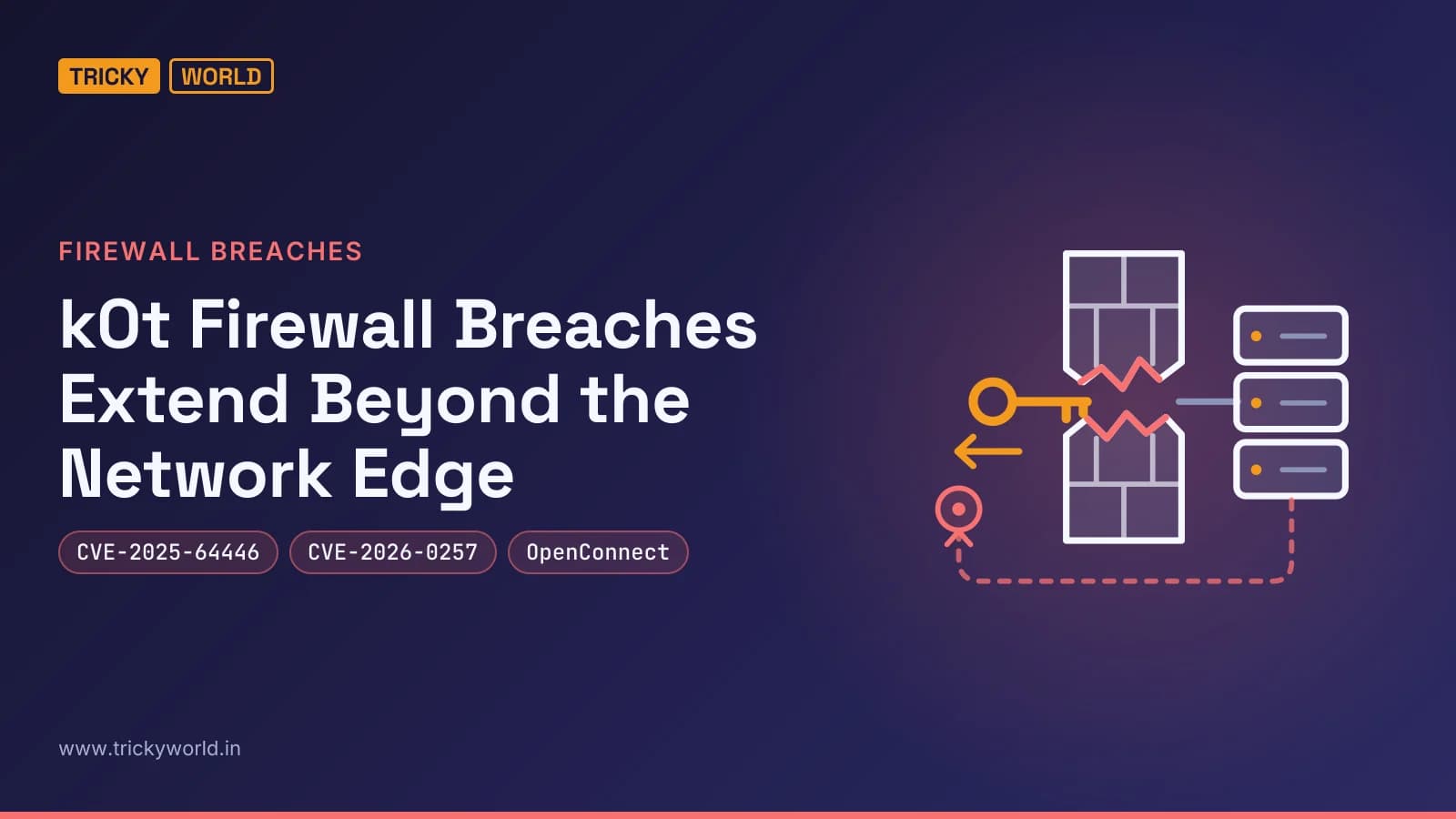
More than 70,000 exposed credentials tied to network devices and LDAP dumps have surfaced in a campaign hitting enterprise edge gear. The k0t firewall breach campaign blends exploitation with password guessing, leaving some victims with persistent remote access and stolen data. Here is how to separate entry-point remediation from the internal investigation.
If you run Fortinet FortiGate or Palo Alto Networks GlobalProtect firewalls, the problem does not stop at the appliance. The joint Group-IB and NyxLab investigation describes directory enumeration, further credential theft, and remote-access tooling inside corporate environments. Checking whether a gateway needs patching is not enough.
Exposure drives the target list, not industry
k0t builds target lists by finding exposed appliances at scale, not by researching individual organisations. The reconnaissance leans on public scanning services — FOFA and ZoomEye — to identify internet-facing VPN and firewall products, then filters potential targets.
Victims span multiple sectors and regions. Nearly 38% sit in Asia Pacific, while a significant share of compromises landed between February and June 2026.
“The product and location of an exposed device therefore appear to matter more than the industry of the organization operating it, consistent with the broad range of victims observed in this campaign.”
— Group-IB and NyxLab researchers
Inventory exposed appliances regardless of industry.
How the foothold becomes persistent access
The reported chain continues after initial access, through an OpenConnect VPN connection and into the corporate environment. The investigation describes this sequence:
- Find exposed infrastructure. The operator uses FOFA and ZoomEye to enumerate appliances, filter by product, and assemble lists of potentially vulnerable targets.
- Attempt entry through known vulnerabilities or common username and password combinations. Researchers identify bespoke Python scripts — fortnew.py and exploit_2026_0257.py — as part of the exploitation activity.
- Establish a foothold through an OpenConnect VPN connection. This follows the initial access attempt in the reported attack chain.
- Enumerate Active Directory, SMB, and installed antivirus software while pursuing additional credentials. The attacks also use administrator and penetration-testing utilities, including NetExec and Impacket, to move deeper into corporate environments.
- Establish persistence through legitimate remote-access software — MeshCentral Agent and Atera — as well as the open-source adversary-emulation framework AdaptixC2.
- Exfiltrate harvested data using Rclone, with Wasabi S3 buckets and MEGA cloud drives named as destinations.
A gateway-only review misses the reported internal activity. The investigation would also need to ask whether directory access, remote-access deployments, or data transfers followed the entry event.
I'd follow that progression when assigning evidence checks, placing the reported use of Impacket in the internal investigation rather than treating the whole case as an appliance patch ticket. The source describes these as legitimate utilities, so a review should establish who used them and for what purpose rather than treating a tool name alone as a verdict.
Check and contain k0t's firewall entry paths
The product-to-flaw mapping matters: the appliances named in the campaign overview are not interchangeable with the products named in its exploitation details. These are the specific vulnerability mappings the investigation supplies.
| Product | Vulnerability | Reported flaw |
|---|---|---|
| FortiWeb | CVE-2025-64446 | Path traversal |
| Palo Alto Networks PAN-OS and Prisma Access | CVE-2026-0257 | Authentication bypass |
- Identify the actual exposed product. Record the product and its internet exposure before choosing remediation. In particular, keep the report's FortiGate references distinct from its FortiWeb vulnerability mapping. Keep any network-device patching checklist tied to that product inventory.
- Remedy the applicable vulnerability. Use the relevant vendor's guidance to determine the correct action for the installed product, and retain evidence of completion. The researchers explicitly advise organisations to ensure that vulnerabilities mentioned in their report are appropriately remedied.
- Review the password-based entry route separately. Where authentication records are available, check for attempts involving common username and password combinations and for unexpected successful access. Include credential replacement in the response plan when the review identifies exposed or compromised credentials.
- Trace activity beyond the gateway. Look for unexpected OpenConnect access and correlate it, where records permit, with directory enumeration and additional credential activity. Use the reported February–June 2026 concentration to inform historical review without treating it as the only period worth checking.
- Validate remote-access deployments. Establish the owner and purpose of MeshCentral Agent or Atera installations found during the review, and investigate signs of AdaptixC2. Record whether each finding is authorised, unexplained, or associated with other suspicious activity.
- Review possible data movement. Check available evidence for Rclone use and transfers involving Wasabi S3 or MEGA. If those appear, establish which data moved and whether the transfer was authorised, rather than stopping at the presence of a named utility.
Keep separate completion records for the appliance work and the internal review. That makes the response answer two distinct questions: whether the documented entry route has been addressed, and what evidence exists of activity after entry. Neither record should substitute for the other.
The report leaves ransomware attribution and fixed releases unresolved
The reported connections to Qilin and The Gentlemen are assessments, not a fully established account of the relationship. Many campaign victims later appeared on those ransomware groups' data-leak sites. Researchers assess that k0t likely operates as an initial access broker or affiliate, but the exact connection remains unclear.
The relationship with FortiBleed is also unresolved. The compromise window overlaps that credential-harvesting campaign, yet investigators found a “negligible overlap” in compromised data. They allow for possibilities including a separate dataset or a related access operation within the broader activity cluster. Overlapping timing should not be presented as settled attribution.
The source supplies no affected-version ranges, fixed firmware releases, vendor-specific remediation commands, or detection queries. Consequently, this report is not enough to select an upgrade target or run a reproducible appliance check. Nor does it establish that every exposed device was compromised, or that every compromise progressed to persistence and exfiltration.
Remedy the documented entry paths and investigate subsequent access without waiting for the ransomware relationship to clarify.
Frequently asked questions
What other names does k0t use?
The investigation identifies CryptoFeel, Member19 and QazWsxShop as aliases used by k0t.
Which countries did k0t say it wanted to target?
The researchers describe k0t's stated geographic priorities as the United States and Canada first, followed by European countries and selected Asia Pacific markets. Those stated preferences are separate from the observed distribution of victims.
How this article was made: drafted with AI from the source above and fact-checked against it. How we write and check articles.

Vishal writes Trickyworld's tutorials and interview-preparation guides on programming, databases, cyber security and AI. Vishal has been shipping production software long enough to have firm opinions about Python, PHP, Node.js, and JavaScript, and to have been wrong about each of them at least once. The work has run the whole stack: Drupal and Laravel applications, React front ends, MySQL and MongoDB underneath, Redis and Memcached for the things that had to be fast, Apache Solr for the things that had to be findable. That last part turned out to matter more than anyone expected. Tune a Solr index for a season, then watch a language model confidently retrieve the wrong document, and you recognise an old problem wearing new clothes. Most of what is hard about AI systems is not the model. It is retrieval, caching, latency budgets, and deciding what the system does when the answer comes back wrong — which is work he has been doing since well before anyone called it AI engineering. He plays a lot of games, which is less a hobby disclosure than an admission of where a good share of his engineering instinct came from. Real-time systems with a frame budget. State that has to stay coherent while a player does something no designer anticipated. The permanent question of what happens when the frame cannot finish in time. Those habits carry over more directly than they have any right to. He has written several books on programming, all built on the same conviction: most technical writing is unclear because the author never decided what to leave out. More from Vishal → · Editorial policy