CVE-2024-10441: DSM fixes, attack link unconfirmed
Synology DSM has branch-specific fixes for CVE-2024-10441, a remote code execution flaw, but its role in ransomware attacks is unconfirmed. Update to the latest DSM and verify the full installed build; DSM 7.2.2 requires at least 7.2.2-72806-1. The fixes do not establish recovery of already-encrypted files.
Summary written with AI from this article, and checked against it.

Affected systems and impact
| Flaw | Affected systems | Impact |
|---|---|---|
| CVE-2024-10441Improper output encoding in the system plugin daemon | Synology DSM 7.2, 7.2.1 and 7.2.2; Synology beestation os 1.0, 1.0.1, 1.0.2 and 1.1 | Remote arbitrary code execution |
| CVE-2024-50629Improper output encoding in webapi | Synology DSM; branch-specific scope not stated. Synology beestation os 1.0, 1.0.1, 1.0.2 and 1.1 | Remote reading of limited files |
| CVE-2024-10445Improper certificate validation in update functionality | Synology DSM; branch-specific scope not stated. Synology beestation os 1.0, 1.0.1, 1.0.2 and 1.1 | Writing of limited files by an adjacent man-in-the-middle attacker |
At a glanceCVE-2024-10441
CVE-2024-10441 has a CVSS 3.1 base score of 9.8 (Critical) from Synology. No fixed version has been published yet.
| Severity | 9.8 Critical (CVSS 3.1, Synology) |
|---|---|
| Fixed in | No fixed version published yet |
| Affected | Synology beestation os 1.0; 1.0.1; 1.0.2; 1.1 |
| Exploited | Not in CISA's Known Exploited Vulnerabilities catalog |
| EPSS | 1.3% chance of exploitation in the next 30 days (FIRST, November 2, 2026) |
| Public exploit | 3 GitHub repositories name it: proofs of concept, scanners, detections. Unverified: some are fake or malicious. |
| Vector | CVSS:3.1/AV:N/AC:L/PR:N/UI:N/S:U/C:H/I:H/A:H |
| Weakness | CWE-116 Improper Encoding or Escaping of Output |
| Ubuntu | Listed, no packages yet |
| Debian | Listed, no packages yet |
| Red Hat | Not tracked yet |
| Also in | Synology diskstation manager |
Is there a public exploit for CVE-2024-10441?
Public code exists as of November 3, 2026: 3 public GitHub repositories name it (proofs of concept, scanners and detections). It is not in CISA's Known Exploited Vulnerabilities catalog. None of it is verified: some such repositories are fake or carry malware, so read the code before running it, and only against systems you own. FIRST's EPSS puts the chance of exploitation in the next 30 days at 1.3%, higher than 69.4% of scored CVEs.
Synology says attackers are encrypting NAS data through a DSM flaw patched in December 2024. CVE-2024-10441 appears in the linked advisory, but Synology hasn't identified which flaw is being exploited. Check your installed DSM build against the branch-specific fixes below; for DSM 7.2.2, the minimum is 7.2.2-72806-1.
If your team relies on a Synology appliance for shared files, what you face is encrypted data and extortion — not just a scanner finding. The Hacker News reports Synology's warning alongside customer reports of C3RB3R ransomware. Synology urges immediate updates and automatic updates.
Check your Synology DSM build against fixed releases
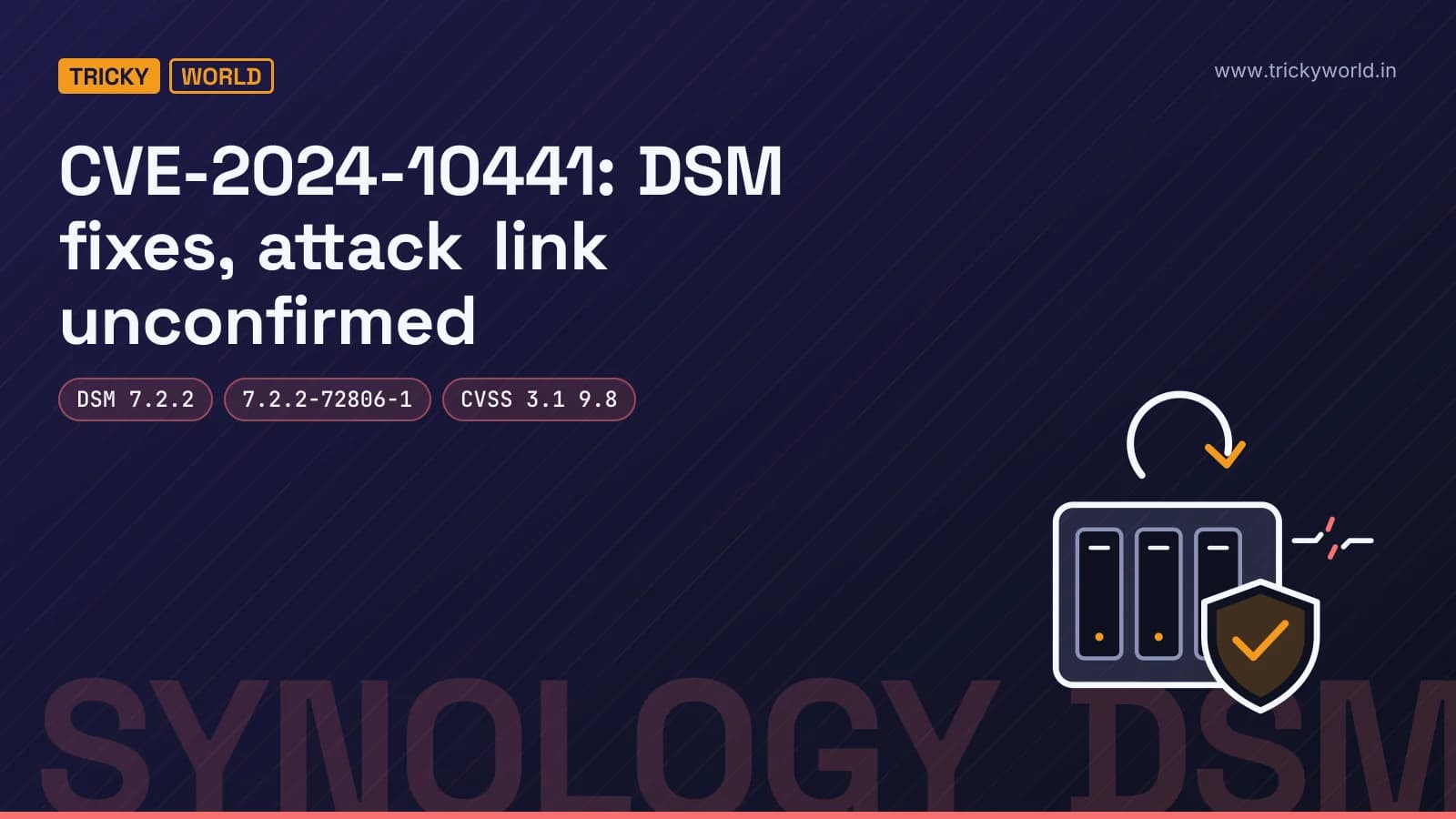
The full installed build is what matters, not a label like DSM 7.2.2. Retrieve the complete installed build from the management interface and compare it with the table.
Synology's SA-24:20 advisory lists these product-specific severities and fixed releases.
| DSM branch | Advisory severity | Required release |
|---|---|---|
| DSM 7.2.2 | Critical | 7.2.2-72806-1 or above |
| DSM 7.2.1 | Critical | 7.2.1-69057-6 or above |
| DSM 7.2 | Critical | 7.2-64570-4 or above |
| DSM 7.1 | Critical | 7.1.1-42962-7 or above |
| DSM 6.2 | Moderate | 6.2.4-25556-8 or above |
These are minimum fixed builds for this advisory covering CVE-2024-10441, not the latest DSM releases. Synology's current warning says to update to the latest version.
There's a publication mismatch to handle. As of November 3, 2026, NVD's records show no fixed version for these CVEs, while Synology's advisory names the DSM fixes above. For patch decisions, use the vendor's explicit guidance — don't read NVD's silence as evidence no patch exists.
What does CVE-2024-10441 let an attacker do?
CVE-2024-10441 lets remote attackers execute arbitrary code via an improper output-encoding flaw in DSM's system plugin daemon. Synology rates it CVSS 3.1 9.8; NVD carries that vendor score.
The advisory covers separate code-execution, file-reading, and file-writing issues. Don't collapse their consequences and access requirements into one description.
| Vulnerability | Component | Consequence described by Synology | Synology CVSS 3.1 score |
|---|---|---|---|
| CVE-2024-10441 | System plugin daemon | Remote arbitrary code execution | 9.8 |
| CVE-2024-50629 | webapi | Remote reading of limited files | 5.3 |
| CVE-2024-10445 | Update functionality | Writing of limited files by an adjacent man-in-the-middle attacker | 4.3 |
Synology's code-execution description names DSM 7.2, 7.2.1, and 7.2.2. The broader product table also includes fixes for 7.1 and 6.2 — don't read it as saying every flaw affects every branch.
There's also a scoring disagreement on the certificate-validation issue. NVD gives CVE-2024-10445 a 5.3 with network attack vector; Synology gives 4.3 and describes an adjacent attacker. The table keeps Synology's assessment rather than silently swapping in NVD's.
My priority would be patching below-floor devices, especially those covered by the code-execution description. That follows documented impact, not an assumption this flaw is the confirmed ransomware entry point.
Old patches have become an immediate ransomware concern
The new development is the attack warning, not a new fix. Synology published the advisory in November 2024; its current warning says attackers are exploiting a vulnerability patched in December 2024. The advisory status is resolved.
Uncertainty persisted after follow-up. BleepingComputer asked Synology which flaw was exploited; a spokesperson pointed back to the same advisory. That supports acting on the fixes, but doesn't identify which vulnerability enabled the attacks.
Customers report encrypted files with the .L0CK3D extension and a ransom note named read-me3.txt. BleepingComputer also reported demands to buy a tool called C3rb3r Decryptor. These are reported signs of ransomware activity, not a substitute for checking an appliance's installed software.
An admin doesn't need a confirmed exploit chain to act on Synology's immediate-update warning. Equally, an incident report shouldn't pin CVE-2024-10441 as the entry vulnerability just because it has the highest score in the advisory.
Restrict Internet access and update Synology DSM
The practical response combines reducing management exposure with applying the documented fixes. BleepingComputer advises blocking Internet access to the management web interface immediately; Synology separately urges updates and automatic updates.
Block Internet access to the management web interface. Treat this as immediate exposure reduction. Synology's advisory lists no mitigation, so restricting access isn't a vendor-approved replacement for installing fixes.
Record the complete installed DSM build and compare it to the matching branch in the table. For an inventory across several appliances, record both branch and full build rather than marking an entire family as updated.
Update appliances below their branch's listed fixed release. The minimum builds answer whether the advisory's fix is present; Synology's broader recommendation is to install the latest DSM. Keep that distinction clear in the change record.
Check the installed build again after the update. Close the patch task only after verifying the installed build. That makes the completion criterion the same concrete value used for the initial check.
Enable automatic DSM updates, as Synology recommends. Keep that decision separate from current remediation: the immediate task is establishing each affected appliance has reached a fixed build.
The exact attack path and recovery outcome remain unconfirmed
Synology has not publicly identified the exploited CVE. Attackers are exploiting a previously patched DSM vulnerability, and Synology directs customers to this advisory, but the exploited CVE has not been publicly identified. It's not yet a confirmed attribution to CVE-2024-10441.
CISA's catalog doesn't list any of the three CVEs as exploited in the wild as of November 3, 2026. That doesn't negate Synology's attack report. It also doesn't resolve which flaw attackers used. Keep those two pieces of evidence separate.
Exposure figures need similar care. BleepingComputer cites Shadowserver tracking 380,000+ Internet-exposed Synology NAS devices, but the report doesn't establish how many were patched or honeypots. That's not a count of vulnerable or compromised appliances.
I wouldn't treat an update as a recovery plan for already-encrypted files. Synology's advisory documents software fixes, not decryption, and the attackers' sales pitch isn't independent evidence their tool restores data.
Use the DSM build to decide, not the campaign label
The patch decision is clearer than the attack attribution. Synology published branch-specific fixes, says outdated devices are under attack, and urges immediate updates. No need to wait for a named exploit chain before addressing an appliance below the listed build.
For appliances already at or above the relevant fixed release, document that result without stretching it into a claim the device couldn't have been compromised earlier. The useful outcome is a verified patch position and reduced exposure, with the remaining uncertainty stated honestly.
Frequently asked questions
Who does Synology credit for reporting the advisory’s vulnerabilities?
Synology acknowledges Pumpkin Chang and Orange Tsai from the DEVCORE Research Team, Ryan Emmons, and Team Smoking Barrels. The acknowledgement does not assign each named researcher to an individual CVE.
Is C3RB3R the same operation as the original Cerber ransomware?
BleepingComputer describes C3RB3R, also known as CerberImposter, as borrowing its name from the older Cerber ransomware operation that emerged in 2016. It reports that C3RB3R was first spotted in December 2021.
Sources
Primary sources
- AdvisorySynology_SA_24_20 · synology.com
- Write-upEnterprise Email Security Assessment · adaptivesecurity.com
- CVE recordNVD and distribution data for CVE-2024-10441, CVE-2024-50629, CVE-2024-10445 (checked 2026-11-03) · nvd.nist.gov
Reports of the story
- News reportSynology NAS Devices Targeted in Ransomware Attacks Exploiting Patched DSM Flaw · thehackernews.com
- News reportSynology warns of C3RB3R ransomware attacks targeting NAS devices · bleepingcomputer.com
How this article was made: drafted with AI from the sources above and fact-checked against them, then reviewed by Vishal on . How we write and check articles.

About the author
Vishal · Software & security engineerVishal writes Trickyworld's tutorials and interview-preparation guides on programming, databases, cyber security and AI. Vishal has been shipping production software long enough to have firm opinions about Python, PHP, Node.js, and JavaScript, and to have been wrong about each of them at least once. The work has run the whole stack: Drupal and Laravel applications, React front ends, MySQL and MongoDB underneath, Redis and Memcached for the things that had to be fast, Apache Solr for the things that had to be findable. That last part turned out to matter more than anyone expected. Tune a Solr index for a season, then watch a language model confidently retrieve the wrong document, and you recognise an old problem wearing new clothes. Most of what is hard about AI systems is not the model. It is retrieval, caching, latency budgets, and deciding what the system does when the answer comes back wrong — which is work he has been doing since well before anyone called it AI engineering. He plays a lot of games, which is less a hobby disclosure than an admission of where a good share of his engineering instinct came from. Real-time systems with a frame budget. State that has to stay coherent while a player does something no designer anticipated. The permanent question of what happens when the frame cannot finish in time. Those habits carry over more directly than they have any right to. He has written several books on programming, all built on the same conviction: most technical writing is unclear because the author never decided what to leave out. More from Vishal → · Editorial policy