What is AGI? Meaning and a Practical AI Use Case
Artificial general intelligence (AGI) is hypothetical AI that could learn and perform almost any human intellectual task without task-specific redesign. A JavaScript summary workflow routes drafts to human review only when all recorded checks pass. The checks still need trustworthy evaluation; passing permits review, not publication.
Summary written with AI from this article, and checked against it.

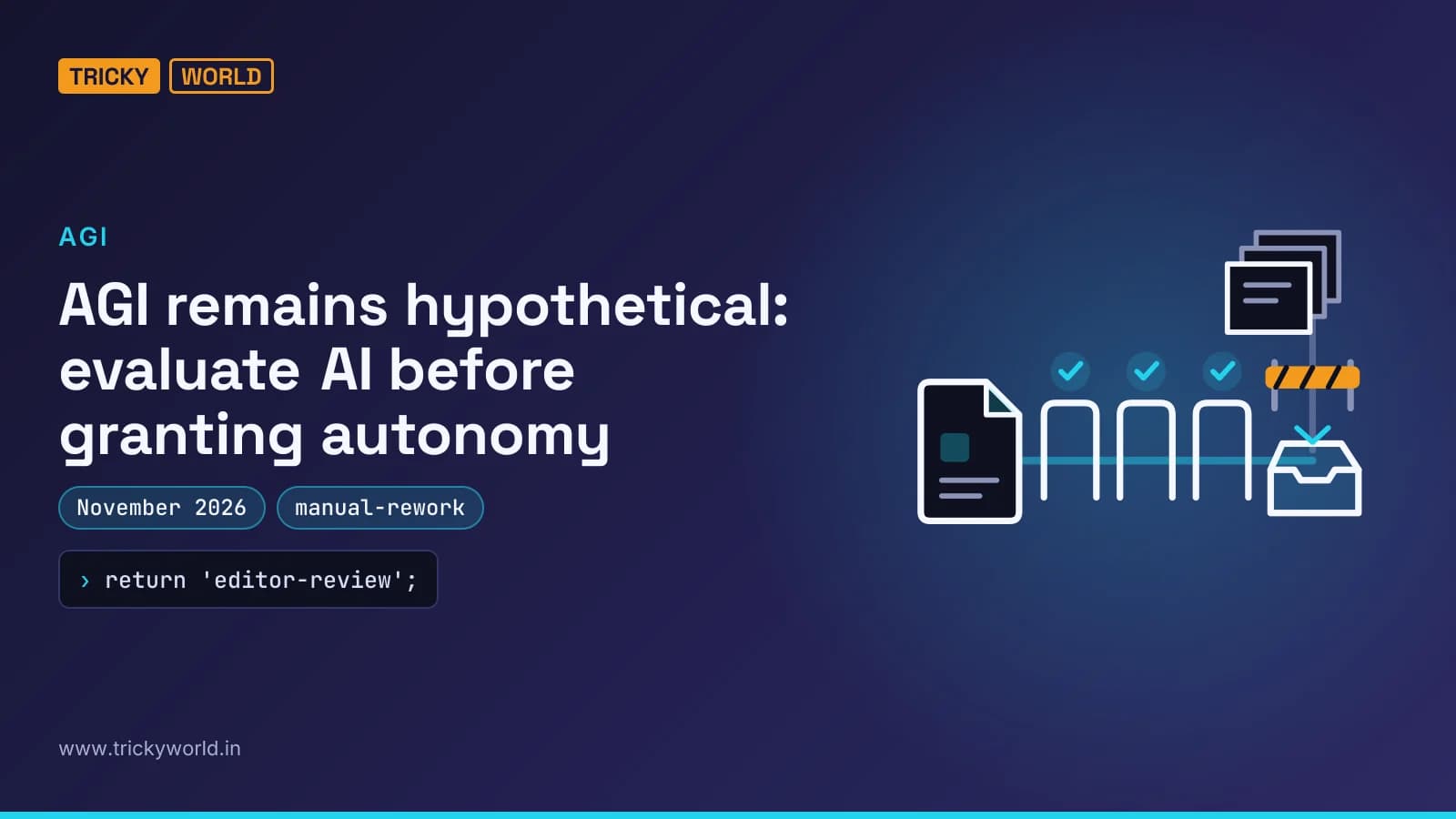
No system is widely accepted as artificial general intelligence (AGI) as of November 2026. What is AGI? It remains hypothetical: AI that could learn and perform almost any human intellectual task without task-specific redesign. Today's tools can still draft article summaries. This guide explains the distinction and shows how to evaluate a summary workflow that sends passing drafts to human review, not publication.
For a team adding AI to a content system, confusing assistance with authority could mean letting a summary tool make an editorial decision it was never evaluated for. What is AGI? Meaning for Developers argues for testing those boundaries separately.
What is AGI? Understanding generality
Generality means transferring knowledge to unfamiliar problems, not merely performing a familiar task exceptionally well. Databricks' explanation of artificial general intelligence describes flexible, transferable intelligence that would not require task-specific programming for each new domain.
They describe different capability scopes, not a guaranteed sequence through which every AI product will progress.
| Category | Capability scope | Status |
|---|---|---|
| Narrow AI | Particular tasks, sometimes at superhuman performance | In use today |
| Artificial general intelligence | Broadly human-level intellectual capability across tasks | Hypothetical |
| Artificial superintelligence | Beyond the best humans across virtually everything | Hypothetical |
AGI would need more than breadth of output. The proposed capabilities include learning through experience, adapting when conditions change, and applying knowledge beyond its original setting. A system producing convincing answers across many subjects does not, by that fact alone, demonstrate all those abilities.
The promised use cases
Healthcare and scientific research illustrate the proposed value of intelligence that transfers across domains. Databricks describes hypothetical diagnostic support and personalised treatment planning across medical specialties, alongside research applications such as drug discovery and materials science.
Those possibilities remain conditional on achieving AGI. They are not capabilities a developer can assume are available simply because a current product uses an advanced model.
Today's tools already have narrower uses worth evaluating. The developer explainer describes frontier systems writing software, explaining science, and handling varied conversations. It also discusses AI-assisted drafting and language-based search.
For example, an article-summary feature has a concrete job: preserve the supplied material while producing a useful draft. Whether its model could also explain mathematics is a different evaluation question.
Why ChatGPT draws conflicting AGI labels
ChatGPT does not qualify under the broad capability test used by Databricks, which classifies it as specialised AI. The developer explainer similarly says it is not AGI by most definitions, despite capabilities such as software writing and scientific explanation.
However, Wikipedia's AGI article describes a Google DeepMind researchers' framework that places models such as ChatGPT in an emerging AGI category. That is a classification within a particular framework, not broad agreement that the full research goal has been achieved.
Disagreement about what is AGI therefore includes disagreement about which capabilities the label must certify. The evaluation question is whether the system can transfer knowledge to unfamiliar tasks.
The developer explainer also says current models generally do not learn from experience while working. Providing information during a request should not be treated as evidence of a lasting new skill. Those are different claims and deserve different tests.
Uneven capability makes demonstrations a weak release gate
A successful demonstration establishes less than a dependable operating boundary. The developer explainer discusses a Harvard Business School and BCG experiment in which researchers found that AI helped consultants on tasks within its capability frontier but reduced correctness on a task outside it.
This unevenness is described as a jagged technological frontier: apparently similar tasks can sit on different sides of what a system handles well. For a production workflow, the useful response is to evaluate each responsibility rather than generalise from the most impressive example.
Google DeepMind's framework also separates capability from autonomy. A more capable model does not automatically need more permission to act. In an editorial application, drafting a summary, recommending an angle, and publishing an article would be separate responsibilities, even if the same model supplied the text.
Evaluate an AI summary workflow before granting access
Suppose a content system uses AI to turn supplied articles into draft summaries. This is an application of current AI, not an implementation of AGI. I'd begin with summaries for editorial review, leaving publication outside the model's authority.
Define the permitted task and failure conditions
Specify the input article, the requested summary, and the actions the system must not take. Keep choosing a new editorial angle outside the initial scope. Treat unsupported statements, lost qualifications, and unusable responses as distinct failure categories.
These are proposed acceptance criteria for this application, not a universal intelligence test. A reviewer should be able to judge the output against the same requirements the team agreed before testing.
Test requests that expose the boundary
Include articles with conflicting passages, incomplete context, and requests that need clarification. Check whether the draft preserves uncertainty rather than replacing it with confident language.
Keep the evaluation tied to the summary task. A good result should not become evidence that the system can safely recommend an editorial position or make a publication decision.
Route recorded checks through application policy
This JavaScript sends a draft to editorial review only when every recorded check is explicitly true.
function routeSummary(checks) {
  if (checks.supportedBySource !== true) {
    return 'manual-rework';
  }

  if (checks.preservesQualifications !== true) {
    return 'manual-rework';
  }

  if (checks.matchesRequestedScope !== true) {
    return 'manual-rework';
  }

  return 'editor-review';
}

const passingDraft = routeSummary({
  supportedBySource: true,
  preservesQualifications: true,
  matchesRequestedScope: true
});
// passingDraft: 'editor-review'

const overconfidentDraft = routeSummary({
  supportedBySource: true,
  preservesQualifications: false,
  matchesRequestedScope: true
});
// overconfidentDraft: 'manual-rework'
The function consumes evaluation results; it does not produce them. The application still needs a trustworthy process for recording those checks, and the generating model's own approval should not be the only evidence. Even a passing draft reaches a person, not publication.
Review failures before widening responsibility
Record the input, output, review decision, and rejection reason, subject to the application's data-handling rules. Make transparency and explainability in AI part of that review policy by keeping the acceptance decision inspectable.
Examine rejected drafts before changing the workflow. Rerun the evaluation after changing the model or instructions, then decide whether the revised system meets the agreed criteria. A stronger model should still pass the application's release gate.
A review gate cannot certify general intelligence
The routing example does not detect AGI, verify factual accuracy, or prove that reviewers recorded their checks correctly. It makes a narrower policy explicit: passing the recorded checks permits human review and nothing more.
Databricks says there is no widely accepted metric for general intelligence. The developer explainer also treats differing AGI forecasts as uncertainty rather than a delivery schedule. Neither a label nor a predicted arrival date replaces acceptance criteria for an actual application.
For a deterministic feature with clear requirements and no need for AI, the AGI debate need not influence that release.
When a stakeholder asks what is AGI, explain the research goal. When approving a deployment, ask what the system can reliably do, how that was evaluated, and who retains the decision to act.
Frequently asked questions
Does AGI have to be conscious?
That remains unresolved. Wikipedia distinguishes the philosophical strong AI claim about minds and consciousness from functional AGI capabilities. Databricks likewise describes disagreement over whether AGI would require consciousness or only functional equivalence to human cognition.
Would passing the Turing test prove that a system is AGI?
No. Databricks describes the Turing test as insufficient for validating AGI because human-like conversation can reflect imitation rather than general cognitive capability. Evaluating adaptability, learning and knowledge transfer requires broader evidence.
Sources
- Write-upWhat is AGI? Meaning for Developers · officialdeepak.in
- Write-upArtificial general intelligence · en.wikipedia.org
- Write-upWhat is Artificial General Intelligence? · databricks.com
How this article was made: drafted with AI from the sources above and fact-checked against them, then reviewed by Vishal on . How we write and check articles.

About the author
Vishal · Software & security engineerVishal writes Trickyworld's tutorials and interview-preparation guides on programming, databases, cyber security and AI. Vishal has been shipping production software long enough to have firm opinions about Python, PHP, Node.js, and JavaScript, and to have been wrong about each of them at least once. The work has run the whole stack: Drupal and Laravel applications, React front ends, MySQL and MongoDB underneath, Redis and Memcached for the things that had to be fast, Apache Solr for the things that had to be findable. That last part turned out to matter more than anyone expected. Tune a Solr index for a season, then watch a language model confidently retrieve the wrong document, and you recognise an old problem wearing new clothes. Most of what is hard about AI systems is not the model. It is retrieval, caching, latency budgets, and deciding what the system does when the answer comes back wrong — which is work he has been doing since well before anyone called it AI engineering. He plays a lot of games, which is less a hobby disclosure than an admission of where a good share of his engineering instinct came from. Real-time systems with a frame budget. State that has to stay coherent while a player does something no designer anticipated. The permanent question of what happens when the frame cannot finish in time. Those habits carry over more directly than they have any right to. He has written several books on programming, all built on the same conviction: most technical writing is unclear because the author never decided what to leave out. More from Vishal → · Editorial policy