RAG alternatives: When to use CAG, KAG and APIs
Use CAG when the knowledge base fits in the model's context, KAG for reasoning over explicit relationships, SQL for exact values and live APIs for changing data. Test representative questions and policy changes: context capacity and graph grounding alone do not establish which conflicting fact is current.
Summary written with AI from this article, and checked against it.

A small FAQ bot skips query-time retrieval entirely when its entire knowledge base fits in the model's context. That's Cache-Augmented Generation (CAG). Knowledge-Augmented Generation (KAG) takes a different tack: it uses knowledge graphs for reasoning. These alternatives aren't interchangeable — pick based on context size, data freshness, and reasoning needs using the checks below.
For a production support assistant, a delayed lookup and a confidently repeated obsolete policy are different problems. The CAG and KAG comparison on LinkedIn calls out retrieval delays, document-selection errors, and architectural complexity as reasons to look elsewhere. I'd diagnose which problem the application actually has before ripping out its retrieval stack.
What actually changes when you swap retrieval
Replacing vector search doesn't mean abandoning RAG. In Exxact's comparison of alternative retrieval architectures, SQL queries, live API calls, and knowledge-base lookups still feed external context to an LLM. The difference is how the system gets that context.
Conventional vector retrieval embeds text and searches for semantic matches. Exxact points out a practical weakness: a passage can match the topic without answering the question. Similarity also doesn't capture a database schema, hierarchy, or logical relationship.
CAG makes a different architectural move: it preloads knowledge instead of fetching documents at query time. KAG integrates structured knowledge with generation to support reasoning. Neither is the same as moving an existing vector index into another database.
CAG preloads; KAG reasons
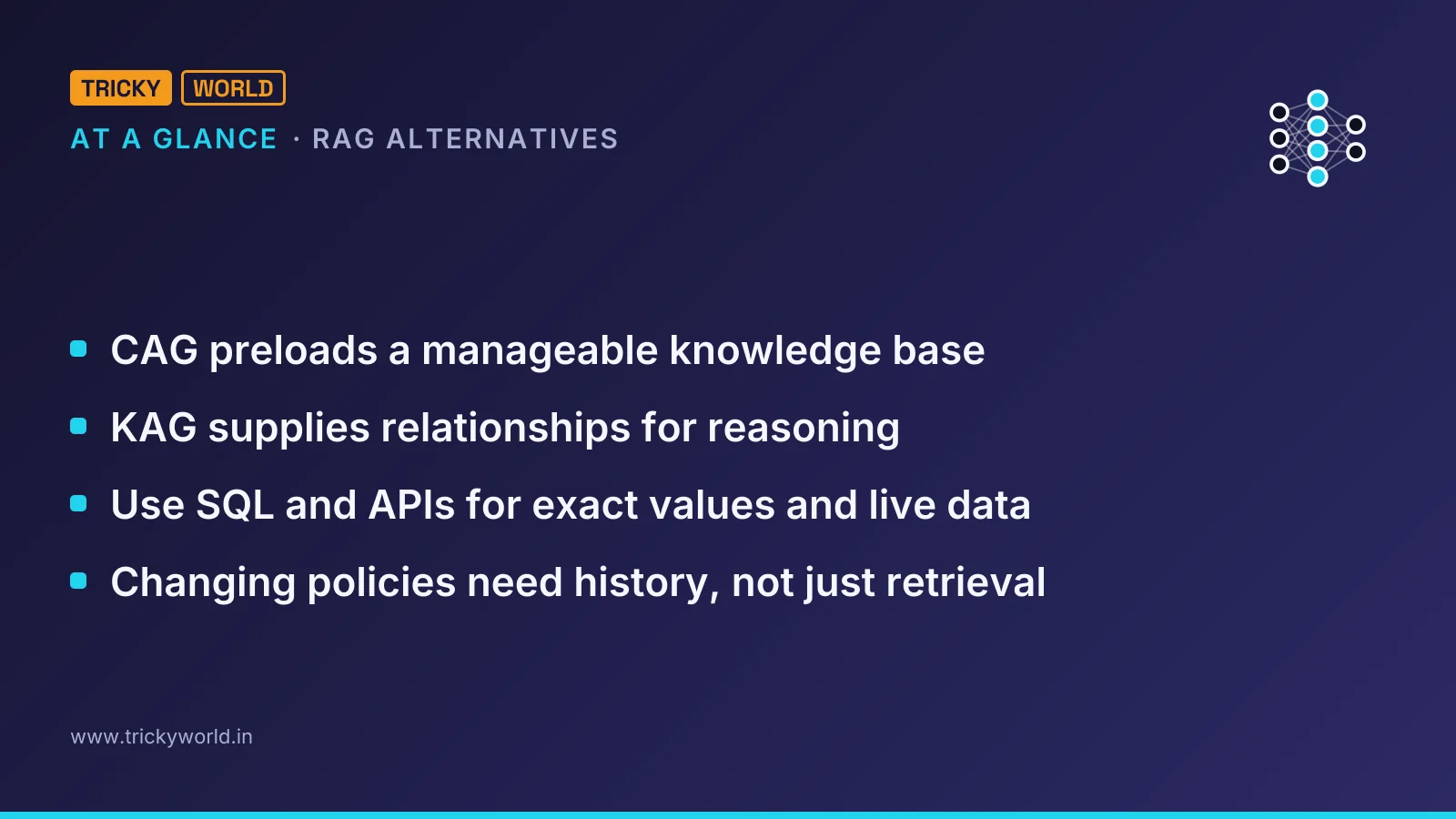
CAG preloads a manageable knowledge base
CAG puts the necessary knowledge into the model's context upfront. The LinkedIn comparison describes this as a precomputed knowledge cache, removing the separate retrieval pipeline from the answering path.
I find the appeal straightforward for a bounded FAQ collection or single-domain assistant. Removing retrieval eliminates the document-selection step that can return the wrong passage. No query-time lookup delay. I'd recommend CAG for small or manageable knowledge bases — customer-support chatbots, for instance.
Evaluate preloaded context by checking whether the complete required knowledge fits in the model's context and testing answer quality against representative questions. CAG lets the model work from that prepared material directly. The decision is about making knowledge available together, not improving how a search engine ranks fragments.
KAG supplies relationships for reasoning
KAG combines knowledge graphs with LLMs. The LinkedIn comparison presents it as an approach for logical, multi-step reasoning over structured knowledge — particularly in domains like law, healthcare, and government services.
The related knowledge-based RAG approach Exxact describes retrieves facts through explicit entities, relationships, and rules. It can use knowledge graphs, ontologies, or logic-based rule engines. I see the attraction as an inspectable relationship between the answer and the domain knowledge supporting it.
My preference: investigate KAG when the hard part is connecting facts correctly, not just finding a relevant paragraph. A legal-document assistant that needs explicit relationships between entities presents a different design problem than a bot answering a compact product FAQ.
Use SQL and APIs for exact values and live data
Structured retrieval queries relational databases or tabular sources instead of searching for similar prose. Exxact says its strengths include schema awareness, traceability, and exact matches under defined schemas and database constraints. That makes it a candidate when the answer already lives as structured data.
API-augmented retrieval addresses a different requirement: information that changes frequently. Exxact gives current stock prices, weather conditions, and device information as examples. The model pulls context from live endpoints rather than a pre-ingested document index.
Exxact groups the retrieval approaches by data structure and timeliness as follows.
| Approach | Data structure | Data timeliness |
|---|---|---|
| Vector RAG | Unstructured | Static |
| Structured DB RAG | Structured | Static |
| API RAG | Both | Real-Time |
| Knowledge Base RAG | Structured | Static & Real Time |
I find the useful distinction for choosing is: where does the answer live? An exact table value calls for a precise query. An up-to-the-minute external value calls for a live lookup. I don't think either automatically demands a knowledge graph.
Changing policies need history, not just retrieval
A relevant document can still contain the wrong version of a fact. In its analysis of agent memory and changing facts, Sentra argues that similarity-based retrieval alone doesn't decide which conflicting statement is current.
The architectural distinction they propose: retrieving passages versus maintaining facts with history. A temporal memory layer records when a fact became effective and when the system learned it. When another fact supersedes it, the older fact gets an end time but stays available as history.
Say a refund policy changes after an assistant has already used the previous version. Test the current policy, the previous policy, and the source supporting each. Sentra recommends testing candidates by editing a policy and checking those answers, rather than assuming successful document retrieval proves correct state handling.
I find source permissions matter here too. Sentra's evaluation criteria include whether an answer respects access to the underlying source. Returning the current fact is only part of the requirement; the user must also be entitled to receive it.
Swapping vector databases doesn't replace RAG
Changing the vector store addresses infrastructure, not the choice between preloaded context, structured queries, and temporal facts. Redis's vector database comparison describes the operational burden of running vector search alongside separate databases, caches, and session stores.
The architectural distinction is that changing the vector store addresses infrastructure, not the choice between preloaded context, structured queries, and temporal facts. Redis presents these workload and deployment categories for the database decision.
| Platform | Best for | Deployment |
|---|---|---|
| Redis | Unified real-time platform | Cloud, self-hosted, hybrid |
| Pinecone | Managed cloud vector search | Cloud (SaaS) only |
| Weaviate | Open-source AI-native | Cloud, self-hosted |
| Milvus | Billion-scale distributed vector search | Self-hosted, managed (Zilliz) |
| Qdrant | High-performance filtered vector search | Cloud, self-hosted, hybrid, private |
| Chroma | Rapid prototyping and dev-friendly RAG | Self-hosted, cloud |
| pgvector | Teams already on PostgreSQL | Any PostgreSQL host |
The comparison is vendor-published, not an independent ranking. Its practical advice: benchmark actual workloads and count the cost of the surrounding stack. Choosing PostgreSQL with pgvector may consolidate relational and vector data, for example, but that's not the same architectural change as removing query-time retrieval with CAG.
How to test these approaches on your actual workload
Start with representative questions and the knowledge needed to answer them. The following sequence turns architectural choices into a concrete evaluation without committing to a particular framework.
Identify the required evidence for each question. Separate questions answered by document passages, exact tabular values, live external information, and relationships between facts. Exxact's selection guidance follows these distinctions. Keep them separate during evaluation so a good document-search result doesn't hide a failure on structured reasoning.
Check whether the complete required knowledge fits in the chosen model's context. For a bounded FAQ task, test CAG with that material preloaded. For relationship-heavy questions, evaluate a graph-based approach against the entities, relations, and rules the answer needs. Compare the evidence supporting the answer, not just whether its wording sounds convincing.
Change a policy and test the resulting state. Following Sentra's suggested evaluation, ask what is true now, what was true before, and where both answers came from. Also check whether the system distinguishes when the change became effective from when it learned about it, and whether source permissions constrain the response.
Measure the operational result under realistic load. Redis recommends testing latency across typical and slower requests, realistic concurrency, filtering complexity, and actual embedding dimensions. I'd compare answer quality alongside response time and total stack cost, rather than accepting a faster lookup that returns less useful evidence.
A mixed workload need not choose one route for everything. Exxact recommends considering hybrid retrieval, while Sentra recommends retaining document retrieval beside temporal memory. A stable handbook passage and a recently changed account fact can require different evidence paths.
Context capacity and graph grounding don't solve freshness
CAG's simplifying condition is that the necessary knowledge fits in context. The LinkedIn comparison supplies no universal context-size threshold or controlled end-to-end speed comparison. I wouldn't present removing a lookup as a measured speed-up for every application.
I wouldn't read KAG's grounding and reasoning benefits as proof that every generated answer is correct. Exxact notes that structured and symbolic approaches can require domain-specific integrations and logic handling. I see a knowledge graph and a temporal memory layer as answering different design questions: relationships alone don't establish which conflicting fact should be current.
I'd keep ordinary RAG for a single assistant over stable, well-maintained documents unless testing exposes a specific weakness. Choose CAG when the knowledge base fits in context, KAG when reasoning requires explicit relationships, and structured queries or live APIs for exact or changing values. For exact values or changing facts, I'd start with the appropriate structured source, live API, or temporal-memory behavior — not a wholesale replacement of the document pipeline.
Frequently asked questions
Is CAG the same as semantic caching?
No. CAG preloads knowledge into the model’s context. Semantic caching, as Redis describes it, recognizes differently worded queries with equivalent meaning and returns a cached response instead of making another LLM call.
Does structured retrieval require a SQL database?
No. Exxact includes CSV files as well as relational databases and SQL tables among the structured sources that can supply context.
Is Microsoft GraphRAG a live memory layer?
Sentra describes Microsoft GraphRAG as building a knowledge graph and community summaries over a corpus before retrieval. It targets broad questions across documents, but remains retrieval over an index rather than live memory.
Sources
Primary sources
- Write-upThree Alternative RAG Models | SQL, Knowledge Bases, & APIs | Exxact Blog · exxactcorp.com
- Write-upBest RAG Alternatives for AI Agents (2026): 7 Compared · sentra.app
- Write-upTop vector database alternatives for RAG pipelines · redis.io
Reports of the story
- News reportAlternatives to RAG Systems: KAG and CAG · linkedin.com
How this article was made: drafted with AI from the sources above and fact-checked against them, then reviewed by Vishal on . How we write and check articles.

About the author
Vishal · Software & security engineerVishal writes Trickyworld's tutorials and interview-preparation guides on programming, databases, cyber security and AI. Vishal has been shipping production software long enough to have firm opinions about Python, PHP, Node.js, and JavaScript, and to have been wrong about each of them at least once. The work has run the whole stack: Drupal and Laravel applications, React front ends, MySQL and MongoDB underneath, Redis and Memcached for the things that had to be fast, Apache Solr for the things that had to be findable. That last part turned out to matter more than anyone expected. Tune a Solr index for a season, then watch a language model confidently retrieve the wrong document, and you recognise an old problem wearing new clothes. Most of what is hard about AI systems is not the model. It is retrieval, caching, latency budgets, and deciding what the system does when the answer comes back wrong — which is work he has been doing since well before anyone called it AI engineering. He plays a lot of games, which is less a hobby disclosure than an admission of where a good share of his engineering instinct came from. Real-time systems with a frame budget. State that has to stay coherent while a player does something no designer anticipated. The permanent question of what happens when the frame cannot finish in time. Those habits carry over more directly than they have any right to. He has written several books on programming, all built on the same conviction: most technical writing is unclear because the author never decided what to leave out. More from Vishal → · Editorial policy