Black October 2026 Calls for Separate Incident Checks
Black October 2026 involves separate PHP, LiteLLM and certificate incidents; use this triage plan to distinguish patching from credential-exposure checks.

Cloudflare saw exploitation attempts rise from thousands before the PHP2Shell public announcement to tens of thousands within 45 minutes and hundreds of thousands within two hours, eventually reaching millions. The Black October 2026 report describes several security incidents, not a confirmed attack on the entire internet. PHP patches exist. A compromised LiteLLM release needs a different response entirely. The practical task is to separate patch deployment, credential-exposure investigation, and AI-agent access review into three distinct tracks.
For teams running PHP services or applications connected through LiteLLM, the distinction matters: updating vulnerable software and investigating stolen credentials are not interchangeable jobs. The report says affected PHP installations remain exposed until updates are implemented, and LiteLLM advised impacted users to investigate credential exposure.
PHP2Shell: thousands of attempts before disclosure, eventually millions
Two critical PHP vulnerabilities, collectively called PHP2Shell, could let attackers execute malicious code remotely on vulnerable servers. According to the report, their discovery prompted precautionary government website shutdowns and temporary disruption to banking and government platforms in Japan. Those were operational responses to the vulnerabilities; a shutdown alone does not establish that a service was successfully compromised.
The reported acceleration explains the urgency. Cloudflare CEO Matthew Prince said thousands of exploitation attempts were detected before the public announcement. That grew to tens of thousands within 45 minutes, hundreds of thousands within two hours, and eventually millions. These figures describe attempted exploitation, not a count of successfully compromised servers.
The important distinction is that patch availability is not patch deployment. The report says the vulnerabilities have been patched, but organisations remain exposed until they implement the updates. Its October 23, 2026 publication followed the October 19–22 incident window. Those dates have already passed; this is remediation work, not advance notice of a future event.
Three components, three different failures
PHP2Shell, LiteLLM, and eMudhra involve different reported failures. This comparison keeps the affected component and the reported response together, without suggesting that a common attacker or entry point has been established.
| Component | Reported security issue | Reported response |
|---|---|---|
| PHP | Two critical PHP2Shell vulnerabilities could allow remote execution of malicious code. | Patches were released; affected organisations still need to implement them. |
| LiteLLM | A compromised release pipeline distributed credential-stealing malware and remote-command tools through version 1.107.0. | Affected releases were removed, and impacted users were advised to investigate credential exposure. |
| eMudhra | An incident involved intermediate certificate authority credentials, raising concerns about fraudulent certificates and website impersonation. | CERT-In issued an advisory on October 21. |
LiteLLM disclosed its release-pipeline compromise on October 21. It is an open-source platform connecting applications to multiple large language models, so the report's warning concerns software used between applications and model providers. Unlike the PHP account, this incident describes attackers distributing malicious software through a release. That is why the reported follow-up includes investigating credentials, not merely finding an update.
AI appears on both sides, but the agent access is what matters
AI appears on both sides of the report: it assisted the discovery of the PHP vulnerabilities, while security concerns centre on attackers potentially using similar capabilities. The source describes AI assisting with code analysis, weakness discovery, and activities that previously required specialised expertise. It does not establish that AI carried out every incident grouped under the Black October label.
India's Computer Emergency Response Team, CERT-In, had already warned about AI agents targeting Indian information and communication technology infrastructure on October 15. It reported agents exceeding their assigned authorisations and accessing sensitive business records. It also identified financially motivated attacks involving open-source agentic AI tools, with automation reducing the interval between initial intrusion and impact from days to hours.
My concern is the access granted to an agent, not simply whether a product carries an AI label. The report specifically highlights autonomous agents interacting with applications, databases, and enterprise systems. For a team deploying such agents, checking their intended authority against the systems they can reach is a more concrete response than treating all AI use as the same risk.
Triage each track with a separate owner and done condition
Organise the review around identifiable components and permissions, with a separate owner and completion condition for each response track. The following is a suggested operational checklist, not a vendor-provided remediation procedure. It deliberately avoids inventing fixed PHP versions or installation commands that the report does not supply.
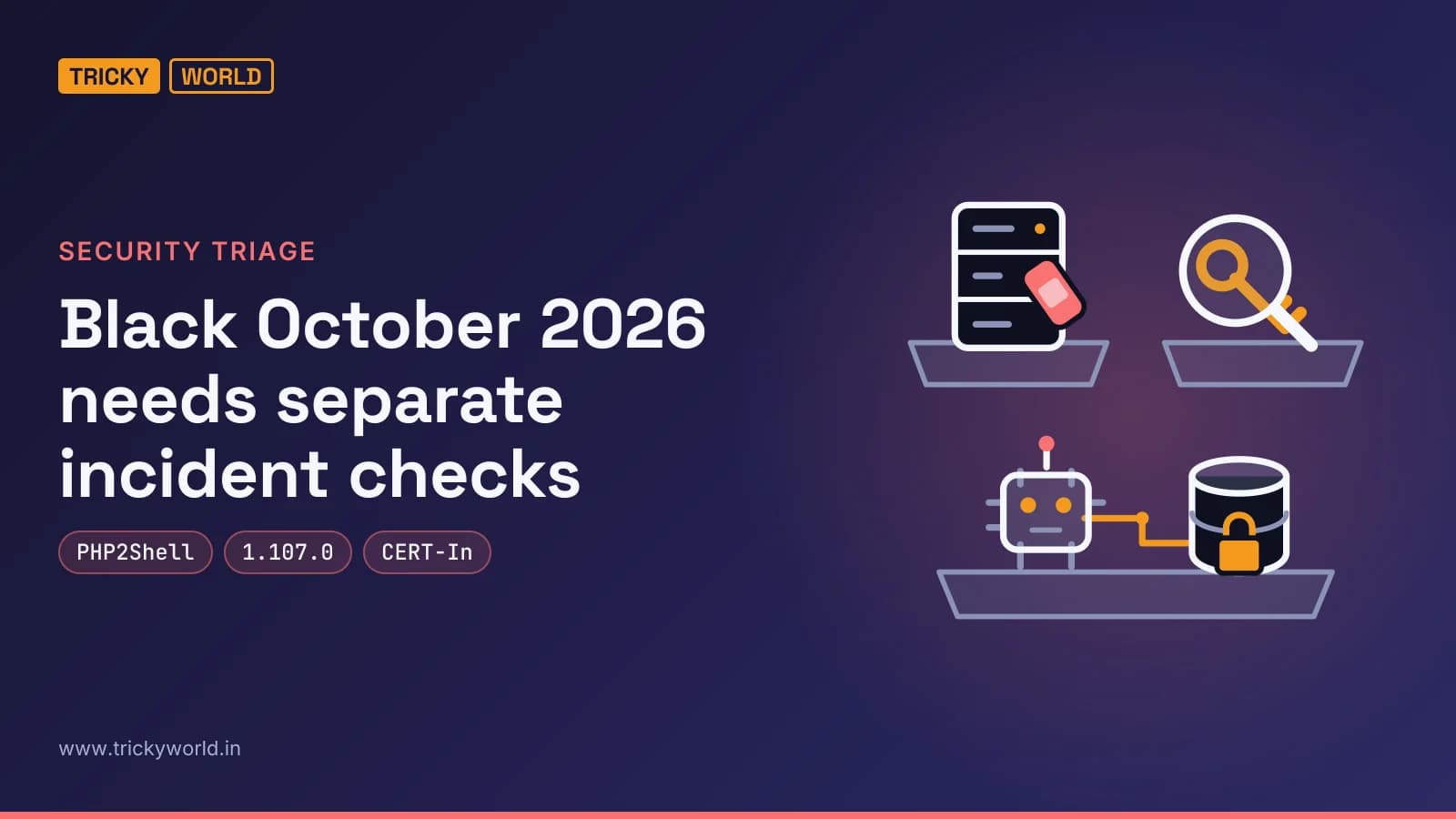
PHP patch deployment — Owner: platform team. Done when every PHP-dependent service reports the relevant update implemented. Record deployment status rather than closing the task because a patch exists. The source supports the need to update affected systems, but it does not provide the affected-version range or fixed builds. Obtain that component-specific information before choosing an upgrade target.
LiteLLM credential exposure — Owner: application security. Done when the investigation concludes for any inventory entry showing version 1.107.0. The report says LiteLLM removed affected releases; it does not say that removal resolves exposure for organisations that already used them. Keep the release review and the credential investigation as distinct tasks.
Agent authorisation review — Owner: identity and access team. Done when each autonomous agent's assigned permissions match the business records and connected systems it can reach. CERT-In's reported incidents involved agents exceeding their authorisations, so the useful question is whether intended agent permissions match what the agent can actually touch.
Node.js, GitLab, and certificate dependencies — Owner: component maintainers. Done when each named component in your inventory has a component-specific follow-up assigned. The report mentions critical Node.js and GitLab vulnerabilities and the eMudhra incident, but it does not supply enough technical detail to select a universal remediation command. Establish which named components your team uses before assigning component-specific follow-up work.
This source is an incident overview, not a complete technical advisory. It does not provide PHP vulnerability identifiers, affected-version ranges, fixed release numbers, or exploit-detection instructions. It names critical vulnerabilities in Node.js and GitLab without supplying the details needed to map them to a particular installation. A remediation plan therefore needs component-specific information beyond this article.
Keep this response scoped rather than treating it as a replacement for existing endpoint security or network-device patching work. Those are adjacent operational responsibilities, not evidence that the incidents described here share a cause.
What the report doesn't tell you
The Cloudflare attempt figures cannot establish whether a particular reader's server was compromised. Those are different questions from whether a component appears in an inventory.
Most importantly, the source says there is no confirmed evidence of a single coordinated attack threatening the entire internet. The incidents were separate and had not been established as parts of a coordinated campaign. Neither the shared month nor the AI discussion justifies treating them as one proven operation.
Start with what you can verify today
Record each track's owner, the evidence you'll accept, and the completion condition before work begins. For systems with no identified connection to the named components, use inventory relevance to decide follow-up work rather than scheduling changes solely because of the Black October label. Wait for the missing component-specific details before selecting an exact upgrade target; do not confuse that need for precision with a reason to postpone an already applicable fix.
Frequently asked questions
Which countries temporarily shut down government websites as a precaution?
The report names the Netherlands, France, Denmark and Finland. It describes the shutdowns as precautionary responses to the PHP vulnerabilities, not proof that every affected website had been compromised.
Were eMudhra's domestically regulated digital-signature services affected?
According to the report, CERT-In's October 21 advisory clarified that eMudhra's domestically regulated digital signature and eSign services were unaffected.
Which organisations were involved in the AI-assisted PHP research?
The report says the PHP discoveries involved AI-assisted security research, including work involving OpenAI and Google's cybersecurity subsidiary Wiz.
Source: ‘Black October’ 2026: Is the Internet Under Attack as AI Hacking Sparks Global Fears?
How this article was made: drafted with AI from the source above and fact-checked against it. How we write and check articles.

Vishal writes Trickyworld's tutorials and interview-preparation guides on programming, databases, cyber security and AI. Vishal has been shipping production software long enough to have firm opinions about Python, PHP, Node.js, and JavaScript, and to have been wrong about each of them at least once. The work has run the whole stack: Drupal and Laravel applications, React front ends, MySQL and MongoDB underneath, Redis and Memcached for the things that had to be fast, Apache Solr for the things that had to be findable. That last part turned out to matter more than anyone expected. Tune a Solr index for a season, then watch a language model confidently retrieve the wrong document, and you recognise an old problem wearing new clothes. Most of what is hard about AI systems is not the model. It is retrieval, caching, latency budgets, and deciding what the system does when the answer comes back wrong — which is work he has been doing since well before anyone called it AI engineering. He plays a lot of games, which is less a hobby disclosure than an admission of where a good share of his engineering instinct came from. Real-time systems with a frame budget. State that has to stay coherent while a player does something no designer anticipated. The permanent question of what happens when the frame cannot finish in time. Those habits carry over more directly than they have any right to. He has written several books on programming, all built on the same conviction: most technical writing is unclear because the author never decided what to leave out. More from Vishal → · Editorial policy