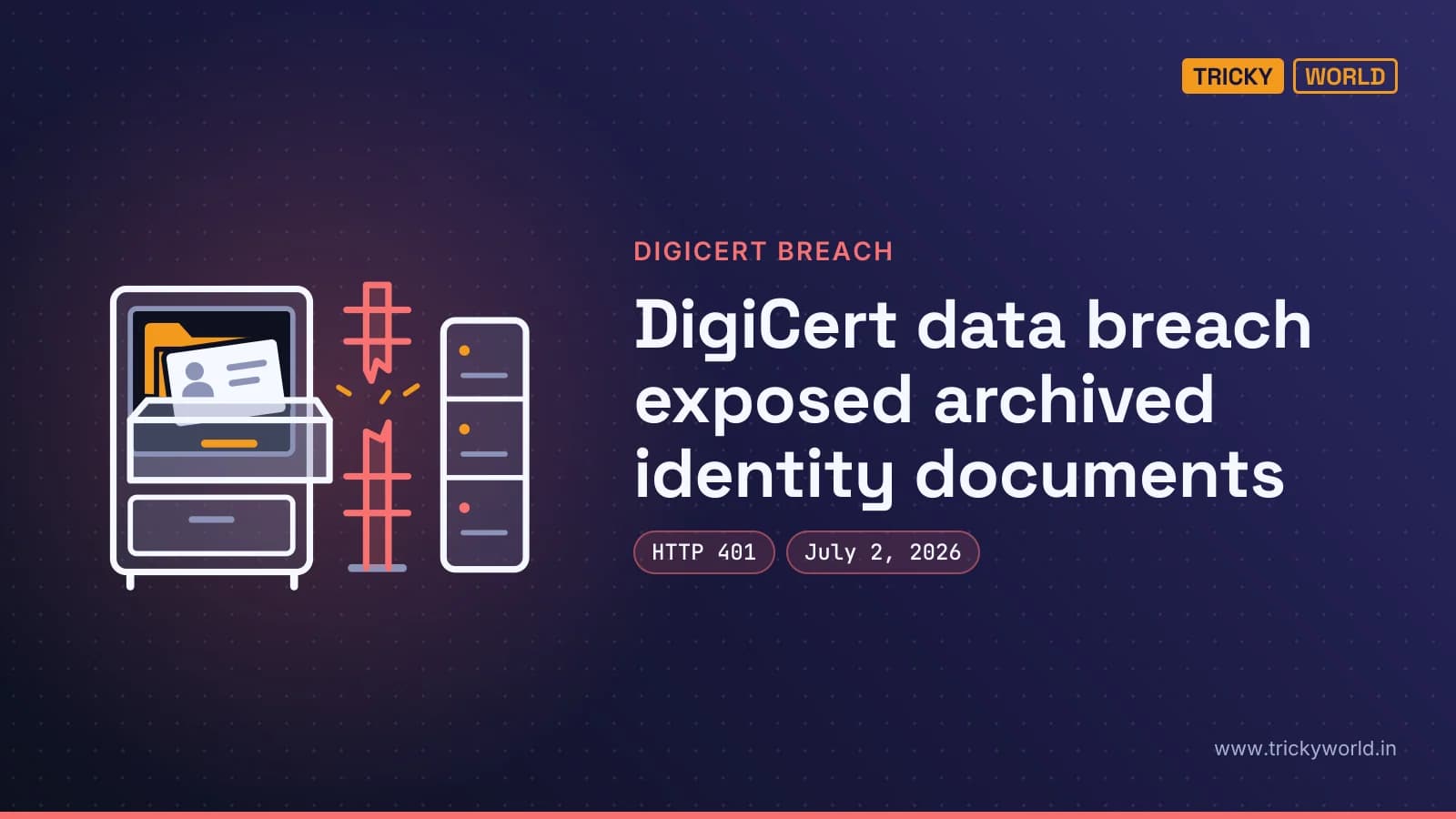
DigiCert data breach exposed archived identity documents
DigiCert's data breach exposed archived customer details and, in some cases, identity documents after unassigned accounts gained read access to an internal business system. DigiCert blocked that access on July 2, 2026; customers should check exposure notices, but active certificates need no action. Identification-document exposure was still under review when notifications were sent.
Summary written with AI from this article, and checked against it.

Affected systems and impact
| Flaw | Affected systems | Impact |
|---|---|---|
| Missing authorization checks allowed accounts without an assigned application to read archived data | DigiCert's internal business system and archived customer information | Unauthorized access to customer contact details and, in some cases, identity documents |
| A server migration inadvertently exposed a VPN-restricted internal system externally | DigiCert's internal business system moved on February 4, 2025 | Made the internal system and its unintended self-registration flow externally accessible |
| Unintended self-registration created accounts without required multi-factor authentication | The separate account-management deployment for DigiCert's internal business system | Allowed creation of unassigned accounts that could access archived information |
| Insufficient alerting for unexpected account creation and internal endpoint request volume | DigiCert's internal business system | Not stated |
An account with no application assigned could read DigiCert's archived customer data — including identity documents in some cases. The DigiCert data breach hit an internal business system exposed during a server migration, not the certificate platforms, the company says. I'd say the practical response is to check exposure notices and review registration and authorization controls, not replace active certificates.
For customers who submitted identity-verification documents, the concern extends beyond business contact details. BleepingComputer reports that DigiCert has begun notifying affected customers, with some records containing documents such as passports or driving licences. DigiCert says its review of identification documents was still under way when it sent the notification, so I'd advise recipients to distinguish confirmed exposure from information still being assessed.
How the migration opened the archive
The entry point was a network change. According to DigiCert's full incident report on Mozilla Bugzilla, an internal business system moved from a virtual private network (VPN)-restricted segment to another availability zone on February 4, 2025. That migration inadvertently made the system externally accessible. DigiCert says the migration was treated as an infrastructure change rather than a security change, so it did not receive the more detailed security review and sign-off.
The exposed system used an account manager with an optional self-registration flow intended for other implementations. That flow became available on the business system even though the system was not intended to use it. Accounts created through this route had no application assigned and did not receive the multi-factor authentication (MFA) that DigiCert otherwise required.
In my view, the decisive failure was authorization. These unassigned accounts received read-only access to archived information rather than being denied access. DigiCert's initial review incorrectly concluded that the absence of an assigned application meant the account could not reach customer data. The account's apparent lack of entitlement did not match what the system actually allowed.
The July fix came before confirmation of data access
DigiCert blocked the authorization path before it established that customer information had already been accessed. The company says it restricted access to the system, disabled self-registration, and added access controls. Its July authorization change validated the account-manager token and returned HTTP 401 for accounts without an assigned application.
| Date | Event |
|---|---|
| February 4, 2025 | The migration inadvertently made the internal business system externally accessible. |
| June 21, 2026 | DigiCert identified the unintended external accessibility and an unassigned account. |
| June 27–July 2, 2026 | An unauthorized account accessed customer information, according to BleepingComputer's account of the investigation. |
| July 2, 2026 | DigiCert deployed the authorization fix, blocking archived-data access by unassigned accounts. |
| October 15, 2026 | Additional application-access alerts and a request-volume alert were added. |
| October 19, 2026 | DigiCert confirmed unauthorized access to archived data and determined that the incident was reportable. |
The DigiCert data breach therefore has different containment and confirmation dates. The company's own description of its initial handling is direct:
“The incident was initially handled as an account-creation issue rather than a data-access event.”
— DigiCert's full incident report
My concern is that initial stopping point: the review inferred what the account could do from its assignment state instead of establishing what it had actually accessed. DigiCert says retained logs and audit tables later allowed investigators to reconstruct the access list, access window, and account activity. Those records also supported its finding that the account performed no write actions.
The DigiCert data breach scope still lacks a customer total
DigiCert describes the affected information as a small proportion of its archived data. Most of it consisted of customer representatives' names, business email addresses, phone numbers, and business addresses. The company has not supplied a numerical definition of that proportion in its full incident report.
A small minority of customer accounts also included additional personal information in customer-provided documents. DigiCert names driving licences, passports, utility bills, and other documents containing a name and address. That does not mean every affected person lost every document type. The notification described by BleepingComputer says DigiCert was reviewing identification documents to determine whose documents were involved and would notify those people after completing that review.
The company says its certificate systems were not compromised. DigiCert's certificate authority (CA) services, CertCentral, and DigiCert ONE were unaffected. Customer login credentials and issued certificates remain secure, valid, and trusted, according to DigiCert. The unauthorized account could not write records, act as a validation approver, or issue certificates. DigiCert says its review of CA and validation logs found no associated validation, issuance, or revocation activity.
In my view, the unresolved customer total matters when interpreting the company's description of the incident as limited. BleepingComputer says it asked DigiCert how many people were affected, but its report supplies no answer. I see the supported distinction as between a bounded archive-access incident and unaffected certificate operations — not between a known small number of victims and everyone else.
Check DigiCert notices without replacing active certificates
DigiCert says active certificates need no action; customers should check which personal records were exposed. DigiCert explicitly says customers need take no action regarding active certificates or continued use of its services. I'd start with the notification and the people who supplied verification documents, rather than a certificate-replacement project.
- Identify what the notice actually confirms. Separate business contact information from identification documents that are confirmed as involved or still under review. Record the categories DigiCert names for your organisation rather than assuming that every item in its general description was present in your records.
- Bring the notice to the people responsible for your organisation's security and privacy response. As a recommended internal hand-off, include the affected representative and the document categories identified. This keeps the response tied to the archived personal information rather than treating it solely as a certificate-administration issue.
- Seek document-specific clarification where the notification remains conditional. DigiCert said it would notify people whose identification documents were affected after its review. Until that clarification arrives, distinguish an unresolved question about a submitted document from a confirmed disclosure of that document.
- Keep certificate work separate from the privacy response. DigiCert's stated position is that active certificates need no action. Its report does not call for customers to replace certificates or change their use of CertCentral or DigiCert ONE because of this incident.
Audit registration and authorization after internal migrations
In my view, DigiCert's root-cause analysis points to checks that belong together: network exposure, registration behaviour, application assignment, and actual data access. I'd use the following sequence when reviewing a comparable internal archive, because it follows the failure path DigiCert documented rather than stopping at the network boundary.
- Review the security effect of the migration. Establish whether a system previously reachable only through a VPN has become externally accessible. DigiCert says its network change did not trigger the detailed security review it should have received. Make the review cover the resulting attack surface, including account-registration functionality, rather than only whether the migrated application still works.
- Inspect registration features inherited from shared account-management software. DigiCert's business system exposed an optional flow intended for other uses. Check whether a comparable system offers self-registration at all, whether it is intended, and what happens to an account created through it. Include the MFA requirement in that review instead of assuming every registration path applies the staff sign-in controls.
- Test access with an account that has no application assigned. The expected result should follow your authorization policy, not an assumption about the account's status. DigiCert's fix rejected these accounts with HTTP 401. For a comparable archive, explicitly test whether such an account can retrieve records; testing only whether it can modify them would miss the read-only access involved here.
- Review account and request monitoring alongside the access controls. DigiCert identified insufficient alerting for new accounts created through the exposed endpoint and for request volume at internal endpoints. It later added application-access and request-volume alerts. Use those documented gaps to decide which account-creation and data-access events your own system needs to surface.
- Investigate data access when unexpected account creation is discovered. Preserve and examine the logs and audit records needed to connect an account to its activity. DigiCert's retained records allowed that reconstruction later. The investigation should establish which records were accessed, when access occurred, and whether there were write actions, rather than closing with an account-assignment check.
I'd note these are review and test objectives, not a configuration recipe: DigiCert's report describes the failure and the authorization behaviour of its fix, but does not publish deployable code. Apply the checks to the system you operate without assuming its account manager or authorization implementation matches DigiCert's.
I see the useful lesson from the DigiCert data breach as being that an internal location was carrying too much of the security assumption. Once the network boundary changed, an unintended registration flow and permissive read access became reachable together. DigiCert's report explicitly says business-system authorization must not depend on network position.
Migration sign-off should demonstrate that unassigned accounts cannot retrieve records.
Frequently asked questions
Was the exposed account manager the same instance used by DigiCert’s customer-facing products?
No. DigiCert says the business system used its own instances of the account-management platform, separate from the customer-facing instance. The optional registration feature was available in that separate business-system deployment.
Did DigiCert stop issuing certificates in response to the incident?
No. DigiCert says issuance was not stopped because the access was limited to archived information and did not allow validation or certificate-issuance operations. Its CA systems operated on separate secure network segments.
Has DigiCert completed alerting for unexpected account and permission changes?
A later update in the Bugzilla discussion says DigiCert completed Action Item 13: automated alerting for unexpected account creation and changes to account or user permissions.
Sources
Primary sources
- Write-upEnterprise Email Security Assessment · adaptivesecurity.com
- Write-up2084460 - DigiCert: Unauthorized access to business system · bugzilla.mozilla.org
Reports of the story
- News reportDigiCert data breach exposes customer information, identity documents · bleepingcomputer.com
How this article was made: drafted with AI from the sources above and fact-checked against them, then reviewed by Vishal on . How we write and check articles.

About the author
Vishal · Software & security engineerVishal writes Trickyworld's tutorials and interview-preparation guides on programming, databases, cyber security and AI. Vishal has been shipping production software long enough to have firm opinions about Python, PHP, Node.js, and JavaScript, and to have been wrong about each of them at least once. The work has run the whole stack: Drupal and Laravel applications, React front ends, MySQL and MongoDB underneath, Redis and Memcached for the things that had to be fast, Apache Solr for the things that had to be findable. That last part turned out to matter more than anyone expected. Tune a Solr index for a season, then watch a language model confidently retrieve the wrong document, and you recognise an old problem wearing new clothes. Most of what is hard about AI systems is not the model. It is retrieval, caching, latency budgets, and deciding what the system does when the answer comes back wrong — which is work he has been doing since well before anyone called it AI engineering. He plays a lot of games, which is less a hobby disclosure than an admission of where a good share of his engineering instinct came from. Real-time systems with a frame budget. State that has to stay coherent while a player does something no designer anticipated. The permanent question of what happens when the frame cannot finish in time. Those habits carry over more directly than they have any right to. He has written several books on programming, all built on the same conviction: most technical writing is unclear because the author never decided what to leave out. More from Vishal → · Editorial policy