CVE-2026-129271: N-central patch and version checks
CVE-2026-129271 is a local privilege escalation flaw in N-central Patch Management, reportedly addressed by 2026.4 Hotfix 3, though no CVE-specific fixed version is published. N-able requires on-premise server upgrades; hosted servers update automatically. Both groups must also upgrade Agents and Probes, which remain susceptible to impersonation if not upgraded.
Summary written with AI from this article, and checked against it.

Affected systems and impact
| Flaw | Affected systems | Impact |
|---|---|---|
| CVE-2026-129273Syslog injection in Audit Export | N-central Audit Export; affected versions not stated | Root command execution |
| CVE-2026-129286Path traversal in SIS GenericFiles version handling | N-central SIS GenericFiles; affected versions not stated | Remote code execution |
| CVE-2026-129272Predictable passcode in MMS3 appliance authentication | N-central MMS3 appliance; affected versions not stated | Authentication bypass |
| CVE-2026-129271Local privilege escalation in Patch Management | N-central Patch Management; affected versions not stated | Local privilege escalation |
| CVE-2026-129282Test-email sendmail argument injection and missing authorisation | N-central test-email functionality; affected versions not stated | Not stated |
| CVE-2026-129274Missing authentication for ServerMMS2 task-result submission | N-central ServerMMS2; affected versions not stated | Unauthenticated task-result submission |
At a glanceCVE-2026-129271
CVE-2026-129271 has no CVSS score yet: NVD has no record of it so far. No fixed version has been published yet.
| Severity | Not scored yet: NVD has no record of it yet |
|---|---|
| Fixed in | No fixed version published yet |
| Affected | Not published yet |
| Exploited | Not in CISA's Known Exploited Vulnerabilities catalog |
| Public exploit | None reported |
| Ubuntu | Not tracked yet |
| Debian | Not tracked yet |
| Red Hat | Not tracked yet |
Is there a public exploit for CVE-2026-129271?
No public exploit is listed as of November 17, 2026: NVD has no record of it yet, no public GitHub repository names it, and it is not in CISA's Known Exploited Vulnerabilities catalog.
From NVD · checked November 17, 2026
Updating the N-central server does not protect unpatched Agents and Probes from impersonation, according to N-able. CVE-2026-129271 is among the 17 flaws The Hacker News reports as addressed by N-central 2026.4 Hotfix 3, but no CVE-specific fixed version has been published yet. Use the checklist below to check server and component versions separately, track required upgrades, and review workflows affected by feature restrictions.
CVE-2026-129271 is listed as a local privilege escalation flaw in N-central Patch Management. N-able describes the release as a critical security update for its Remote Monitoring and Management (RMM) and Unified Endpoint Management (UEM) platform. On-premise customers must upgrade their servers as soon as possible. Hosted servers receive the updates automatically, but that only takes care of the server: customers in both groups still need to upgrade their Agents and Probes.
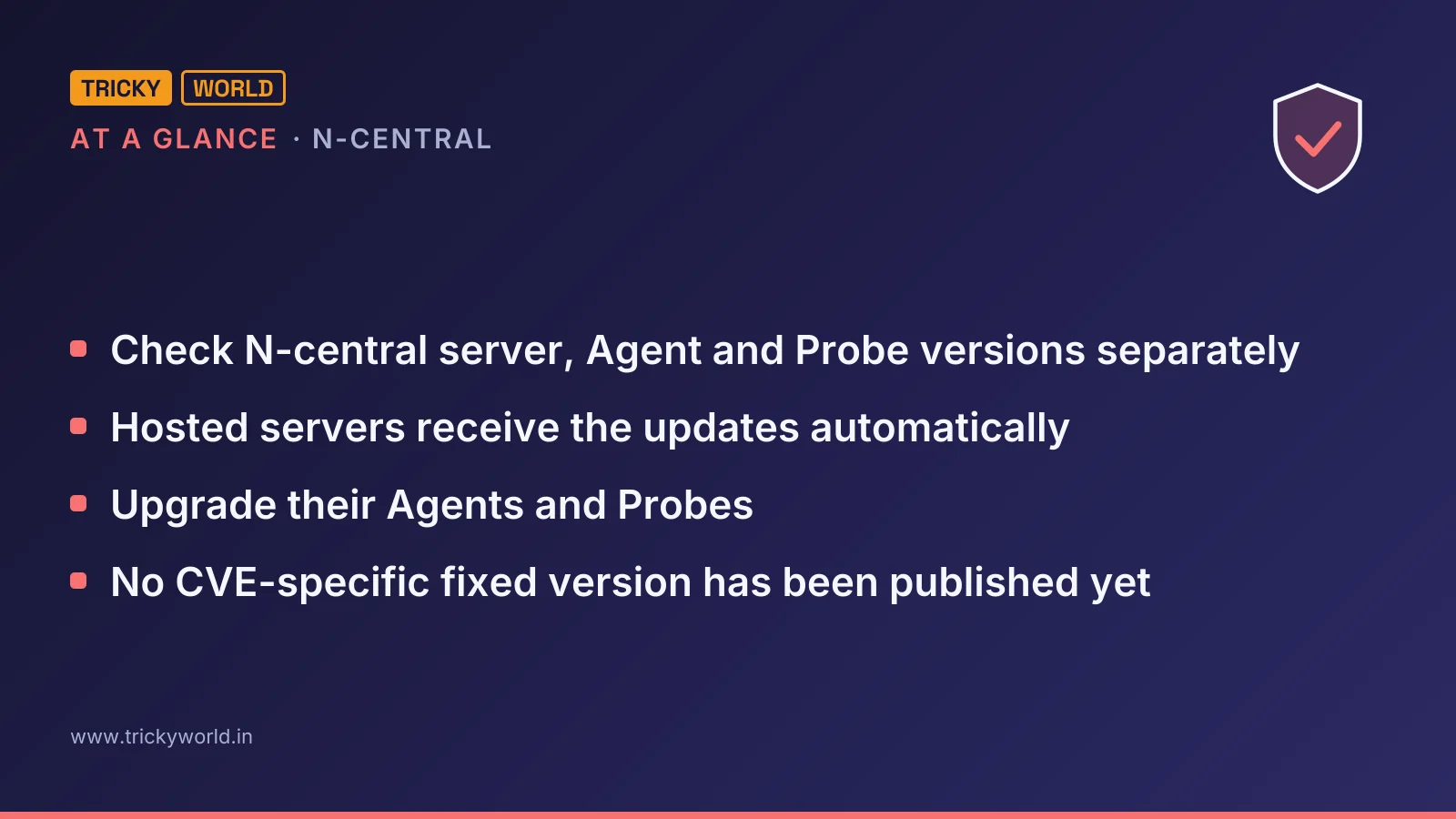
Check N-central server, Agent and Probe versions separately
I would not treat a server-version check alone as proof that the deployment is fully updated. N-able's instructions explicitly distinguish the server update from the Agent and Probe upgrades required for protection. I'd make that distinction in the inventory too.
My starting point would be to record the installed server version, then the versions of the Agents and Probes in scope, using the administration process already available in the deployment. I'd keep separate inventory entries for those components. A single N-central patch-status entry for CVE-2026-129271 does not capture which part of that work is complete.
For an on-premise server, compare the installed release against N-able's recommendation to deploy N-central 2026.4 Hotfix 3. Hosted deployments have a different server-update process: the update happens automatically. That does not, however, take the Agent and Probe upgrades off the customer's list.
The reported guidance provides neither a version-check command nor exact target build numbers for Agents and Probes, so there is no verified command to reproduce here. Follow N-able's latest-version guidance for those components. I would not assume their version strings should match the server's just because they belong to the same deployment.
What changed in N-central 2026.4 Hotfix 3?
This update addresses authentication bypass, root command execution, and other flaws across several security boundaries rather than fixing just one vulnerable operation. N-able describes work on authentication and access controls, Agent and Probe communications, appliance security, file and import handling, server hardening, and user management. Those are separate parts of the product, and the reported fixes reach across them.
The Hacker News lists the following vulnerabilities, including CVE-2026-129271, as addressed by the update. I'd read the descriptions below as the reported flaws, not as a published matrix of affected versions or a source of independently assigned severity scores.
| CVE | Reported flaw |
|---|---|
| CVE-2026-129271 | Local privilege escalation in N-central Patch Management |
| CVE-2026-129272 | MMS3 appliance authentication bypass through a predictable passcode |
| CVE-2026-129273 | Audit Export syslog injection enabling root command execution |
| CVE-2026-129274 | Missing authentication for ServerMMS2 task-result submission |
| CVE-2026-129275 | Policy disclosure through repositoryItemGet without authentication |
| CVE-2026-129276 | Missing authentication for ServerMMS2 asset-data submission |
| CVE-2026-129277 | Missing authentication for reading ServerMMS maintenance actions |
| CVE-2026-129278 | Unauthenticated tampering with Take Control audit logs |
| CVE-2026-129279 | User enumeration through differing password-reset responses |
| CVE-2026-129280 | Missing authorisation checks in ServerUI SOAP operations |
| CVE-2026-129281 | View-only users able to set DeviceExecute configuration |
| CVE-2026-129282 | Test-email sendmail argument injection and missing authorisation |
| CVE-2026-129283 | XML external entity injection in custom-service imports |
| CVE-2026-129284 | SSRF in Report Manager and Data Export settings |
| CVE-2026-129285 | Origin-validation error in XMPP action responses |
| CVE-2026-129286 | SIS GenericFiles version path traversal leading to remote code execution |
| CVE-2026-129287 | XML external entity injection in the SIS repository parser |
I'd separate authentication and authorisation here. Some reported operations lack authentication entirely. Others are available to users whose permissions should not allow them to perform those operations. I would not file this as a password-related update: that description would leave out much of what the reported fixes actually address.
If you operate N-central across managed Windows systems, the changes therefore reach further than the management server's login path. Agent and Probe communications, task submissions, imported files, and user permissions all appear in the reported security work. I'd plan the rollout around those parts of the deployment, not just the server login.
Keep the earlier mining attacks separate from the new CVEs
The reported cryptocurrency-mining attacks involve the earlier 4EverAble2Shell flaws. The Hacker News reports active exploitation of those vulnerabilities. I would not read that as reporting active exploitation of every CVE listed in the new update.
N-able began restricting certain N-central features and integrations after disclosure of the flaws called 4EverAble2Shell and Agent2Shell. According to the report, those shortcomings can permit arbitrary code execution as root and SYSTEM-level access to Windows systems under specific conditions. I'd keep those conditions attached to the claim.
For 4EverAble2Shell, the report names one condition explicitly: legacy API mode must be enabled. The latest N-central version removes the legacy API and closes that reported attack vector. This is a permanent removal in the new hotfix, rather than advice to keep a risky configuration option switched off.
I would not take that history as establishing identical preconditions for the newly listed vulnerabilities, including CVE-2026-129271. In particular, the reporting does not say that turning off legacy API mode addresses every authentication, file-handling, or permission issue covered by this update. I would not treat the legacy API change as a substitute for the rest of the reported security work.
I would use the earlier exploitation reports as a reason to prioritise N-able's update guidance, not as grounds to mark all 17 newly listed CVEs as actively exploited. I'd preserve that distinction in an incident record or patch record.
Complete the N-central server and component rollout
N-able gives different server-update instructions for hosted and on-premise deployments, but the component requirement is the same for both: all customers must upgrade their Agents and Probes. A hosted server does not remove that work from the customer's responsibility.
“Agents and Probes that are not upgraded are susceptible to impersonation.”
— N-able
The sequence below turns those instructions into a rollout checklist for CVE-2026-129271. N-able supplies the server-upgrade direction and the component requirement. Keeping separate completion records is my recommendation, so that a finished server update does not obscure Agent and Probe work that still needs doing.
Identify who owns the server update. For an on-premise N-central deployment, arrange the upgrade to 2026.4 Hotfix 3 as soon as possible and follow N-able's guidance. For hosted N-central, updates to the server are applied automatically. No customer server-side action is required for that part of the rollout.
Give Agent and Probe upgrades their own tasks. Include every Agent and Probe in the rollout, whether the server is hosted or on-premise. N-able requires the latest versions for full protection. A completed server update is not evidence that these component upgrades have happened, so I would not use it to close those tasks.
Review workflows that depend on restricted functionality. Identify any reliance on legacy APIs, remote control, or Intune integration before declaring the operational work complete. The reported changes include both permanent API removal and blocked functionality. I'd handle those changes differently from an ordinary version change, rather than treating them as part of the version check alone.
Record completion against the component inventory. Reconcile the server, Agent, and Probe entries collected at the start of the work. Record which upgrades are complete and which components still need attention. I'd keep the task open for that remaining work instead of closing the entire rollout on the strength of a server-only check.
Take a hosted customer whose server update is already handled by N-able. There is no customer server hotfix to install, but there is still a concrete question to answer: has every Agent and Probe received the required upgrade? An on-premise administrator reaches the same question after finishing the server update. Neither hosting model makes the component check unnecessary.
Separate completion checks for server patching and component upgrading keep that remaining work visible in the change record. They also follow the separation in N-able's own instructions. I see no need to invent an affected-build range in order to record which upgrades are done and which are still outstanding.
CVE-2026-129271 records and N-central feature restrictions
I'd account for two limits in the available information on CVE-2026-129271. Per-CVE publication is incomplete, and the update restricts or removes functionality. I would avoid a blanket statement that everything is fixed and operating normally, because it would hide both the missing advisory details and the restrictions that still affect workflows.
As of November 17, 2026, NVD has no record for CVE-2026-129271, CVE-2026-129272, CVE-2026-129273, or CVE-2026-129274. No CVSS score or CVE-specific fixed version has been published yet for those four IDs. None of those four appears in CISA's catalog either.
I'd therefore keep the two accounts distinct. The Hacker News includes the vulnerabilities in its list of flaws addressed by N-central 2026.4 Hotfix 3. The checked advisory information, however, does not yet publish individual fixed versions for those four CVEs. N-able has supplied a product-level rollout recommendation, but a complete mapping from each CVE to a fixed version is not available.
The missing-record status applies only to those four IDs; the supplied NVD and advisory checks do not cover the other CVEs in the table. The absence of a CISA listing also does not change the separate reporting about attacks involving the earlier 4EverAble2Shell vulnerabilities. I would not use either gap to extend a claim beyond the information that was checked.
I'd be equally careful in wording the feature restrictions. N-able has completely removed the legacy API configuration option and permanently blocked those APIs. Remote control functionality and Intune integration were also blocked at the time of The Hacker News report. That report does not provide a restoration date for either of those two features.
I would not, therefore, plan a workflow that relies on a legacy API around re-enabling its old configuration option. For remote control and Intune integration, I'd keep the statement narrower: both were blocked when reported, and no restoration schedule was provided. The reporting establishes neither an imminent return nor permanent removal for those features, so I would not promise either outcome in the change record.
My recommendation is to follow N-able's server and component upgrade guidance without waiting for NVD entries to appear. To complete the rollout, upgrade the Agents and Probes, reconcile their inventory, and check workflows affected by blocked features. In the change record, I'd keep the published hotfix recommendation separate from the missing CVE-specific version details and the outstanding feature restrictions. Before closing the work, I'd reconcile the Agent and Probe inventory and check the workflows that depend on the blocked functionality.
Frequently asked questions
How does Hotfix 3 relate to Hotfix 2?
N-able says HF3 builds on the protections delivered in HF2 and adds further improvements. Its description presents HF3 as additional security work across several parts of N-central.
Did the researcher expect the published vulnerability details to work against the latest patch?
The Hacker News credits independent security researcher Sean Bales with publishing additional details for 24 CVEs. Bales said these were patched vulnerabilities and should not work on the latest patch; that is his assessment, not a published per-CVE version matrix.
Sources
Primary sources
- DocumentNVD and distribution data for CVE-2026-129271, CVE-2026-129272, CVE-2026-129273, CVE-2026-129274 (checked 2026-11-17)
- CVE recordCVE-2026-129271 in the National Vulnerability Database · nvd.nist.gov
Reports of the story
- News reportN-able Patches 17 N-central Flaws as Attackers Exploit Earlier Bugs to Deploy Crypto Miners · thehackernews.com
How this article was made: drafted with AI from the sources above and fact-checked against them, then reviewed by Vishal on . How we write and check articles.

About the author
Vishal · Software & security engineerVishal writes Trickyworld's tutorials and interview-preparation guides on programming, databases, cyber security and AI. Vishal has been shipping production software long enough to have firm opinions about Python, PHP, Node.js, and JavaScript, and to have been wrong about each of them at least once. The work has run the whole stack: Drupal and Laravel applications, React front ends, MySQL and MongoDB underneath, Redis and Memcached for the things that had to be fast, Apache Solr for the things that had to be findable. That last part turned out to matter more than anyone expected. Tune a Solr index for a season, then watch a language model confidently retrieve the wrong document, and you recognise an old problem wearing new clothes. Most of what is hard about AI systems is not the model. It is retrieval, caching, latency budgets, and deciding what the system does when the answer comes back wrong — which is work he has been doing since well before anyone called it AI engineering. He plays a lot of games, which is less a hobby disclosure than an admission of where a good share of his engineering instinct came from. Real-time systems with a frame budget. State that has to stay coherent while a player does something no designer anticipated. The permanent question of what happens when the frame cannot finish in time. Those habits carry over more directly than they have any right to. He has written several books on programming, all built on the same conviction: most technical writing is unclear because the author never decided what to leave out. More from Vishal → · Editorial policy