China’s AI bubble has cracked, but a global crash is unproven
China’s technology stock sell-off raises valuation and supplier questions; separate the reported losses from unproven claims of a global AI collapse.


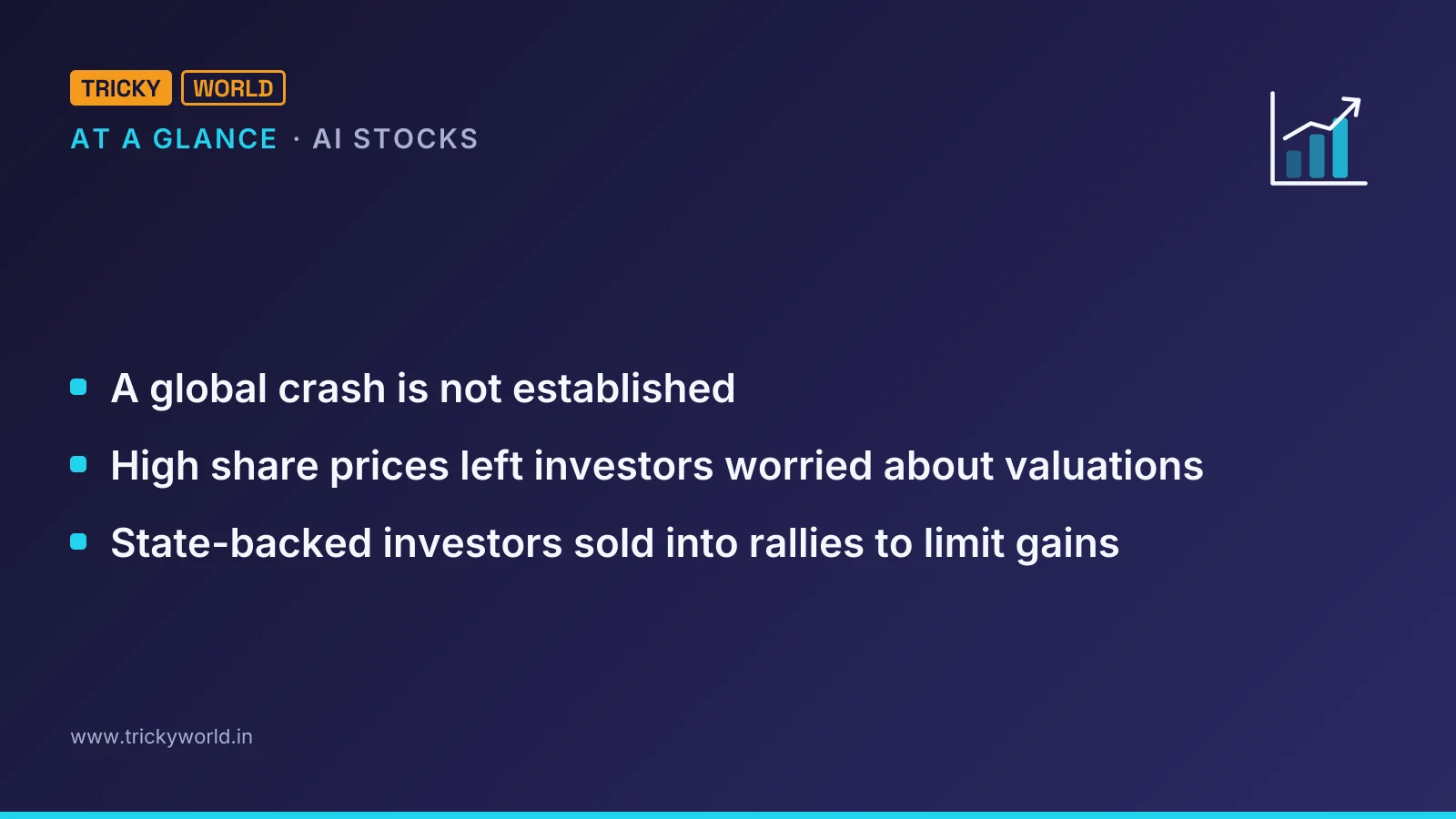
China's STAR50 index of artificial intelligence and semiconductor leaders has fallen 40% in less than four months, wiping out about $480 billion, Reuters reports. The AI bubble has deflated in Chinese stocks. A global crash is not established. Here is how I separate that valuation shock from supplier risks worth checking before you expand a project.
For teams planning hardware purchases or long supplier commitments, the practical stakes are fundraising and availability. Reuters says the sell-off will likely slow technology firms' equity fundraising, while possible restrictions on supplying US data centres weigh on Chinese optical-equipment companies.
The central account in Has China's AI Stock Bubble Finally Burst? $480 Billion Wipeout Puts Tech Valuations Under Scrutiny describes several pressures rather than a single obvious trigger.
Where the AI bubble has already deflated
I see the Chinese sell-off as substantially deeper than the US decline described in the same reporting. That distinction matters to me: a severe correction in one market is not the same event as a synchronised collapse across global technology stocks.
Reuters gives the following index declines, measured from different reference points.
| Index | Reported decline | Reference point |
|---|---|---|
| STAR50 | 40% | Less than four months |
| CSI300 | About 20% | June highs |
| Nasdaq | 6% | Record high reached three weeks before the report |
To me, the valuation figures explain why a large fall has not settled the argument about expensive shares. Reuters puts the STAR50 at around 100 times trailing earnings, down from a peak near 250 times. Its comparison for the Nasdaq 100 is around 30 times earnings.
I read those figures as describing both a substantial repricing and a remaining valuation difference. They do not establish where prices should stop falling. Also, I'd note that the valuation comparison uses the Nasdaq 100, while the decline above concerns the broader Nasdaq index; those benchmarks should not be silently treated as interchangeable.
Policy support did not remove valuation risk
I see Beijing's effort to fund technology through the stock market as having helped create the setting for the rally, but it did not prevent the reversal. Reuters describes a two-year advance following economic stimulus promises, alongside an official ambition for a steadier market rather than another boom-and-bust cycle.
Authorities had also tried to restrain speculation through action against borrowing-backed trading and high-frequency trading. State-backed investors sold into rallies to limit gains. I'd say the reported crash therefore did not arrive in a market where officials had simply ignored excessive speculation.
The retail-investor story shows me how policy enthusiasm became investment conviction. Reuters interviewed Chen Wensheng, a small-business owner from Hainan, who bought shares encouraged by what he regarded as official support. Unitree, one of the companies attracting that enthusiasm, counted state-backed funds among its investors. Reuters reports that its listing was 8,000 times oversubscribed by retail buyers.
Traders identified several pressures behind the reversal, without pointing to one obvious selling trigger:
- High share prices left investors worried about valuations.
- Tax bills contributed to selling pressure.
- Possible restrictions on Chinese equipment in data centres threatened suppliers' prospects.
I would not read state backing as protection against overpaying for a business. To me, the reported combination of official support, extraordinary retail demand and subsequent losses is a reason to separate a national technology strategy from the price attached to an individual company.
The losses reach chipmakers and optical suppliers
The damage is spread across different parts of China's technology supply chain. Company names below follow Reuters' written account, which reports losses among robotics businesses, chipmakers and optical-component suppliers.
Reuters describes the following company-level declines; these are market-price changes, not measurements of product performance.
| Company | Reported share-price decline | Reference point |
|---|---|---|
| Unitree | About half | Since trading began in August |
| CXMT | More than a quarter | Month preceding the report |
| MetaX Integrated Circuits | About half | Since July |
| Moore Threads Technology | About half | Since July |
| Zhongji Innolight | Roughly 60% | June and July highs |
| Eoptolink Technology | Roughly 60% | June and July highs |
MetaX and Moore Threads rose 700% and 400%, respectively, on their market debuts. Reuters reports that MetaX and Moore Threads rose 700% and 400%, respectively, on their market debuts. I see their subsequent falls as belonging to a story of sharply changing expectations, rather than a small adjustment after an uneventful listing.
For optical suppliers, I see an additional commercial pressure. Reuters attributes part of the decline to Washington's moves towards barring their equipment from US data centres. I'd call that a developing restriction risk, not evidence that every possible ban has already taken effect.
I see the market's exposure as broad. Goldman Sachs estimates, as reported by Reuters, that AI stocks represent 42% of China's market capitalisation and 57% of turnover across mainland-listed A-shares and Hong Kong-listed H-shares. That concentration helps me explain why the reversal reaches beyond a handful of speculative favourites.
US power and financing pressures are a different warning
I read the US argument as concerning the ability to turn investment into usable infrastructure. The AI bubble is about to pop describes data centres waiting for electricity connections and equipment bottlenecks delaying their operation. I see that as a different mechanism from investors marking down Chinese technology shares.
The account describes companies buying chips while grid connections remain unresolved, along with shortages of large power transformers. It also describes attempts to bypass grid constraints through on-site gas generation, which introduces another dependency: obtaining turbines and completing the electrical work.
For an engineering project, I find the useful distinction is between equipment purchased and capacity available. A building, a chip order and an energised facility represent different stages in the account's investment story. I don't think announced spending alone answers when a particular deployment can run.
The same source presents a separate accounting dispute. It describes companies spreading server costs over longer estimated useful lives and Michael Burry challenging those assumptions. It also reports Nvidia's response that its chips can remain useful for up to six years.
I think these arguments can reinforce concerns about the global AI bubble, but they should not be merged into one explanation for China's losses. The China reporting points me to expensive shares and trade-policy worries. The US account strikes me as concentrating on physical infrastructure, financing commitments and contested assumptions about hardware life.
Review AI supplier commitments before expanding
I'd start with a supplier and capacity review, not an emergency rewrite. For a team evaluating a purchase or expansion, I'd say the practical response is to ask which assumptions depend on future financing, future infrastructure or continued access to a particular market.
Map the supplier commitments behind the proposed project. I'd write down what must be delivered, by whom, and which commitments are already in place. I'd keep the review tied to the actual purchase rather than treating every Chinese technology company as equally exposed. The reported pressures differ between a chipmaker seeking financing and an optical supplier facing possible restrictions.
I'd separate available capacity from expansion promises. Ask the supplier to distinguish what can be delivered now from what depends on an unfinished facility or an electricity connection. For a project involving a new data centre, request the relevant capacity and power milestones rather than accepting the size of an announced investment as the delivery answer.
I'd examine the financing assumptions behind the delivery plan. Ask whether the proposed expansion depends on a listing, additional equity or another funding event. Reuters' concern about slower technology fundraising makes this a focused question for me. A falling share price alone doesn't answer it for me, so I'd request a project-specific explanation rather than drawing conclusions from the ticker.
I'd revisit the purchase decision against the project's own acceptance criteria. State what the equipment or service must accomplish and what evidence would justify expansion. If the case mainly depends on expectations of a continuing investment boom, ask for a version supported by current availability and demonstrated usefulness to the intended workload.
For an existing production service, I'd make the corresponding review narrower: check whether its operation or planned growth actually depends on the suppliers and infrastructure under discussion.
I see these as decision checks, not a software migration procedure.
Share-price losses do not establish service failure
I see the largest evidence gap as between falling financial expectations and the condition of an individual product or supplier. I don't think either a stock-price decline nor a broad claim about an investment bubble establishes that a particular service is failing, that a particular chip is unusable, or that a supplier will miss a contract.
I think the US account's accounting allegations also require careful treatment. Burry's criticism is attributed to him, and Nvidia's competing position is reported alongside it. The supplied material doesn't establish fraud as a finding to me. Nor does a newer chip generation, by itself, establish the useful life of every older deployment in my view.
I also see no supported promise here of cheaper equipment after the sell-off. Fund manager Wang Zhuo, a partner at Shanghai Zhuozhu Investment Management, predicts eventual price competition among Chinese chipmakers and AI suppliers. That's his forecast, not a reported outcome already covering the sector as I see it.
I think a team without a relevant procurement or expansion decision can reasonably keep this story in the financial-risk category. A team considering a major commitment faces a more immediate question for me: does the delivery case still hold when optimistic financing and infrastructure assumptions are challenged?
My verdict: the AI bubble has visibly deflated in Chinese listed technology shares, while a global collapse remains unproven by these sources. I'd proceed where present capacity and project value justify the commitment, and wait where the case depends mainly on an expansion plan whose funding or power supply is unresolved.
Frequently asked questions
Have Asia-focused funds abandoned Chinese stocks?
Not according to the HSBC research cited by Reuters. Asia funds generally remained overweight on China, even though they had been sellers during the three months preceding the report. Remaining overweight and reducing holdings can therefore coexist in this account.
Are major banks still recommending any Chinese AI stocks?
Yes. Reuters reports that Goldman Sachs included Innolight and CXMT among dozens of Chinese AI stocks on a revised recommendation list published earlier in October. BNP Paribas Securities strategist William Bratton also described opportunities for careful buyers. These are attributed investment views, not assurances that the sell-off has ended.
Source

Vishal writes Trickyworld's tutorials and interview-preparation guides on programming, databases, cyber security and AI. Vishal has been shipping production software long enough to have firm opinions about Python, PHP, Node.js, and JavaScript, and to have been wrong about each of them at least once. The work has run the whole stack: Drupal and Laravel applications, React front ends, MySQL and MongoDB underneath, Redis and Memcached for the things that had to be fast, Apache Solr for the things that had to be findable. That last part turned out to matter more than anyone expected. Tune a Solr index for a season, then watch a language model confidently retrieve the wrong document, and you recognise an old problem wearing new clothes. Most of what is hard about AI systems is not the model. It is retrieval, caching, latency budgets, and deciding what the system does when the answer comes back wrong — which is work he has been doing since well before anyone called it AI engineering. He plays a lot of games, which is less a hobby disclosure than an admission of where a good share of his engineering instinct came from. Real-time systems with a frame budget. State that has to stay coherent while a player does something no designer anticipated. The permanent question of what happens when the frame cannot finish in time. Those habits carry over more directly than they have any right to. He has written several books on programming, all built on the same conviction: most technical writing is unclear because the author never decided what to leave out. More from Vishal → · Editorial policy