Object-Oriented Programming in PHP: Interview Preparation
Object-Oriented Programming in PHP uses classes and objects to organize code, with encapsulation controlling access to data and methods. Classes define properties and methods, while objects are their instances; public, private and protected access modifiers determine where those members can be accessed.
Summary written with AI from this article, and checked against it.

Object-Oriented Programming (OOP) is a programming paradigm that utilizes objects and classes to create more organized and modular code. It's a vital concept in modern programming and is prominently featured in PHP. This article focuses on the object-oriented features in PHP, helping you familiarize yourself with classes, objects, and encapsulated code.
Object-Oriented Programming Concepts
Classes
A class is a blueprint for creating objects in PHP. It defines the properties (attributes) and methods (functions) that the object created from the class will have.
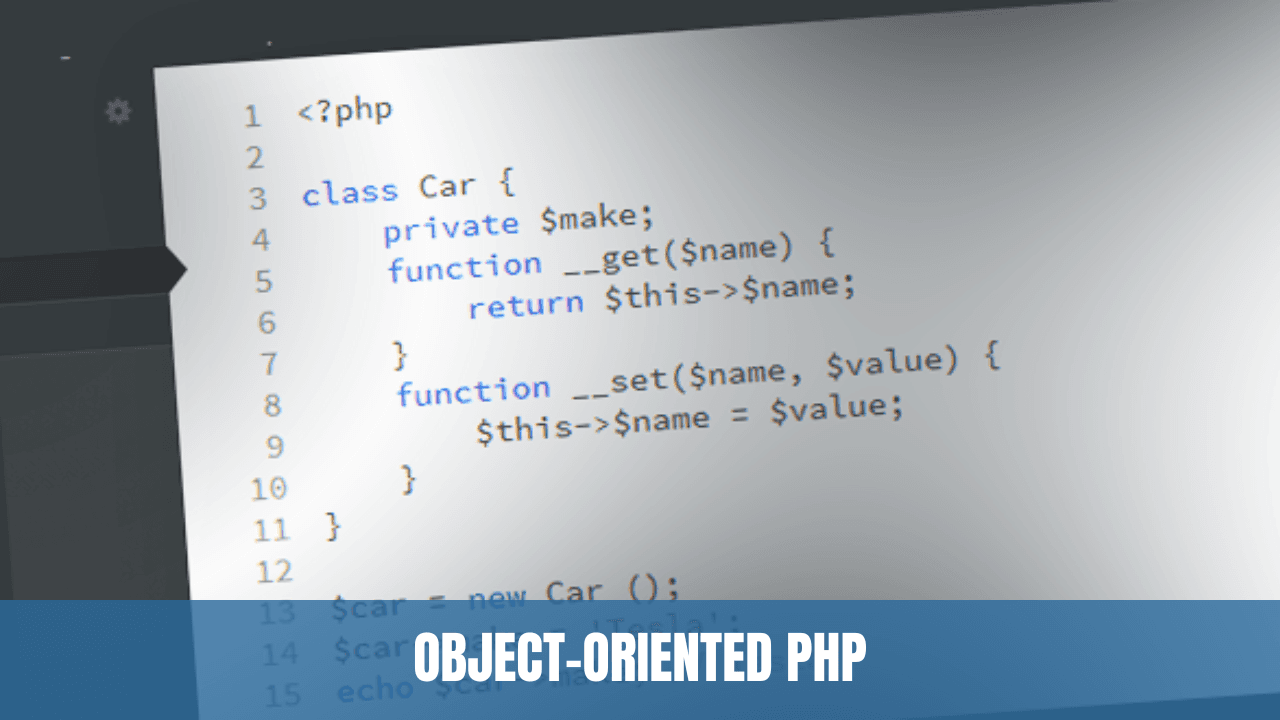
class Car {
    public $color;

    public function setColor($color) {
        $this->color = $color;
    }
}
Objects
Objects are instances of classes. They are used to access the properties and methods defined in the class.
$myCar = new Car();
$myCar->setColor('red');
Encapsulation
Encapsulation is the bundling of data and the methods that operate on that data. It restricts direct access to some of an object's components, which is a means of preventing unintended interference.
In PHP, this can be achieved using access modifiers:
- Public: Accessible everywhere.
- Private: Accessible only within the class.
- Protected: Accessible within the class and its subclasses.
class BankAccount {
    private $balance = 0;

    public function deposit($amount) {
        $this->balance += $amount;
    }

    private function getBalance() {
        return $this->balance;
    }
}
Advantages of Using OOP in PHP
- Modularity: Classes and objects help in organizing code, making it more modular and easier to maintain.
- Reusability: Classes can be reused across different parts of a program or in different projects.
- Extensibility: New functionalities can be easily added without altering existing code.
Conclusion
Object-Oriented Programming in PHP offers a powerful way to write clear, organized, and efficient code. By understanding classes, objects, and encapsulation, you showcase your ability to write professional code. Whether you're preparing for an interview or looking to improve your coding skills, grasping these concepts will serve as a substantial asset in your programming toolkit. Familiarizing yourself with PHP's object-oriented features allows for more effective collaboration, higher code quality, and greater adaptability in your development process.
Interview flashcards
What is object-oriented programming in PHP?
Object-oriented programming is a programming paradigm that uses objects and classes to create more organized and modular code.
What is a class in PHP?
A class is a blueprint for creating objects. It defines the properties, or attributes, and methods, or functions, that objects created from it will have.
What is an object in PHP?
An object is an instance of a class. It is used to access the properties and methods defined in that class.
What is encapsulation, and how is it achieved in PHP?
Encapsulation bundles data with the methods that operate on it and restricts direct access to some object components to prevent unintended interference. PHP achieves this using access modifiers.
How do public, private, and protected access differ in PHP?
Public members are accessible everywhere. Private members are accessible only within the class. Protected members are accessible within the class and its subclasses.
How does OOP improve code modularity in PHP?
Classes and objects help organize code, making it more modular and easier to maintain.
How does OOP support code reusability in PHP?
Classes can be reused across different parts of a program or in different projects.
How does OOP support extensibility in PHP?
OOP allows new functionalities to be added easily without altering existing code.
Written with AI from this article, and checked against it.

About the author
Vishal · Software & security engineerVishal writes Trickyworld's tutorials and interview-preparation guides on programming, databases, cyber security and AI. Vishal has been shipping production software long enough to have firm opinions about Python, PHP, Node.js, and JavaScript, and to have been wrong about each of them at least once. The work has run the whole stack: Drupal and Laravel applications, React front ends, MySQL and MongoDB underneath, Redis and Memcached for the things that had to be fast, Apache Solr for the things that had to be findable. That last part turned out to matter more than anyone expected. Tune a Solr index for a season, then watch a language model confidently retrieve the wrong document, and you recognise an old problem wearing new clothes. Most of what is hard about AI systems is not the model. It is retrieval, caching, latency budgets, and deciding what the system does when the answer comes back wrong — which is work he has been doing since well before anyone called it AI engineering. He plays a lot of games, which is less a hobby disclosure than an admission of where a good share of his engineering instinct came from. Real-time systems with a frame budget. State that has to stay coherent while a player does something no designer anticipated. The permanent question of what happens when the frame cannot finish in time. Those habits carry over more directly than they have any right to. He has written several books on programming, all built on the same conviction: most technical writing is unclear because the author never decided what to leave out. More from Vishal → · Editorial policy