Crypto cloud mining shifts hardware work, not profit risk
Cloud mining lets you rent mining capacity without owning rigs; use provider checks, fee comparisons and cautious projections to assess a contract.

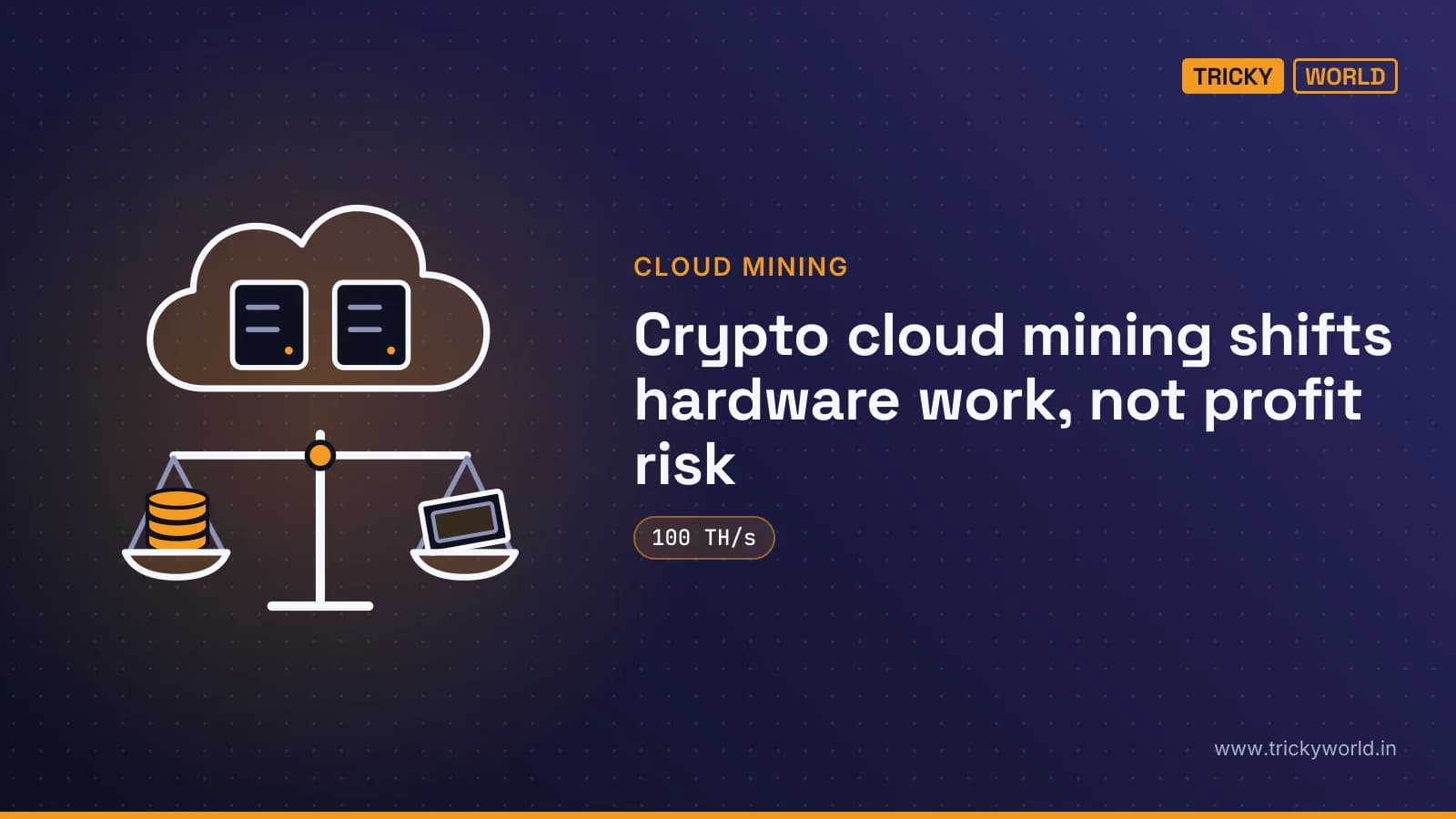
A one-year Bitcoin cloud-mining contract can specify 100 TH/s without telling you whether you'll make money. Cloud mining lets you rent capacity from a remote operator instead of buying and maintaining rigs; it shifts the hardware work, not the risk of loss. This guide shows you how to check the provider, contract terms, fees, and conservative break-even case before paying.
For a developer considering mining income, the work shifts from operating machines to assessing a provider and its economics. Coinbase's cloud mining explainer describes the reduced hardware burden, but also warns about fraudulent operators and potentially diminishing returns. Technical confidence alone does not answer whether a company actually operates the capacity it sells or whether its fees leave you with a profit.
What you're actually renting
You rent mining capacity, usually expressed as hash power, rather than taking responsibility for a physical rig. The provider operates the equipment at a remote facility. Mining rewards are then distributed according to the capacity users have purchased, with the company also receiving a share.
Crypto.com's beginner explainer illustrates this with a one-year Bitcoin contract providing 100 TH/s, or terahashes per second. That is an example of the capacity and duration a contract can specify—not a return forecast. Its example explicitly ties the resulting Bitcoin earnings to network difficulty and uptime.
Hash power describes computational capacity used in mining; a payout describes rewards received. Profit requires considering what those rewards are worth against what the contract costs, including applicable fees.
The provider still has to operate that capacity, distribute rewards under the agreement, and charge fees that leave the arrangement economically sensible for the buyer.
The workload moves, not the costs
The practical attraction is avoiding equipment ownership and day-to-day maintenance. You do not personally have to arrange the mining hardware, its electricity supply, cooling, or repairs. Those responsibilities move to the operator rather than disappearing.
Crypto.com compares the two operating models across these areas:
| Feature | Cloud mining | Local hardware mining |
|---|---|---|
| Setup cost | Little or no hardware purchasing | High; mining hardware is required |
| Electricity use | Covered by the provider | Paid by the miner |
| Maintenance | Managed externally | The miner manages cooling and repairs |
| Technical skill | Beginner-friendly | Requires expertise |
| Profit control | Depends on provider efficiency | Full control over the rigs |
| Scalability | Capacity expands through contracts | Limited by physical capacity |
| Risks | Platform trust, fees and scams | Hardware failure and power costs |
The electricity row needs careful interpretation. Not paying the facility's electricity bill directly does not mean the service has no operating costs. Crypto.com specifically warns that maintenance or management fees can reduce earnings. Less infrastructure to manage is not the same as fewer costs to evaluate.
For someone without the facilities or technical skills to run mining hardware, that transfer can make participation more accessible. For someone who wants direct control over the machines, it is a different proposition: the provider's efficiency becomes part of the outcome.
How to vet a cloud mining contract before paying
Start with evidence of an operation and readable contract terms, not the projected payout. Coinbase's warning is direct:
“Be wary of companies that guarantee returns or use assertive marketing approaches.”
— Coinbase's cloud mining explainer
Check whether the mining operation is transparent. Look for the provider's data-centre location, information about its hardware, and published uptime records. Crypto.com recommends checking these details and warns that unclear hardware or location information prevents users from verifying whether real mining occurs. Treat a return projection and evidence of mining activity as separate parts of the review.
A location alone does not settle the question. The useful assessment combines the stated operation, its performance information, and a transparent explanation of how mining produces customer payouts.
Write down what the agreement actually sells. Identify the amount of hash power, the contract duration, the cryptocurrency being mined, and the fees and payout terms. Crypto.com defines a mining contract through these elements. Keep the purchased capacity separate from any estimate of what it might earn.
That separation also makes comparisons more meaningful. A projected return is not a complete description of an offer when the underlying duration, capacity, and charges differ.
Review the pricing model beyond the initial payment. Check maintenance and management charges rather than assuming that outsourcing hardware makes the quoted purchase price the entire expense. Compare providers using their disclosed charges and projected returns together.
I'd reject an offer whose costs cannot be explained clearly before payment. That is a decision rule, not proof that every unclear offer is fraudulent; it simply avoids committing money while a basic part of the economics remains unresolved.
Assess break-even using conservative assumptions. Crypto.com recommends this approach instead of relying on marketing projections. Consider how lower Bitcoin prices, higher fees, changes in mining difficulty, or weaker uptime would affect the rewards available to cover the contract's costs.
The question is whether the arrangement still looks acceptable when conditions are less favourable—not merely whether an optimistic estimate exceeds the initial payment. Long contracts can become unprofitable when prices fall, so duration belongs in this assessment alongside capacity.
Confirm how you will receive and review rewards. Establish which asset the provider pays, how often it credits earnings, and which wallet will receive them. Crypto.com says accounts are often credited daily or weekly and identifies a secure wallet as necessary for receiving earnings.
Also check the provider's dashboard before assuming that payouts will be easy to evaluate. The source recommends monitoring performance there; make sure you understand the information you will be using to review the contract after committing.
This process does not certify a provider. It gives you a structured reason to proceed, ask for clarification, or decline rather than allowing a projected earnings figure to make the decision on its own.
Payouts aren't profit
A credited reward tells you that the provider has recorded a payout. It does not, by itself, establish that the contract has recovered its costs. Keep the distinction between receiving cryptocurrency and making a net gain throughout the agreement.
Crypto.com recommends monitoring the provider's dashboard. Use that review to compare actual rewards with the conservative expectations used before purchase, while keeping maintenance and management charges visible. Mining difficulty, cryptocurrency prices, and provider uptime remain relevant after the initial decision.
Compare the reward record with the full contract cost before considering additional capacity. A better-than-expected payout is a reason to revisit the assessment, not an automatic instruction to buy another contract.
This is also where the convenience trade-off becomes concrete. You are monitoring an externally operated service rather than maintaining your own rigs. The dashboard is useful for following performance, but the original questions about provider transparency and fee clarity still apply.
Legitimacy doesn't equal profit
Provider legitimacy and contract profitability are separate questions. A real operation can still produce disappointing returns. Coinbase identifies increasing mining difficulty and competition as potential pressures on earnings; Crypto.com also describes falling asset prices and rising maintenance fees as conditions that can eliminate profits.
Fraud remains a separate concern. Crypto.com describes some fraudulent mining websites that pay existing users from new deposits rather than genuine mining proceeds. Transparent operations and cautious research matter, but neither supplied explainer presents a checklist that guarantees protection.
There are wider constraints too. Local rules can restrict mining services or impose additional taxes, according to Crypto.com. Coinbase also flags centralisation as a concern when mining activity becomes concentrated. Renting capacity does not resolve either issue merely because the customer no longer owns the hardware.
This guide cannot rank current offers.
Direct purchase vs. mining contract
If the goal is simply to hold Bitcoin, my preference would be to compare a direct purchase before accepting an ongoing mining contract. Crypto.com makes that distinction in its explainer, describing direct buying as offering clearer costs and immediate ownership for beginners.
That does not make buying cryptocurrency risk-free. The same source warns that cryptoasset values can fall and that buyers can lose all or a substantial part of their purchase price. The narrower point is that a mining contract adds provider performance, fees, and mining economics to the assessment.
Cloud mining is worth evaluating only as the arrangement it actually is: paid access to someone else's mining operation, with rewards that may or may not justify the costs. If you cannot explain the capacity, duration, charges, payout process, and conservative break-even case in plain language, the practical next step is clarification—not payment.
This guide is educational, not a recommendation to purchase a mining contract or cryptocurrency.
Frequently asked questions
Can cloud mining still produce Ether?
Crypto.com’s explainer states that Ether mining ended in 2022 when the network moved to Proof of Stake. It identifies Bitcoin, Litecoin and Dogecoin as examples of Proof of Work assets associated with cloud mining.
Will a cloud mining provider require identity verification?
It may. Crypto.com says registration can involve identity and email verification to comply with Know Your Customer requirements. The supplied sources do not establish one registration process for every provider.
Can mining rewards be converted automatically into fiat or stablecoins?
Some services allow automatic conversion into stablecoins or fiat, according to Crypto.com. This is provider-dependent, not a feature the sources establish for every mining contract.
Are free Bitcoin cloud mining websites legitimate?
Crypto.com warns that most websites advertising free Bitcoin cloud mining are phishing or Ponzi scams intended to collect deposits or personal information. Its explainer stresses that genuine mining has operating costs.
Sources
How this article was made: drafted with AI from the sources above and fact-checked against them, then reviewed by Vishal on . How we write and check articles.

Vishal writes Trickyworld's tutorials and interview-preparation guides on programming, databases, cyber security and AI. Vishal has been shipping production software long enough to have firm opinions about Python, PHP, Node.js, and JavaScript, and to have been wrong about each of them at least once. The work has run the whole stack: Drupal and Laravel applications, React front ends, MySQL and MongoDB underneath, Redis and Memcached for the things that had to be fast, Apache Solr for the things that had to be findable. That last part turned out to matter more than anyone expected. Tune a Solr index for a season, then watch a language model confidently retrieve the wrong document, and you recognise an old problem wearing new clothes. Most of what is hard about AI systems is not the model. It is retrieval, caching, latency budgets, and deciding what the system does when the answer comes back wrong — which is work he has been doing since well before anyone called it AI engineering. He plays a lot of games, which is less a hobby disclosure than an admission of where a good share of his engineering instinct came from. Real-time systems with a frame budget. State that has to stay coherent while a player does something no designer anticipated. The permanent question of what happens when the frame cannot finish in time. Those habits carry over more directly than they have any right to. He has written several books on programming, all built on the same conviction: most technical writing is unclear because the author never decided what to leave out. More from Vishal → · Editorial policy