Hidden Features in Popular Software: A Guide to Lesser-Known Enhancements
Discover hidden features in popular software like Microsoft Office Suite, Adobe Creative Suite, and leading internet browsers. Explore our guide to uncover lesser-known tools and functionalities that can supercharge your favorite applications.

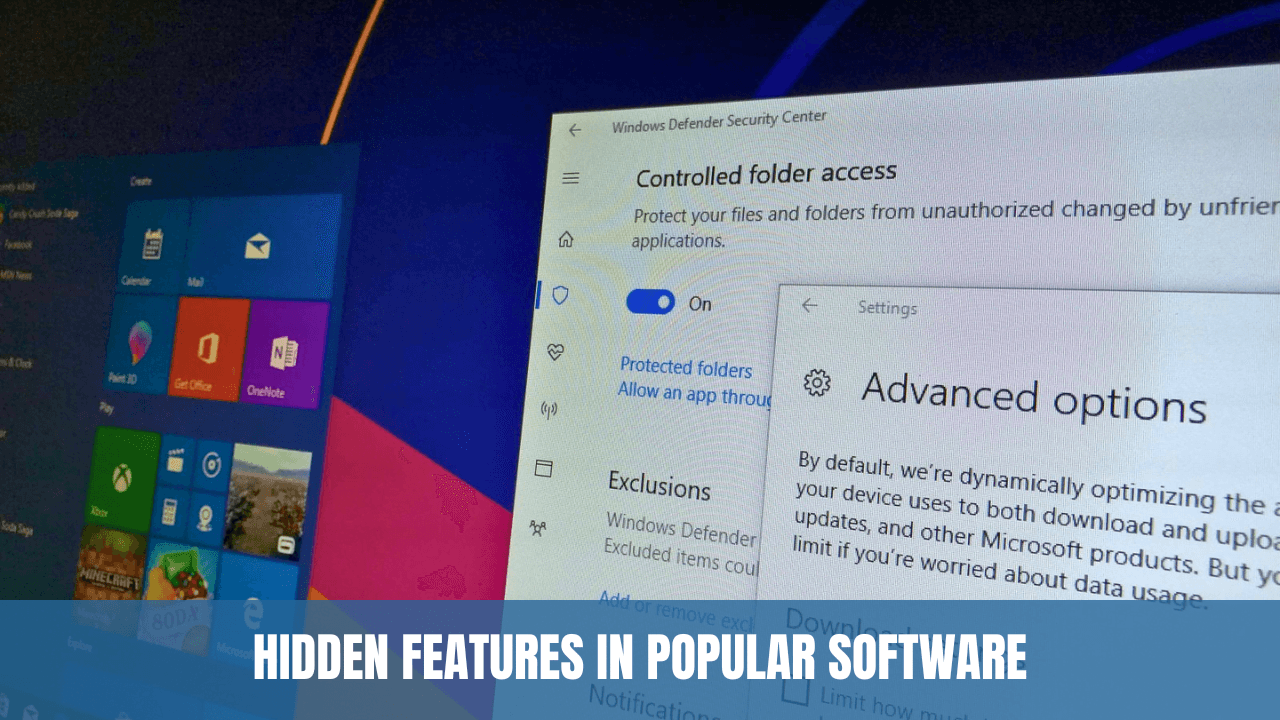
Popular software applications are equipped with a multitude of features, many of which are prominently advertised and well-known. However, there are also numerous hidden or lesser-known features that can provide additional functionality and enhance user experience. This article aims to uncover some of these hidden gems in widely used software applications.
Section 1: Microsoft Office Suite
1.1 Microsoft Word
- Spike Functionality: Use the spike to collect text from different parts of a document and paste it all at once. Cut the text with Ctrl+F3 and paste with Ctrl+Shift+F3.
- Recover Unsaved Documents: In the 'File' tab, you can access the 'Recover Unsaved Documents' option to restore lost files.
1.2 Microsoft Excel
- Camera Tool: Capture live, updateable images of cells by adding the Camera Tool to the Quick Access Toolbar.
- 3D Maps: Visualize data in a three-dimensional context using Excel's 3D Maps feature.
Section 2: Adobe Creative Suite
2.1 Adobe Photoshop
- Content-Aware Fill: Easily remove objects by selecting them and using the Content-Aware Fill option under the 'Edit' menu.
- Bird's Eye View: Hold down the 'H' key and click to quickly zoom out and navigate to another part of the image.
2.2 Adobe Illustrator
- Global Colors: Change all instances of a color simultaneously by using the Global Color option in the Swatches panel.
- Shape Builder Tool: Merge or subtract overlapping shapes using the Shape Builder Tool (Shift+M).
Section 3: Internet Browsers
3.1 Google Chrome
- Task Manager: Use Shift+Esc to open Chrome's Task Manager and view information about the resources used by each tab.
- Experimental Features: Access 'chrome://flags' in the address bar to explore experimental browser features.
3.2 Mozilla Firefox
- Reader Mode: Click the reader icon in the address bar or press F9 to access a clutter-free reading view.
- Customize Interface: Right-click on the toolbar and select 'Customize' to personalize your browser's appearance.
Conclusion
Hidden features in popular software applications offer valuable tools that can enhance functionality and streamline tasks. Many of these features remain underutilized simply because they are not widely advertised or immediately apparent.
By exploring these lesser-known options and integrating them into daily use, users can supercharge their favorite applications and optimize their workflows. Taking the time to delve into these features can lead to a more enriched and productive software experience, unlocking potentials that may otherwise go unnoticed. Whether for personal or professional use, these hidden gems are worth discovering and exploring.

Vishal writes Trickyworld's tutorials and interview-preparation guides on programming, databases, cyber security and AI. Vishal has been shipping production software long enough to have firm opinions about Python, PHP, Node.js, and JavaScript, and to have been wrong about each of them at least once. The work has run the whole stack: Drupal and Laravel applications, React front ends, MySQL and MongoDB underneath, Redis and Memcached for the things that had to be fast, Apache Solr for the things that had to be findable. That last part turned out to matter more than anyone expected. Tune a Solr index for a season, then watch a language model confidently retrieve the wrong document, and you recognise an old problem wearing new clothes. Most of what is hard about AI systems is not the model. It is retrieval, caching, latency budgets, and deciding what the system does when the answer comes back wrong — which is work he has been doing since well before anyone called it AI engineering. He plays a lot of games, which is less a hobby disclosure than an admission of where a good share of his engineering instinct came from. Real-time systems with a frame budget. State that has to stay coherent while a player does something no designer anticipated. The permanent question of what happens when the frame cannot finish in time. Those habits carry over more directly than they have any right to. He has written several books on programming, all built on the same conviction: most technical writing is unclear because the author never decided what to leave out. More from Vishal → · Editorial policy